Quackoria Learn
American Wigeon: The Duck That Whistles and Grazes
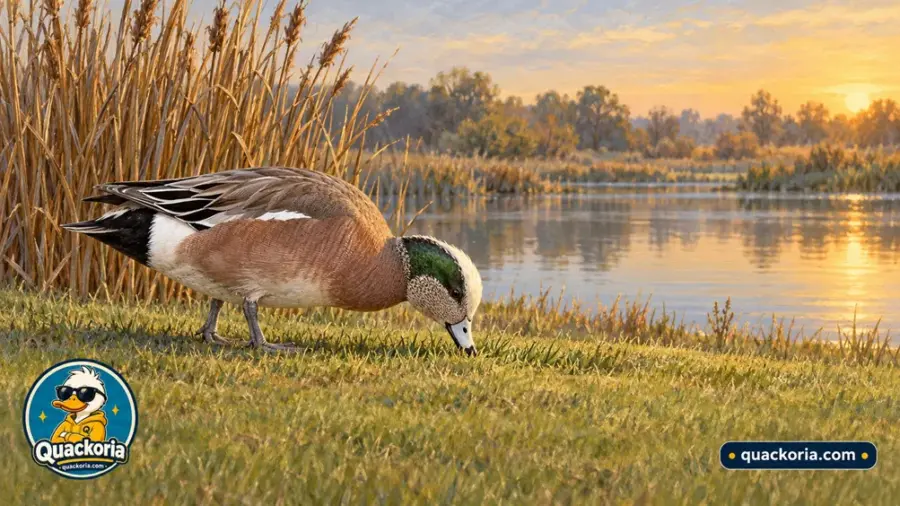
The American wigeon is a compact North American dabbling duck: the breeding male has a white crown, the origin of the old name baldpate, and a green stripe behind the eye, and he calls with a soft three-part whistle. It grazes fields and lawns with its short, gooselike bill, and Audubon says it also steals food from coots and diving ducks on deep water.
Key takeaways
- Cornell: the male gives a "3-parted nasal whistle" that "sounds a bit like someone softly blowing through a kazoo."
- Cornell: American wigeons eat a higher proportion of plant matter than any other dabbling duck, thanks to their short, gooselike bill.
- Audubon reports wigeon taking food from coots and diving ducks, and the Animal Diversity Web has them feeding on what those birds bring up; Cornell does not mention it.
- Cornell: populations fell about 56% between 1966 and 2019; the Tennessee Wildlife Resources Agency says a 1980s drought decline of up to 50 percent has largely recovered.
- BTO: a handful reach Britain every year, most often in autumn and winter; the first British record was in Middlesex in 1838.
The American wigeon, Mareca americana, is a compact North American dabbling duck known for two things: the breeding male’s white crown, which earned the species the old name “baldpate”, and its whistle. It also grazes, “plucking plants with their short gooselike bill from wetlands and fields”, so American birders meet flocks on fields and lawns as well as on water, mostly between August and April. In Britain it is a rare vagrant, found among Eurasian wigeon.
How to recognise an American wigeon
The breeding male has “a brownish gray head with a wide green stripe behind the eye and a gleaming white cap”, and “The body is pale cinnamon with white patches on the sides of the rump that contrast with the black undertail feathers.” That white cap explains the old name: Cornell says the species is “also known as ‘baldpate’ because the white stripe resembles a bald man’s head.” The female is warm brown with a brownish grey head and “a dark smudge around the eye”; the non-breeding male is similar but has “a reddish brown body”. Both sexes have “a pale gray bill with a black tip”, and in flight Cornell points to “the white patch on the upperwing and a green patch on the secondaries”. Cornell sizes the bird between the green-winged teal and the mallard and gives 42–59 cm (16.5–23.2 in), 540–1,330 g (19.1–46.9 oz) and a wingspan of 84 cm (33.1 in); the Animal Diversity Web gives 86.4 cm and the Tennessee Wildlife Resources Agency 32 inches.
“Males give slow, high-pitched whistles year-round: during courtship, when sensing danger or disturbance, and as contact calls”, Cornell says, a “3-parted nasal whistle” that “sounds a bit like someone softly blowing through a kazoo.” Audubon writes “whew-whee-whew” and adds that the species “also quacks”. “Females don’t whistle, but instead give a harsh, grating grunt or growl during courtship”, Cornell adds.
American wigeon or Eurasian wigeon?
For males, Cornell’s test is the head: “Eurasians have a chestnut head and a buffy forehead and American Wigeons have a grayish brown head and a white crown.” The RSPB describes the Eurasian male with “a yellow forehead, pink breast and grey body”, a contrast with the American’s pale cinnamon body. Females are harder. Cornell says the Eurasian female has “a rustier head” and is “Best told by the silver (not white) underwings on Eurasian Wigeons in flight”; the Tennessee agency says Eurasian birds “have gray ‘armpits’ on the under-wing”. Cornell also lists the green-winged teal, which is smaller, the male “with a chestnut face and neck, and a vertical white bar on its side that wigeons lack”, and the gadwall, whose female has a “longer orange bill”.
Where and when you will see one
For the United States, Cornell says: “The best time to see American Wigeons in the Lower 48 is from August through April.” Ducks Unlimited says the species breeds “primarily in boreal, prairie parkland, and some Arctic areas”, leaves in September or October, reaches the wintering grounds from October through November, and heads back between February and April. Audubon notes that numbers in southern California do not peak until “December or January”. In Tennessee they arrive “by late September” and leave “by early May”, and the state agency says the species “has never been known to nest” there (see duck migration).
In Britain the BTO says “A handful of individuals of this North American duck are recorded every year in Britain”, lists the species as a “Rare vagrant, most often recorded in autumn and winter”, and gives the first record as Middlesex in 1838. Cornell describes traffic in both directions: the Eurasian wigeon “turns up as a rarity in flocks of American Wigeons on occasion, but the American Wigeon also turns up in Europe in flocks of Eurasian Wigeon.” The flocks are big: the BTO puts the UK’s wintering Eurasian wigeon at 450 thousand for 2012–17, and the WWT describes them “often forming ‘carpets’ as they graze grasses adjacent to water”.
What it eats, and how
Mostly plants. Cornell says “American Wigeons eat primarily plants—both aquatic and terrestrial”, from “wigeon grass, cattail, sedge, duckweed, and water milfoil” to grass, clover, rice, wheat and barley, with more insects and other invertebrates in the breeding season. On water it is a dabbling duck that will “nibble aquatic vegetation from the surface or tip up to grab plants under the water”; on land the birds “waddle through fields plucking at plants with their short bill”. The bill is the key. Cornell: “American Wigeons eat a higher proportion of plant matter than any other dabbling duck thanks to their short gooselike bill”, and “The shortness of the bill helps exert more force at the tip so they can pluck vegetation from fields and lawns with ease.”
Nesting and ducklings
The female nests on dry ground, “often far from water (40–1,000 feet), in fields and grasslands with tall grasses or low shrubs”, Cornell says; Audubon puts the nest “usually within 100 ft of water but sometimes up to a half mile away”. Clutch figures vary: 3–13 for Cornell, “8-11 eggs, sometimes 5-12” for Audubon, an average of 7 to 10 for Ducks Unlimited. The eggs are “Creamy white” and 5.1–5.5 cm (2.0–2.2 in) long, and incubation runs 22–28 days for Cornell, 23–24 for Audubon and an average of 25 for the Animal Diversity Web. The pair stays together until the female is “partway through incubation”, Cornell says, after which the male “usually leaves and prepares to molt”. The young “Leave nest shortly after hatching, feed themselves”, in Audubon’s words, and fly at 45–63 days; the Animal Diversity Web gives 37 to 48.
Do American wigeons steal food from other birds?
Audubon says they do, and the Animal Diversity Web describes them feeding on what diving ducks and coots bring up; Cornell’s pages, Ducks Unlimited and the Tennessee agency do not mention it. Audubon presents it as a paradox: “American Wigeon spend much of their time in flocks grazing on land”, yet “Paradoxically, they also spend more time than other marsh ducks on deep water, where they get much of their food by stealing it from other birds such as coots or diving ducks.” The Animal Diversity Web calls the species “opportunistic and aggressive feeders, often foraging in open water on materials brought to the surface by diving ducks and coots”, while also describing it as “better adapted morphologically and physiologically for grazing on aquatic and terrestrial plants than most other North American birds”. The grazer and the thief are the same bird.
How American wigeons are doing
Cornell and the Tennessee agency point in different directions. Cornell: “American Wigeons are common, but their populations declined by about 1.5% per year for a cumulative decline of approximately 56% between 1966 and 2019.” The Tennessee agency: “Populations declined by as much as 50 percent in the 1980s as a result of an extended drought in prairie regions”, and “Since then, the population has largely recovered.” Cornell also names drought, which “reduces the amount of nesting habitat, pushing them to nest farther north.” Cornell cites a Partners in Flight estimate of 2.7 million breeding birds and a Continental Concern Score of 10 out of 20, “indicating a species of low conservation concern”. The oldest bird Cornell reports was “at least 21 years and 4 months old”; the Tennessee agency’s oldest wild bird was “20 years, 11 months old”; other species are compared in how long do ducks live.
A duck grazing on a lawn or whistling overhead can be checked in which wild duck did I see?, and if the flock might have been geese, see duck vs goose vs swan.
Frequently asked questions
Why is the American wigeon called baldpate?
Because of the male's white crown. Cornell says the species is "also known as 'baldpate' because the white stripe resembles a bald man's head", and Audubon says it "was once known as 'Baldpate' because of its white crown."
What does an American wigeon sound like?
The male whistles. Cornell describes a "3-parted nasal whistle" that "sounds a bit like someone softly blowing through a kazoo", while "Females don't whistle, but instead give a harsh, grating grunt or growl during courtship."
Do American wigeons steal food?
According to Audubon, yes. Audubon says they get "much of their food by stealing it from other birds such as coots or diving ducks"; Cornell's pages do not mention the habit.
What is the difference between an American wigeon and a Eurasian wigeon?
In males, the head. Cornell says "Eurasians have a chestnut head and a buffy forehead and American Wigeons have a grayish brown head and a white crown." Females are "Best told by the silver (not white) underwings on Eurasian Wigeons in flight."
Are American wigeon populations declining?
The sources differ. Cornell says numbers fell "approximately 56% between 1966 and 2019", while the Tennessee Wildlife Resources Agency says a drought decline of up to 50 percent in the 1980s was followed by recovery: "Since then, the population has largely recovered."
Sources
- Cornell Lab of Ornithology, All About Birds — American Wigeon Overview
- Cornell Lab of Ornithology, All About Birds — American Wigeon Identification
- Cornell Lab of Ornithology, All About Birds — American Wigeon Life History
- Cornell Lab of Ornithology, All About Birds — American Wigeon Similar Species Comparison
- Cornell Lab of Ornithology, All About Birds — American Wigeon Sounds
- National Audubon Society — American Wigeon, Guide to North American Birds
- Ducks Unlimited — American Wigeon
- Tennessee Wildlife Resources Agency — American Wigeon
- Animal Diversity Web, University of Michigan — Anas americana
- BTO — BirdFacts: American Wigeon
- BTO — BirdFacts: Wigeon
- RSPB — Wigeon
- WWT — Ducks found in UK wetlands