Quackoria Learn
Why Do Ducks Quack? What Duck Sounds Actually Mean
The classic loud quack is a female mallard's. Males rasp rather than quack, and many ducks do not quack at all.
Key takeaways
- The loud, classic quack is made by female mallards. Males make a quieter, rasping sound.
- Not all ducks quack — many whistle, squeal, grunt, coo or growl.
- Quacking carries meaning: contact, alarm, courtship, and keeping a brood together.
- Ducklings call from inside the egg, and learn their mother's voice before hatching.
- A sudden change in a kept duck's voice can be a sign of illness and is worth noticing.
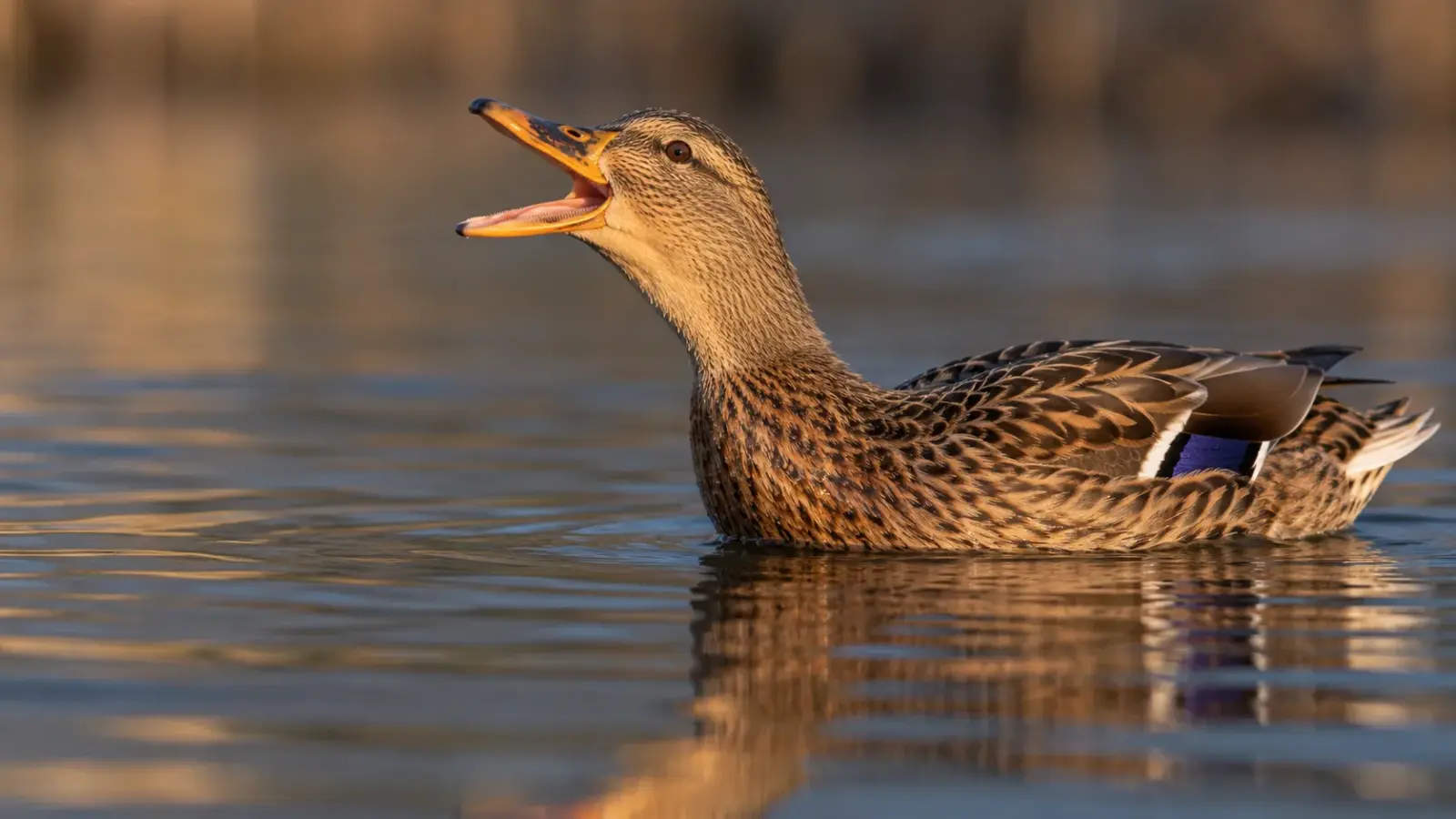
Ducks quack to communicate — but the more interesting answer is that many ducks do not quack at all, and the ones that do are usually female. The loud, unmistakable QUACK of cartoons and sound effects is the call of a female mallard.
Who actually quacks
In mallards, the sexes sound completely different.
The female makes the classic quack: loud, sharp, and often repeated in a series of two to ten quacks that, in Cornell’s description, “begin loudly and get softer”.
Do male ducks quack?
Not the way the female does. A drake mallard makes a much quieter, raspier sound of one or two notes — often written as raeb raeb. It is so different that once you have noticed it you can sex mallards by ear without looking.
Beyond mallards, the picture opens up. Whistling ducks whistle. Male wigeon whistle a clear wheeoo. Eider drakes coo. Goldeneye males give a short, faint peent during display. Muscovies — kept widely on farms — are, in Cornell’s words, “usually silent”; the males hiss during courtship. “Quacking” describes only part of a large family.
The mallard’s outsized reputation comes from its distribution: it is perhaps the most familiar duck in the northern hemisphere and the most abundant, and nearly every domestic duck breed descends from it. When most people picture a duck, they picture a mallard, so the mallard’s voice became the duck voice.
What the sounds mean
Contact
Female mallards call to other mallards. Ducks Unlimited notes that when a female on a pond “spots other mallards flying overhead, she will typically hail them by projecting a loud decrescendo” — the series of quacks that starts loud and fades. Females also give what another Ducks Unlimited article calls “feeding and flight assembly chuckles”.
Alarm
Ducks call when they are alarmed. Cornell notes, for example, that female goldeneyes give “a harsh, croaking gack when disturbed” and female Muscovies “a quiet quack or croak when frightened”. In kept ducks, loud calling at night is worth treating as information rather than nuisance: it may mean a predator is investigating your run.
Courtship
Mallards begin courting in autumn and early winter, and the female takes part: she may swim after the male she prefers, giving a rapid series of quacks. Males contribute grunts and whistles alongside physical display: head-shaking, tail-shaking, and a sudden upward jerk of the bill.
Mother to duckling
A female with a brood keeps up soft calls — New Zealand Birds Online describes “soft quacks in communication with ducklings” — and the ducklings answer. Ducks Unlimited puts it this way: “A series of assembly and maternal calls from the hen and responding vocalizations from the ducklings keep the family unit together.” It is a homing beacon. If she gives an alarm call instead, the ducklings respond, in Ducks Unlimited’s words, “most commonly by freezing”.
Aggression
Not every call is friendly. New Zealand Birds Online describes a rapid gag gag gag repulsion call that female mallards give in courting displays and when pursued by males. Among drakes, Cornell describes males facing off with a head-bob, threatening with an open bill or pushing breast to breast, and paired males defending their territories with chases.
Ducklings call before they hatch
This is the detail worth knowing. In the last day or two before hatching, ducklings vocalise from inside the shell — and the female calls to them.
Two things come of it. The ducklings learn their mother’s individual voice before they have ever seen her, which is a large part of how imprinting works so fast after hatching. And the clutch synchronises: eggs laid over a week or more hatch at about the same time — in Ducks Unlimited’s words, “The hatching period lasts several hours.” Partly that is because the female does not start incubating in earnest until late in the laying period; partly it is the ducklings coordinating through the shell. A female cannot lead a brood to water if half of them hatch two days late, so this matters.
The whole sequence — from egg to fledging — is in our guide to ducklings.
Why does a duck’s quack not echo? It does
You have probably heard that a duck’s quack does not echo. It is one of the most repeated pieces of animal trivia in existence, and it is wrong.
In 2003 the acoustician Trevor Cox at the University of Salford tested it properly, recording a duck called Daisy in an anechoic chamber and then in a reverberation chamber. The quack echoes. Cox’s explanation, as reported at the time: “A duck quacks rather quietly, so the sound coming back is at a low level and might not be heard”, and “a quack is a fading sound. It has a gradual decay, so it’s hard to tell the difference between the actual quack and the echo.” The reason it seems not to is that a quack is a relatively quiet sound that fades gradually rather than stopping sharply, so the echo overlaps the tail of the original and is hard to separate by ear. There is nothing acoustically special about a duck.
When a duck’s voice matters to a keeper
If you keep ducks, their voices are a useful daily signal.
- A normally noisy duck going quiet is worth a closer look.
- A change in the sound itself — wheezy, clicking, or effortful — can point at a respiratory problem.
- Repeated alarm calling at night may mean something is out there. Check the run before you conclude the duck is being dramatic.
Vocal changes are one sign among many, and they are covered alongside the others in common duck health problems and when to call a vet. A duck that sounds wrong and also looks unwell is a vet call, not a wait-and-see.
And if your neighbours are asking
If noise is the worry, it is almost entirely a female mallard-type problem. Drakes are quiet: of Runner ducks, the University of Kentucky says “Only the females quack. All drakes are limited to a hoarse whisper.” Muscovies are close to silent. If noise is a real constraint where you live, choose the species and sex you keep with that in mind.
Frequently asked questions
Do male ducks quack?
Male mallards do not make the loud classic quack. They produce a quieter, raspier call of one or two notes. The difference is reliable enough that you can often sex a mallard by ear alone.
Why does a duck's quack not echo?
It does. Trevor Cox at the University of Salford recorded a duck in an echo-free chamber and then in a reverberant one in 2003, and the echo was clearly there. Two things hide it outdoors: a quack is quiet, so the reflection is quieter still, and it fades gradually instead of stopping sharply, so the echo runs into the tail of the original.
Why do ducks quack at night?
Ducks are not strictly daytime birds — Ducks Unlimited notes that autumn migrations "often occur at night" — and they call when alarmed. Persistent night-time calling in kept ducks is worth investigating as a possible predator problem rather than a noise problem.
Do ducklings quack?
Not at first. Ducklings peep, and the adult voice develops over several weeks as the bird grows: Metzer Farms says that by eight to ten weeks males have a deep, raspy voice while females keep the loud quack.
Sources
- Cornell Lab of Ornithology — Mallard sounds
- ABC Science (Karl Kruszelnicki) — the duck quack echo experiment, University of Salford 2003
- Snopes — Does a duck's quack echo? (with Trevor Cox's explanation)
- The Wildfowl & Wetlands Trust — Ducks found in UK wetlands
- Cornell Lab of Ornithology — Mallard overview
- Ducks Unlimited — Understanding Waterfowl: Mallards and Their Relatives
- US Fish and Wildlife Service — Ducks at a Distance (Bob Hines), Project Gutenberg text
- New Zealand Birds Online — Mallard
- Cornell Lab of Ornithology — Black-bellied Whistling-Duck sounds
- Cornell Lab of Ornithology — Common Eider sounds
- Cornell Lab of Ornithology — Common Goldeneye sounds
- Cornell Lab of Ornithology — Muscovy Duck sounds
- Ducks Unlimited — Waterfowl Vocalizations (Jennifer Kross)
- Ducks Unlimited — Understanding Waterfowl: Science and Duck Calling
- Ducks Unlimited — Mallard Annual Life Cycle
- Stanford University, Birds of Stanford (Ehrlich, Dobkin and Wheye) — Duck Displays
- Cornell Lab of Ornithology — Mallard life history
- Ducks Unlimited — Life in the Egg (Bruce Batt)
- Ducks Unlimited — Why Waterfowl Migrate
- Metzer Farms — Male vs Female: How to Identify Adult Ducks
- Merck Veterinary Manual — Lung and Airway Disorders of Pet Birds
- University of Kentucky Cooperative Extension — Selecting Ducks (ASC-198)