Quackoria Care
Broody Ducks: Recognising It, Letting Her Hatch, and Breaking It
A broody duck is a duck that has decided to hatch something, and she will do it with or without your cooperation, with or without fertile eggs, and — if you are not careful — with or without eating. This is how to recognise it, which breeds do it, how to let a good broody hatch and raise the brood herself, and how to stop one who has chosen badly.
Key takeaways
- A broody stops laying — Metzer: 'once they start sitting, they stop laying' — lines a nest with her own down, flattens and hisses, and comes off once or twice a day.
- Broodiest: Cayuga, then Rouen. Least: Runner (Metzer). Best mother on Metzer's chart: the Muscovy, 'Excellent' and the only breed so rated; Mallard and Silver Appleyard 'Very Good'.
- No source compares a broody's hatch with an incubator's across breeds; the British Waterfowl Association says waterfowl should ideally incubate their own eggs, and she raises the brood herself.
- Moving a broody is a gamble — waterfowl go back to the spot they chose. Make the nest safe where it is if you can.
- Mark the clutch, set it all at once, remove later additions, candle at a week, and put food and water just out of reach so she has to get up.
- Breaking: remove the nest, freezer packs, a bare-floored pen, or Metzer's concrete pen with half an inch of water — 3 to 5 days.
What you need
- A low partition to give her a corner of the house
- A pencil to mark the clutch
- A freezer pack, for breaking
- A small bare-floored pen
- Grower feed and dunkable water just out of reach of the nest
What broody looks like
Metzer Farms’ description is the useful one: a broody female becomes territorial and grumpy, sits on the nest continuously, and leaves it only once or twice a day for basic needs. In practice, the signs in order:
- She stops laying and starts sitting. Metzer is blunt: “Once they start sitting, they stop laying.” A duck that was laying daily and now is not, and is not in the run with the others, is on a nest somewhere.
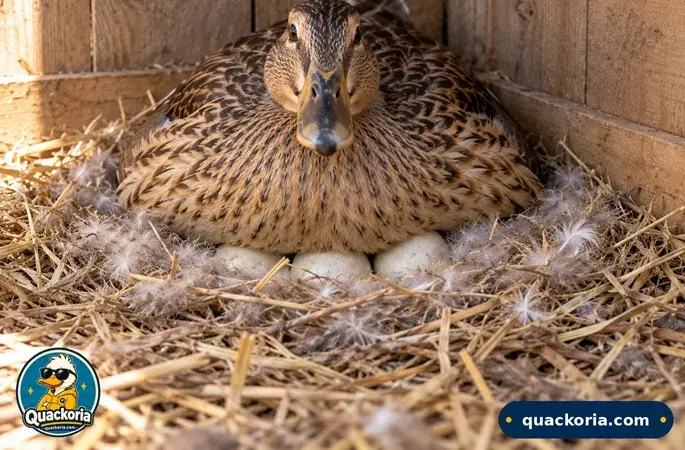
- She has built a nest and lined it with her own down. The British Waterfowl Association’s sign that a clutch is nearly complete is “As soon as down from the mother bird’s breast appears”. A down-lined hollow means she is committed.
- She flattens and hisses. Approach the nest and she spreads herself over it, lowers her head, and hisses or snaps. Metzer’s wording: “As it is her instinct to protect her eggs, she will become territorial and grumpy.”
- She comes off once or twice a day — Metzer: “Most birds that become broody take care of themselves while on the nest, only leaving once or twice a day to eat and bathe.” She eats fast, drinks, does her business, and goes straight back.
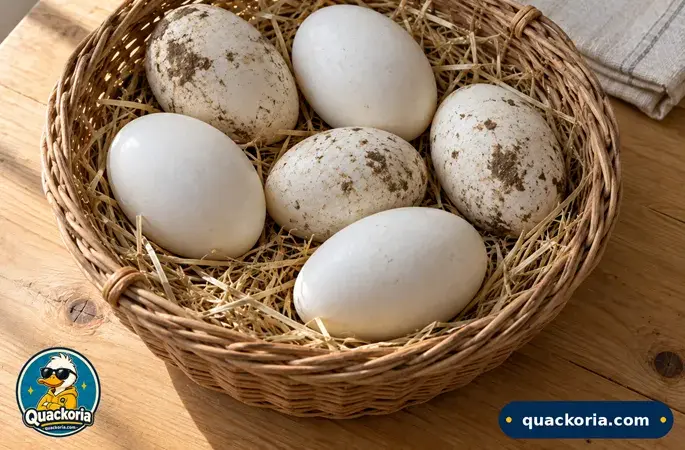
- There are eggs under her. Metzer: “Only in extreme instances will a female become broody without eggs in the nest.” They need not be fertile, and they need not be hers — Metzer notes that “it is possible to slip fertile eggs under her or even ducklings/goslings and trick her into thinking the eggs have hatched.”
That last point is why broodiness is a management issue and not just a breeding one. A duck sitting an infertile clutch sits the full term for nothing, and Metzer’s warning about birds left on eggs that will not hatch is that “they run the risk of malnutrition, dehydration, and even death”.
Which ducks go broody
In at least one laying breed broodiness was bred out on purpose. eXtension and the University of Kentucky’s ASC-198 say of the Khaki Campbell: “They seldom become broody as this characteristic was sacrificed in exchange for a high level of egg production.” Metzer’s chart, on the other hand, still rates the Campbell a “Good” mother, so a Campbell that does sit is not a lost cause. From Metzer’s experience across its own flocks:
- Broodiest: “the Cayuga seem to be the broodiest followed by the Rouen”
- Least broody: “Our Runner are the least likely ducks to be broody”
- Metzer puts these as tendencies — “We find there are some breeds that are broodier than others” — not as rules
Metzer’s breed chart rates mothering ability separately, and the two do not line up: the Cayuga it calls the broodiest it rates only “Fair” as a mother. On the chart, “Excellent” is the Muscovy, and no other breed. “Very Good”: Mallard and Silver Appleyard. “Good”: Australian Spotted, Call, Khaki Campbell, Magpie, Rouen, Welsh Harlequin. “Fair”: Cayuga, and the high-production hybrids Golden 300 and White Layer. “Poor” or “Poor–Fair”: Pekin, Runner, White Crested.
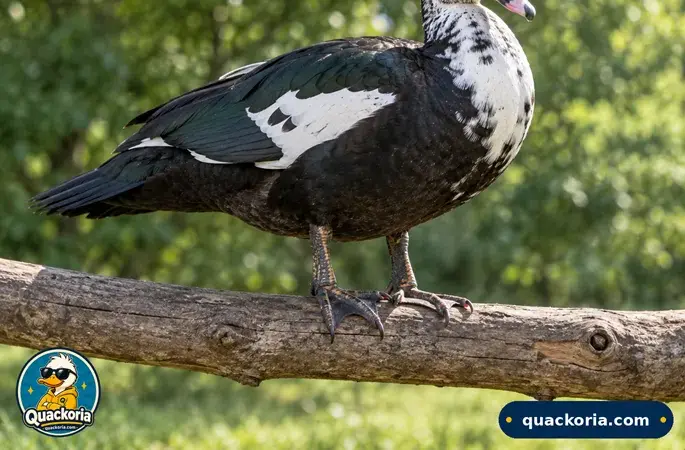
The Muscovy is in a class of its own. Metzer: “There is no breed of duck that does a better job of hatching and raising their young”, and of its eggs, “Oftentimes they are difficult to hatch in an incubator but a broody Muscovy will do an excellent job of hatching”. If you want a duck to hatch for you, that is the breed, and it is covered in keeping Muscovy ducks — with the one caveat that her own eggs take 35 days, not 28.
So: if you keep Cayugas, Rouens, Muscovies or Mallard-types, expect broodiness and plan for it. If you keep Runners, Campbells or the hybrid layers, you may see it rarely or not at all — and the two bodies above disagree about the Campbell, so do not count on either. Where broodiness sits in the rest of the year is in a duck keeper’s year; finding the hidden nest a broody has made is in collecting duck eggs.
Letting her do it
No published comparison of a broody duck’s hatch with a home incubator’s turned up for this guide, so treat the usual claim that she beats the machine as unproven. What the sources do say is that the bird is the default. The British Waterfowl Association: “In an ideal world, female waterfowl should incubate their own eggs” — with the caveat that “Domestic ducks and geese are not always good parents, it very much depends on the breed.” For one breed the comparison is made outright: Metzer says Muscovy eggs are often difficult to hatch in an incubator and that a broody Muscovy does an excellent job of it. Incubator hatch figures to compare against are in the incubation guide.
The trade is that she is off lay while she sits and while she is rearing — Metzer’s Muscovy figure is that if you take the ducklings at three to five weeks “she will probably produce one or two more broods during the season” — and that she is more exposed on the nest than in the house.
If you have fertile eggs, a broody, and a safe place — let her.
The nest
She has usually chosen it already, and Metzer’s observation about relocated waterfowl is the thing to know: “Waterfowl have a tendency of choosing a spot for their nest and sticking to it even if the nest is moved.” One customer’s goose, moved off a walkway, “rebuilt the nest in the exact same place as before”.
So the first question is whether the nest she chose can be made safe where it is. It needs to be:
- Out of the weather — a nest that soaks or floods is no use to her
- Away from the flock’s traffic, so she is not disturbed
- Predator-proof at night — a duck on a nest is out of the locked house, and everything in the predator guide applies twice over, egg-thieves included.
If the nest is in the house, in a corner, that is usually fine: fence it off from the others with a low partition so she has her own space and they cannot add eggs. If it is under a shrub in the run, the choice is to build a small shelter over it and close the run at night, or to move her — and if you move her, do it at night, move the nest material with the eggs, put her in a small enclosed space with the nest so she cannot wander off to look for the old spot, and expect that she may give up on it anyway, because waterfowl stick to the spot they chose.
Setting the clutch
Once she is sitting firmly, decide what she is sitting on.
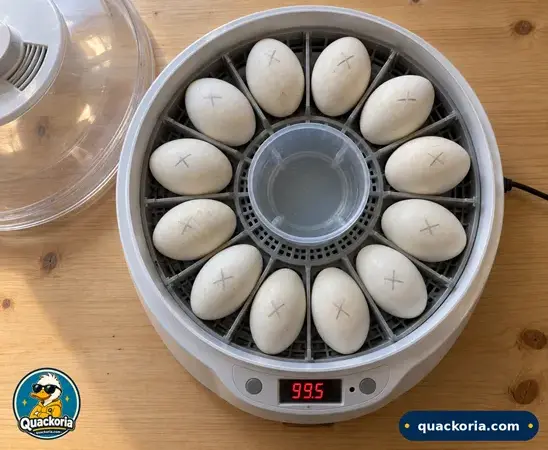
- Mark the eggs she is to hatch — a pencil X — and set them all at once, so they hatch together. Remove any unmarked egg that appears later: an egg added on day 10 will not have hatched when she leaves with the first ducklings.
- How many: as many as she can cover with none showing. No published figure for a domestic clutch turned up for this guide; for the wild bird, Cornell’s Lab of Ornithology gives the Muscovy a clutch of “8-15 eggs”. A big duck on a small nest covers more than a small duck on a big one, so go by what she can cover: if eggs are visible at the edges when she settles, take some away.
- Candle at a week, briefly, while she is off the nest — the incubation guide has what to look for — and remove clear eggs. A clear or rotten egg is better out of the nest than under her.
Food and water
She comes off once or twice a day. Metzer passes on Dave Holderread’s suggestion, from Storey’s Guide to Raising Ducks, of “placing food and water just out of reach in order to entice her to leave the nest in order to take care of her needs” — close enough to be easy, far enough that she has to get up, because a broody that does not get up does not eat. Metzer’s own feeding note is to change the ration: “We suggest switching from a layer feed to a grower feed while she is broody.” Give her water deep enough to dunk her head in, and bathing water within reach if you can — Metzer’s description has a broody leaving the nest “to eat and bathe”.
Watch her weight. A sit is about four weeks for the mallard-derived breeds and five for a Muscovy — Penn State Extension’s table gives 28 days for ducks and 35 for Muscovy ducks — and Metzer’s warning about a bird left on eggs that will not hatch is malnutrition, dehydration and even death. A duck that is visibly losing condition, or that has stopped coming off at all, needs to be lifted off once a day and put in front of food and water until she eats. A bird that will not eat or drink, or that is weak when lifted, is a vet matter.
The hatch
The same timeline as an incubator — see incubating duck eggs — but you will see less of it. Pipping and zipping happen under her; the first you will know is a duckling’s head at the edge. Do not lift her to look. Do not help a duckling out: the incubation guide has the one narrow case in which a hatchery says you may. Leave her alone while the hatch runs, which takes longer than it looks, and then remove any unhatched eggs once she has plainly given up on them and is off the nest with the brood.
Raising them
A broody-hatched brood needs less from you than an incubated one: she provides the heat, and Cornell’s Lab of Ornithology describes the Muscovy female as defending the nest and caring for the nestlings on her own. What she cannot do is make them waterproof — adult waterproofing comes from mature feathers and preen oil, and how water-resistant a duckling’s down is, and whether its mother adds to it, is less settled than it is usually stated (see ducklings); the RSPCA’s welfare standards still ask for drinkers “of a design that prevents young ducklings from getting very wet” until their feathers are waterproofed. Nor can she keep them from a rat. Give her and the brood a small enclosed space for the first fortnight, starter feed with the right niacin (the feeding guide), shallow water with stones in it, and no deep water yet. The week-by-week, including when a first swim is safe, is in raising ducklings week by week.
Breaking a broody
The other case: a duck who is sitting on infertile eggs, or in a place you cannot make safe, or at a time of year when ducklings would be a problem, or simply a duck you need laying. Metzer’s reason for breaking it is production — a sitting duck is not laying — and its warning about a long sit on eggs that will not hatch is the bird’s own condition.
Metzer’s guidance, in rough order of gentleness:
- Remove the nest. “The best way we find to stop brooding is to take away any eggs and destroy the nest.” Clear the nests near it too, “so your broody bird cannot get back and sit”, and “make sure there are no materials around for her to use to make a new nest”.
- Cold. Metzer offers this as an alternative rather than a next step: “Another alternative is to put a freezer pack” in the nest — “The cold will persuade her she should not be sitting there.”
- A smaller pen within the run. “If she continues being broody”, Metzer says, “put her in a new, smaller pen within the same pen she was in”, with two conditions — “She needs to be in sight of her pen mates so she is not stressed”, and “You do not want to move her to completely new surroundings as then she will definitely stop laying.”
- Bare floor. “If she immediately becomes broody in the new pen, remove all bedding so she is on a concrete, wood or plastic floor.” No bedding, no nest.
- The broody pen. For a flock where this keeps happening, Metzer suggests a pen kept for the purpose: “Line it with concrete and put in ½” of water.” “This will definitely stop the broodiness.” A duck cannot settle on water. Keep food and water available throughout, as in any pen.
Metzer’s timing: “Typically it only takes 3-5 days of […] to break the broodiness”, and “You can then re-introduce her to her pen mates.” If you think she will go straight back to it, Metzer suggests you “mark her with a dab of paint before you put her back in with her pen mates”.
Metzer does not list methods that fail. What it does insist on is clearing the nests near hers as well as her own, and leaving her nothing to build a new one with.
A broody with no drake
The commonest situation in a backyard flock, since most first flocks are all-female — see how many ducks to keep. A broody sitting on infertile eggs will sit the full term and beyond and hatch nothing, at the cost of the eggs she is not laying and, if the sit runs long, her condition.
Two choices. Break her, as above. Or give her something to hatch: Metzer says “it is possible to slip fertile eggs under her or even ducklings/goslings and trick her into thinking the eggs have hatched.” Bought fertile eggs should be of a kind she can finish — Penn State Extension gives 28 days for ducks and 35 for Muscovy ducks — so match the term, and start the clutch together as above.
The short version
- A broody stops laying, lines a nest with her own down, flattens and hisses, and comes off once or twice a day
- Broodiest: Cayuga, then Rouen. Least: Runner (Metzer). Best mother on Metzer’s chart: the Muscovy, “Excellent” and the only breed so rated; Mallard and Silver Appleyard “Very Good”
- No source compares a broody’s hatch with an incubator’s across breeds, but the British Waterfowl Association’s position is that waterfowl should ideally sit their own eggs. Let her, if the nest can be made safe where it is
- Moving a broody is a gamble — waterfowl go back to the spot they chose
- Mark the clutch, set it all at once, remove later additions, candle at a week
- Food and water just out of reach so she has to get up, grower feed rather than layer feed while she sits (Metzer); watch her weight over a four-week sit, five for a Muscovy
- Breaking: remove the nest, cold packs, a bare-floored pen, or Metzer’s concrete pen with half an inch of water — 3 to 5 days
- All-female flock with a broody: break her, or slip fertile eggs under her
This is husbandry guidance, not veterinary advice. If a bird is ill or injured, find an avian vet.
Frequently asked questions
How can you tell if a duck is broody?
She stops laying and starts sitting continuously, leaving the nest only once or twice a day; she has lined the nest with down from her own breast, which the British Waterfowl Association treats as a sign that the clutch is close to complete; and she flattens over the eggs and becomes, in Metzer's words, 'territorial and grumpy'. Metzer adds that only in extreme cases does a female go broody with no eggs in the nest at all.
Which duck breeds go broody?
From Metzer's flocks: Cayugas are the broodiest, then Rouens; Runners are the least likely. Metzer's mothering ratings put the Muscovy alone at 'Excellent', Mallard and Silver Appleyard at 'Very Good', the Cayuga and the hybrid layers at 'Fair', and Pekin, Runner and White Crested at 'Poor' or 'Poor–Fair'. eXtension and the University of Kentucky say the Campbell 'seldom' goes broody because that was traded for egg production.
Is a broody duck better than an incubator?
No published comparison of the two across breeds turned up for this guide. The British Waterfowl Association's position is that 'In an ideal world, female waterfowl should incubate their own eggs', with the caveat that domestic ducks 'are not always good parents, it very much depends on the breed'; Metzer makes the comparison for Muscovy eggs, which it says are often hard to hatch in an incubator. The cost is that she is off lay while she sits and rears, and is more exposed on the nest.
Can you move a broody duck?
You can try, and it is a gamble. Metzer's observation is that waterfowl choose a spot and stick to it even if the nest is moved — one relocated goose rebuilt her nest in exactly the same place. If you must, move her at night with the nest material and confine her with it in a small space, and accept that she may give up on the clutch.
How do you stop a duck being broody?
Metzer's methods, gentlest first: take the eggs and destroy the nest, and the nests near it; put freezer packs in the nest; move her to a smaller pen inside the pen she knows, in sight of her flock; strip the bedding so the floor is bare; or, for a recurring problem, a pen lined with concrete and half an inch of water, which it says will definitely stop the broodiness. Metzer gives 3 to 5 days, then back to the flock.
Sources
- Metzer Farms, Broody Ducks and Geese: What It Means and How to Help
- Metzer Farms, Breaking Broody Ducks: Signs, Causes, and Solutions
- Metzer Farms, duck breed comparison — mothering ability
- Metzer Farms, Muscovy Ducks
- Cornell Lab of Ornithology, Muscovy Duck — Life History
- British Waterfowl Association, Incubation
- eXtension (Jacob), Selecting a Duck Breed for Small or Backyard Poultry Flocks
- University of Kentucky Cooperative Extension, ASC-198 Selecting Ducks
- Penn State Extension 4-H Embryology, Incubation period of other species
- RSPCA welfare standards for domestic and common ducks