Quackoria Care
When Do Ducks Start Laying Eggs?
Most ducks start laying at around five to seven months old, depending on feed, daylight and hatch season. What to expect, and what to check when a duck stops.
Key takeaways
- Metzer Farms puts sexual maturity at 20–24 weeks; The Livestock Conservancy says most Khaki Campbells lay their first eggs at 5–7 months.
- Without enough light and the right feed, ducks wait for the lengthening days of spring, and hatch season shifts the age (Metzer Farms; University of Georgia).
- Muscovies normally start later in the spring than other ducks (Metzer Farms).
- Ducks lay early in the morning — collect first thing and you will lose fewer eggs.
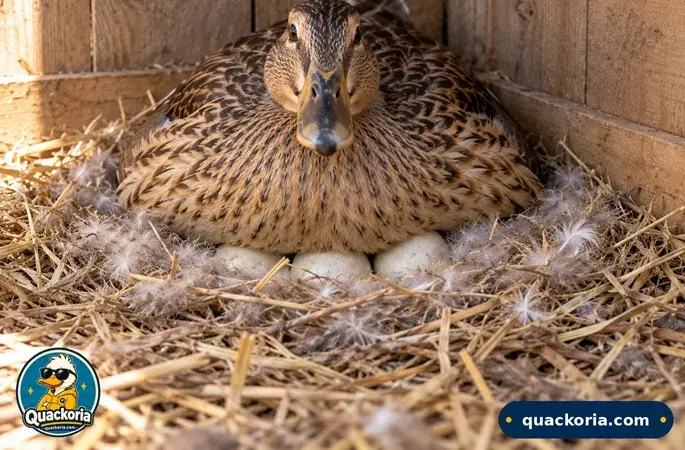
- Ducks nest at ground level and like a hidden spot: give them a floor-level nest box in a corner of the house.
What you need
- A ground-level nest space in a dark corner, about 30 x 35 cm, with sides
- Clean straw or shavings for nesting material
- A layer ration from around 18 weeks
- Oyster shell or another calcium source, offered free choice
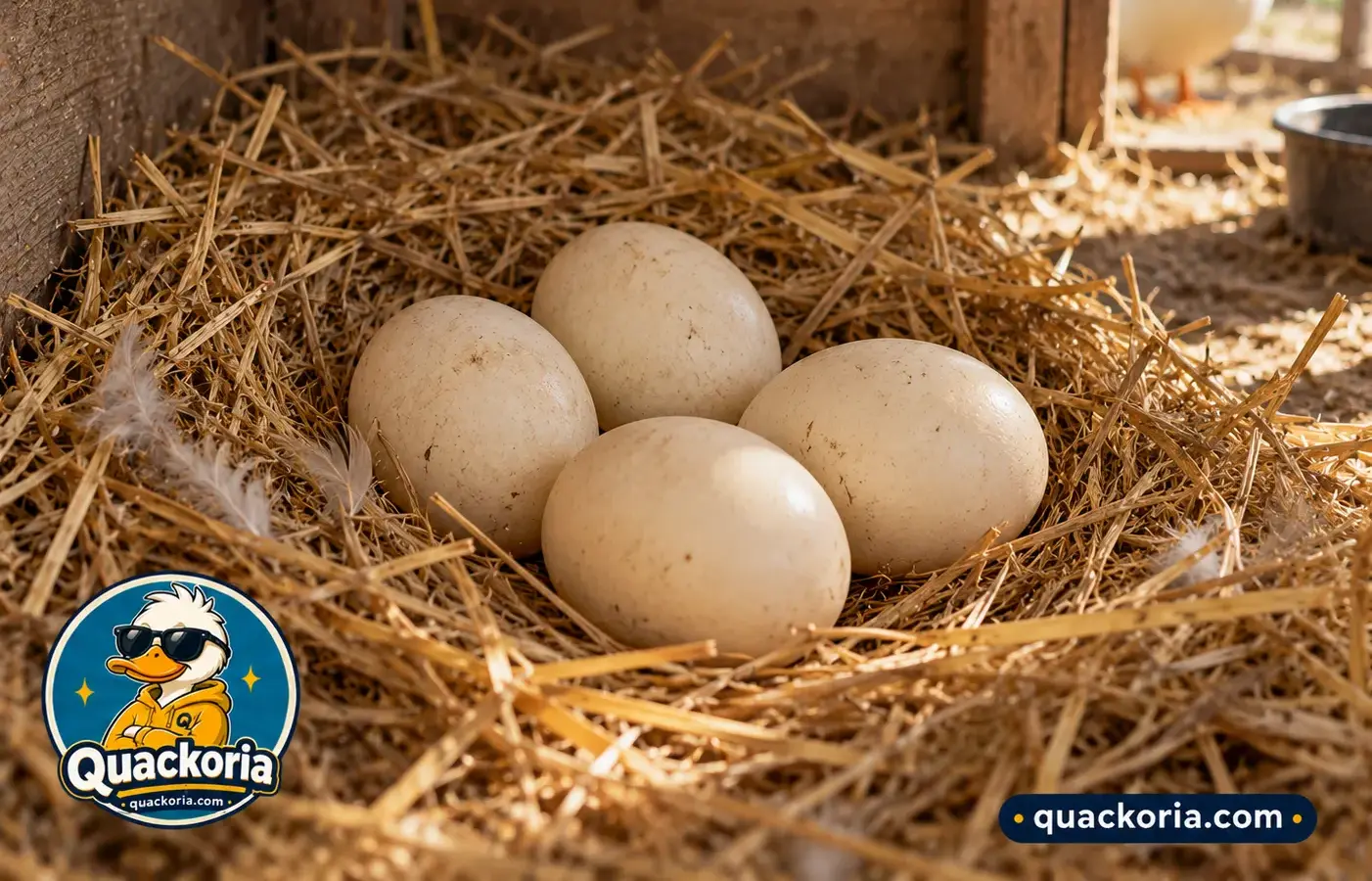
- A basket for daily collection
The age, by breed
There is no single number, and anyone who gives you one is rounding. Metzer Farms says ducks are sexually mature at 20–24 weeks and that “If they have the correct feed and lighting, they will start laying then”; otherwise they start as the days lengthen in spring. Published breed figures are scarce:
- Khaki Campbell: The Livestock Conservancy says most “lay their first eggs when 5-7 months old”. Metzer Farms records that the Jansen family’s Campbells in 1950s Holland “started in production at about 20 weeks of age”.
- Pekin and other heavy breeds: no university, extension service or hatchery we could find publishes a separate figure; Metzer’s 20–24 weeks is for ducks in general.
- Muscovy: later. Metzer says Muscovies normally start laying later in the spring than other ducks; we found no authoritative figure in weeks.
Hatch season matters too, because day length is the other half of the equation. The University of Georgia says ducks hatched from April to July “will reach sexual maturity at about 7 months of age because they are maturing during a decreasing day length”, while those hatched from September to January mature one to two months early, on lengthening days.
How many eggs to expect
The Livestock Conservancy calls Khaki Campbells “prolific layers” and says they “will average 250-340 eggs” a year; Metzer Farms’ breed chart gives 165–240, the upper figure with 17 hours of light. On Metzer’s chart Pekins lay 140–200 and Runners 100–180. Muscovies, at 100–150, lay fewer and “make good setters” (Minnesota Extension), which is a feature if you want ducklings and a nuisance if you want breakfast.
No university, extension service or hatchery we could find publishes a figure for how laying changes as ducks get older. During a moult a duck is “probably not laying”, in the words of Metzer Farms’ John Metzer.
What ducks want from a nest
Ducks nest at ground level: Minnesota Extension says “Provide floor level nest boxes.” They also want a dark, hidden spot. Metzer Farms says that however well protected they are, “their instinct still tells them to hide their nest”, and that a darker nest is what “nesting birds prefer”.
Give them a ground-level box roughly 30 by 35 cm with sides and a back, tucked into a corner of the house, and fill it with clean straw. If you do not, they will pick their own site: Metzer warns that birds without suitable nests “will take matters into their own wings and build nests elsewhere”.
Collect early
Ducks lay early: the University of Georgia says “Most duck eggs are laid before 7 a.m.” Keep the flock shut in the house until they have laid, collect, and then let them out — that one habit is the difference between finding your eggs and hunting for them.
Feeding a laying duck
Move to a layer ration around the time laying starts; the published timing differs. NC State says to “Begin feeding breeder layer feed one month before the first egg is laid”, and Minnesota Extension about a month before production starts, while Metzer Farms switches when the ducks “start mating and laying”. Oyster shell is optional: Metzer says most layer feeds have enough calcium without it, but if the feed has less than 2.5% calcium you can offer a dish of it on the side, and NC State says the layer diet “may be supplemented with free choice ground oyster shell”. Thin or soft shells have several possible causes, covered below. The feeding guide covers the rest of the diet.
When a duck stops laying
Work through this list before worrying:
- Day length. Ducks need long days for continuous laying. Production naturally falls off in autumn and winter.
- Moult. A moulting duck is “probably not laying” (Metzer Farms), and both Metzer and the University of Georgia describe a moult as a rest period from laying.
- A hidden nest. Ducks hide their nests by instinct (Metzer Farms). Walk the run and check under every shrub and along every fence line.
- Broodiness. A duck sitting tight on a nest has stopped laying: “Once they start sitting, they stop laying” (Metzer Farms).
- Stress. A predator visit, a move, a new bird, a dog, building work. Metzer Farms: “If a duck is stressed, it will not lay as well”, and the stress can come from predators, loud noises or a change of feed, animals or people.
- Age. No university, extension service or hatchery we could find publishes a figure for how laying falls with age; the egg production calculator explains how it treats older ducks.
- Diet. Laying ducks need a layer or breeder ration with “more protein, calcium and vitamins” (Metzer Farms), and a sudden change of feed is one of the stresses Metzer lists.
If a bird is straining, sitting hunched, off her food or walking oddly, stop troubleshooting production and read the health guide — a stuck egg is an emergency, not a laying question. Merck, writing about backyard chickens, says a bird that cannot pass an egg “should be seen by a veterinarian as soon as possible, because egg binding can be life-threatening”.
The first eggs are strange, and that is normal
Odd eggs turn up, especially in the first weeks of laying, though most of the published detail comes from hens. The University of Georgia advises against bringing ducks into lay before seven months because of small eggs and poor hatchability. You may see:
- Tiny eggs, sometimes with no yolk at all; Merck says these form around a little leftover egg white in the oviduct.
- Soft or shell-less eggs that arrive like a water balloon. In hens, the University of Georgia says shell-less eggs are more likely “If the shell gland is immature”.
- Odd shapes — wrinkled, ridged, or with a rough chalky patch. In hens, Merck traces most ridged and slab-sided eggs, and chalky bands, to two eggs meeting in the shell gland when a yolk is released too soon after the one before.
If soft or shell-less eggs continue, check the feed first: for hens, the University of Georgia lists diets short of calcium, phosphorus, manganese or vitamin D3, and also disease. A bird that also looks unwell is a matter for a vet.
Egg problems and what they usually mean
- Thin or soft shells, ongoing: check the feed’s calcium (above) and the heat — Penn State, writing about chickens, says shell quality can suffer in hot weather. In hens the University of Georgia adds older age, and Merck viral diseases, so a flock laying soft shells and looking unwell needs a vet.
- Rough, sandy deposits on the shell: in hens, the University of Georgia says these calcium deposits occur “if the shell gland is defective or if there are disturbances during the calcification process”, and Merck that rough eggs “may have been retained too long in the shell gland”.
- Blood spots inside: the USDA, writing about hens’ eggs, says they “are caused by a rupture of one or more small blood vessels at the time of ovulation” and do not mean the egg is unsafe.
- Very dirty eggs every day: check whether the nest is being used and whether its bedding is clean; Brigid McCrea of the Alabama Cooperative Extension System, writing for Metzer Farms, notes that ducks can be messier than chickens.
- Eggs eaten in the nest: Penn State, writing about hens, says breakage is a major reason egg eating starts. Collect more often and add nesting material.
Collecting, cleaning and storing
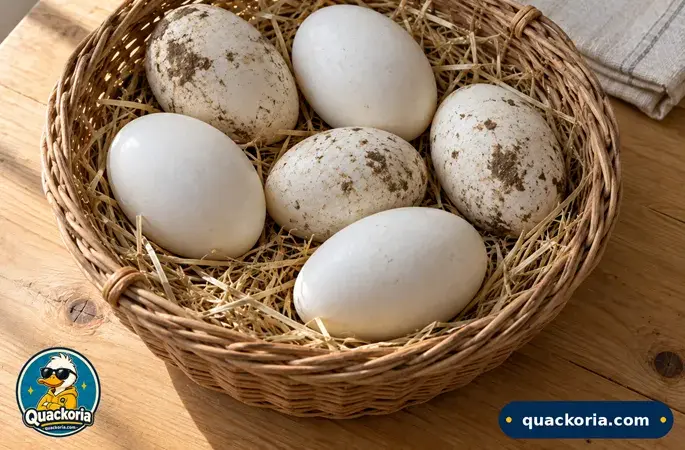
Collect first thing, every day. A duck egg laid on clean straw needs no washing at all — Penn State says home-flock eggs do not have to be washed — and an unwashed egg keeps its natural protective bloom, which seals the pores in the shell but, Penn State adds, “loses effectiveness over time”.
- Lightly soiled: dry-brush it, bearing in mind that Penn State says brushing, like washing, can damage or remove the bloom.
- Genuinely dirty: wash it one egg at a time in water with a food-safe detergent, at least 20 °F (about 11 °C) warmer than the egg and at least 90 °F (32 °C), agitating it rather than submerging it; never scrub it; rinse it in water that contains an approved sanitizer and is slightly warmer than the wash water; dry it, and refrigerate it promptly (Penn State).
- Storage: in the fridge at or below 40 °F (4 °C), the USDA gives raw shell eggs 3 to 5 weeks and Penn State at least one month; neither publishes a figure for duck eggs or for eggs kept out of the fridge. Brigid McCrea of the Alabama Cooperative Extension System, writing for Metzer Farms, says that “For every day that an egg sits on the counter at room temperature, they age as much as if you had left them in the refrigerator for a week.” The egg freshness checker works from the USDA and Penn State figures.
For what to do with them once you have a basket full, duck eggs behave differently from chicken eggs in the kitchen.
Broody ducks
A broody duck stops laying, sits tight on a nest, leaving it only once or twice a day, and becomes, in Metzer Farms’ words, “territorial and grumpy”. Metzer rates the Muscovy “Excellent” for mothering, the top of its scale, and Minnesota Extension says Muscovies make good setters; on Metzer’s own farm the Cayugas seem to be the broodiest, followed by the Rouens.
If you want ducklings, this is free labour; broody ducks covers sitting her. If you do not, collect eggs daily so a clutch never accumulates — Metzer’s way to stop a broody is to “take away any eggs and destroy the nest” — and make sure she is getting off the nest to eat, drink and bathe. Metzer says most broody birds look after themselves, but in extreme cases a duck that keeps sitting on eggs that will not hatch risks malnutrition, dehydration and even death.
Winter light, if you choose to use it
Ducks need long days to lay continuously, which is why production falls in autumn. Supplemental light works, and if you use it, do it properly:
- Aim for 14 to 17 hours of light in total, counting daylight: the Cornell Duck Research Laboratory gives 14–17 hours, the University of Georgia 14, and Metzer Farms brings its own breeders up to 17 hours of light and 7 of dark.
- Add it at both ends of the day, on a timer: Metzer starts with three-quarters of an hour in the morning and three-quarters of an hour in the evening.
- Increase gradually — Metzer adds another half hour every three to four days, alternating morning and evening.
- Moderate brightness is enough. Metzer says as little as 0.5 foot-candle works but 3–5 foot-candles is probably better: “In general this means sufficient light to read a newspaper.”
It is also entirely reasonable to skip it and let the flock rest for the winter; Metzer’s lower breed figures are for ducks kept without artificial light. We found no source showing that rested ducks go on laying for more years.
Frequently asked questions
What age do ducks lay their first egg?
Usually at around five to seven months. Metzer Farms puts sexual maturity at 20–24 weeks, and with the right feed and light ducks start laying then; otherwise they wait for lengthening spring days. Muscovies normally start later in the spring than other ducks.
Why has my duck stopped laying?
Common causes are shorter days, stress, a moult or broodiness (Metzer Farms), or a hidden nest you have not found. Check for a nest before assuming she has stopped.
Do ducks need a drake to lay eggs?
No. Ducks lay whether or not a drake is present. A drake is only needed for fertile eggs.
Do I need to add light in winter?
Only if you want steady winter production. Ducks need long days to lay continuously, and supplemental light works — but you can equally let the birds take the winter off; Metzer Farms' lower breed figures assume no artificial light.
Where do ducks lay if I do not provide a nest?
In the most hidden spot they can find: under a shrub, behind the shed, in long grass. Ducks hide nests by instinct, so a dark sheltered corner in the house is what keeps eggs where you can find them.
Sources
- The Livestock Conservancy — Khaki Campbell duck
- Metzer Farms — duck nesting and laying
- Metzer Farms — why has my duck stopped laying?
- Metzer Farms — FAQ (sexual maturity, layer feed, oyster shell, nests, drakes)
- Metzer Farms — Compare Duck Breeds
- Metzer Farms — Khaki Campbell Ducks
- Metzer Farms — Muscovy Ducks
- Metzer Farms — How to Use Lights to Increase Duck Egg Production
- Metzer Farms — Broody Ducks and Geese
- Metzer Farms (John Metzer) — Using Lights to Maximize Duck Egg Production, Part Two (time clocks)
- Metzer Farms (John Metzer) — How Do I Know Which of My Ducks Are Laying Eggs?
- Metzer Farms blog (Brigid McCrea, Alabama Cooperative Extension System, 2024) — Dirty Duck Eggs: Should They Be Washed?
- University of Georgia Extension (Cunningham, 2006) — Managing Ducks for Eggs
- University of Minnesota Agricultural Extension Service — Raising Ducks (Poultry Fact Sheet 43)
- NC State Extension (Ferket & Davis) — Feeding Ducks
- Cornell University Duck Research Laboratory — Duck Housing and Management
- Merck Veterinary Manual — Common Management-Related Problems in Backyard Poultry (egg binding)
- Merck Veterinary Manual — Defective or Abnormal Eggs in Poultry (written about hens)
- University of Georgia Extension (Dunkley) — A Dozen Egg Abnormalities: How They Affect Egg Quality (written about hens)
- Penn State Extension — Hot Weather Management of Poultry (written about chickens)
- Penn State Extension — Prevention of Egg Eating in Chickens
- Penn State Extension — How to Safely Handle and Store Eggs from Your Home Flock
- USDA Food Safety and Inspection Service — Shell Eggs from Farm to Table