Quackoria Learn
Ruddy Duck: The Blue-Billed Duck, and Why Britain Removed It
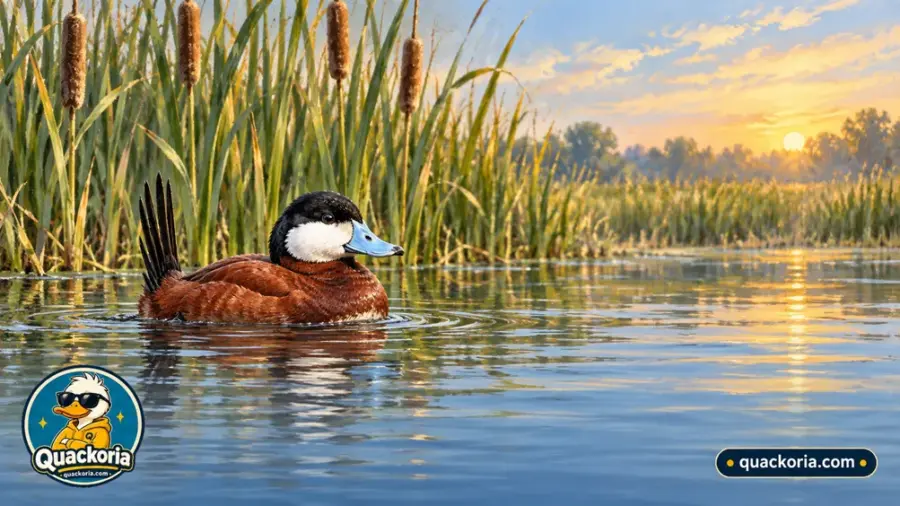
The ruddy duck is a small, stiff-tailed diving duck of North America; in summer the male has a bright blue bill, white cheeks and a chestnut body, and the female lays what Cornell calls "the largest of all duck eggs relative to body size". In Britain, a feral population founded by escapes from Slimbridge became the target of a government-led eradication programme from 2005, after ruddy ducks reaching Spain hybridised with the endangered white-headed duck.
Key takeaways
- Cornell: breeding males have "bright blue bills" in summer and "dull gray bills" in winter.
- Audubon calls the ruddy duck "the main North American representative of the group of stiff-tailed ducks".
- Cornell: ruddy duck eggs are "the largest of all duck eggs relative to body size", at 5.9–6.8 cm (2.3–2.7 in) long.
- The UK feral population, founded by escapes from Slimbridge, reached about 6,000 by 2000, according to the BTO and British Birds.
- The UK eradication programme began in September 2005; the EU project page says fewer than 100 birds were left in March 2011, and British Birds estimates ten by 2026.
The ruddy duck, Oxyura jamaicensis, is a small North American diving duck with a stiff tail it often holds cocked upright, and a breeding male that Cornell calls “almost cartoonishly bold, with a sky-blue bill, shining white cheek patch, and gleaming chestnut body”. In the United States, Cornell says, look for it from autumn to spring on open water. In Britain it has another story: escapes from Slimbridge built a feral population of about 6,000, and a government-led eradication programme from 2005 reduced it to a handful.
How to recognise a ruddy duck
Cornell describes “small, compact ducks with stout, scoop-shaped bills, and long, stiff tails they often hold cocked upward”. The breeding male has a blackish cap over white cheeks, and “In summer, they have rich chestnut bodies with bright blue bills.” In winter the blue goes, and males are “dull gray-brown above and paler below with dull gray bills”. Females and first-year males are brownish with “a blurry stripe across the pale cheek patch”. Cornell gives 35–43 cm (13.8–16.9 in), 300–850 g (10.6–30.0 oz) and a wingspan of 56–62 cm (22.1–24.4 in); the Tennessee Wildlife Resources Agency prints a wingspan of 18.5 inches. No source we read compares it with a mallard; Cornell places it “Smaller than a Common Goldeneye; larger than a Bufflehead.” On voice, the sources describe mainly the courtship display: the male strikes his bill against his inflated neck, “creating bubbles in the water as air is forced from their feathers”, and ends with “a belch-like call”.
Ruddy duck or bufflehead?
Cornell’s comparison page starts with the female bufflehead: “Female Buffleheads have a smaller white patch on their head and a shorter tail that they don’t cock upward like Ruddy Ducks do.” Female black, surf and white-winged scoters are all larger, Cornell says, and the Tennessee agency adds that female black scoters “never cock their tails.” None of the identification pages we read compares it with Spain’s white-headed duck.
Where and when you will see one
Cornell’s advice is to “Look for Ruddy Ducks from fall through spring on open water, both inland and in protected coastal areas such as harbors and small bays”, and in summer “in wetlands of the prairie pothole region and the interior West.” It says “About 86 percent of the breeding population is concentrated in the prairie pothole region of south-central Canada and north-central United States”, and that winter takes them across most of the country and “through Mexico to Central America.” Audubon says the species “apparently migrates mostly at night, in small flocks” (more in duck migration); in Tennessee, the state agency says, they “arrive by mid-October and depart by early May.” In Britain the BTO lists the species as “Very rare”, for reasons covered below.
What it eats, and how
A diver rather than a dabbler (see dabbling vs diving ducks), the ruddy duck feeds on the bottom, “straining mouthfuls of mud through thin plates on their bills”, in Cornell’s words. “Ruddy Ducks dive to feed on aquatic invertebrates, especially midge larvae”, Cornell says, adding that plants are “more common in their diet during migration and winter than during the breeding season”; Audubon names “the seeds and roots of plants including pondweeds, sedges, smartweeds, coontail, and grasses” and adds that “Insects and their larvae may be main foods eaten in summer”. As for when, Cornell says: “They feed most actively at night, so you’ll often see Ruddy Ducks sleeping during the day, head tucked under a wing and tail cocked up.” The Southern Wisconsin Bird Alliance says the same; Audubon does not mention night feeding.
Nesting and ducklings
Cornell says nests are “usually placed 2–10 inches over the water in cattails, bulrushes, or grasses”, usually under a canopy of vegetation the birds weave over it. The eggs are the story: “big, white, pebbly-textured eggs—the largest of all duck eggs relative to body size”, 5.9–6.8 cm (2.3–2.7 in) long. Clutches are 3–13 for Cornell, “between 5-10 eggs, typically 8” for Audubon and 6–10 for the BTO; incubation is 20–26 days, 23–26 or 25–26 by the same three. Audubon adds that “Ruddy Ducks often lay eggs in each others’ nests and in those of other ducks and marsh birds”, which Cornell’s life-history account does not mention. The payoff, in Cornell’s account, is independent ducklings: “The ducklings hatch well-developed and active, receiving minimal care from the mother and none from the father.” They “leave the nest within a day after hatching”, Audubon says, and fly at “about six weeks”; the BTO gives 50–55 days.
Why did Britain remove the ruddy duck?
The answer is in the EU project’s title: “Eradication of Ruddy ducks in the UK to protect the white-headed duck”. The BTO says “escapees from the WWTs collection at Slimbridge founded a population in southern England”; BirdGuides dates the escapes “from 1952”, although the BTO’s first British record is from Gloucester in 1949 and British Birds says the species “became established in the UK in the 1960s”. By 2000 there were about 6,000, according to the BTO, British Birds and a 2015 paper in Biological Invasions. Birds “began arriving in Spain from the late 1980s”, says the GB Non-native Species Secretariat, where they “hybridise with the globally threatened White-headed Duck”; British Birds says hybridisation, “first recorded in Spain in 1991”, “was identified as the principal long-term threat”.
Trials “to refine methods, record costs and assess public acceptability began in 1993”, according to the 2015 paper. The full programme started in September 2005 as an EU LIFE project coordinated by the Central Science Laboratory, and was “being delivered by the Food and Environment Research Agency (FERA)”, according to a written parliamentary answer of February 2011. The 2015 paper calls it “primarily based on shooting”; the Secretariat, which says Defra has financed control since the EU project ended in March 2011, describes the use of “sound-moderated rifles from the bank, sometimes in conjunction with a boat”. The EU page lists an EU contribution of €1,827,130. No official page we read gives a total in pounds; the only sterling figure, “£4.6 million spent so far”, comes from a 2019 BirdGuides opinion column.
The sources disagree on the starting number: “around 5,000” on the EU page, “approximately 4,400 at the beginning of the programme in September 2005” in the 2011 answer, “around 4,000 birds in 2005” from the Secretariat. A companion answer the same day lists 1,365 birds culled in 2008, 717 in 2009 and 386 in 2010, and BirdGuides reported “6,200 birds (or some 90% of the British population) being shot by 2009”. At the project’s close, the EU page says, “there was less than 100 birds left”, and the 2015 paper reports “a population reduction of around 98 % by 2013”.
How ruddy ducks are doing
In the Americas the species is secure. Partners in Flight, quoted by Cornell, estimates 1.3 million breeding birds and rates it “8 out of 20 on the Continental Concern Score, indicating a species of low conservation concern”, and the BTO gives its IUCN status as Least Concern. In Britain the latest figures agree on direction but not on number. The RSPB page says “less than 100 birds”; the Secretariat says numbers “have fallen to around 12 birds”; BirdGuides wrote in 2024 that the population is likely “now only in single figures”; British Birds gives “an estimated ten individuals by 2026” and reports that “no hybrids have been recorded in Spain since 2007”.
To check a small diver with a cocked tail and a pale cheek, try which wild duck did I see?, then test the marks above in the duck quiz.
Frequently asked questions
Are there ruddy ducks in the UK?
Very few. The RSPB says the UK population "now stands at less than 100 birds", the BTO lists 2 breeding pairs in 2017, and British Birds gives "an estimated ten individuals by 2026".
Why were ruddy ducks culled in the UK?
To protect the white-headed duck. The BTO says "Individuals that reached Spain threatened the rare White-headed Duck because of interbreeding", and the GB Non-native Species Secretariat calls hybridisation with the ruddy duck "generally agreed to be the greatest threat" to that species.
Do ruddy ducks have blue bills all year?
No. Cornell says "In summer, they have rich chestnut bodies with bright blue bills", but in winter males are "dull gray-brown above and paler below with dull gray bills". Cornell's captions give females and immatures a black bill.
Do ruddy ducks feed at night?
Yes, according to Cornell: "They feed most actively at night, so you'll often see Ruddy Ducks sleeping during the day, head tucked under a wing and tail cocked up." The Southern Wisconsin Bird Alliance says the same; Audubon does not mention it.
Do ruddy ducks lay eggs in other ducks' nests?
Yes, according to Audubon: "Ruddy Ducks often lay eggs in each others' nests and in those of other ducks and marsh birds." Cornell's life-history account does not mention the habit.
Sources
- Cornell Lab of Ornithology, All About Birds — Ruddy Duck Overview
- Cornell Lab of Ornithology, All About Birds — Ruddy Duck Identification
- Cornell Lab of Ornithology, All About Birds — Ruddy Duck Life History
- Cornell Lab of Ornithology, All About Birds — Ruddy Duck Similar Species Comparison
- National Audubon Society — Ruddy Duck, Guide to North American Birds
- Tennessee Wildlife Resources Agency — Ruddy Duck
- Southern Wisconsin Bird Alliance — Ruddy Duck (6 September 2018)
- RSPB — Ruddy Duck
- BTO — BirdFacts: Ruddy Duck
- GB Non-native Species Secretariat — Ruddy Duck Project
- European Commission, LIFE programme — Eradication of Ruddy ducks in the UK to protect the white-headed duck (LIFE05 NAT/UK/000142)
- UK Parliament, Hansard — House of Commons written answers, 28 February 2011
- Biological Invasions (Springer) — Towards the European eradication of the North American ruddy duck (2015)
- British Birds — Ruddy Ducks in the UK – the end game?
- BirdGuides — Ruddy Duck draws birders to Cheshire reserve (28 March 2024)
- BirdGuides — Comment column on the Ruddy Duck (27 June 2019)