Quackoria Learn
Do Ducks Have Knees?
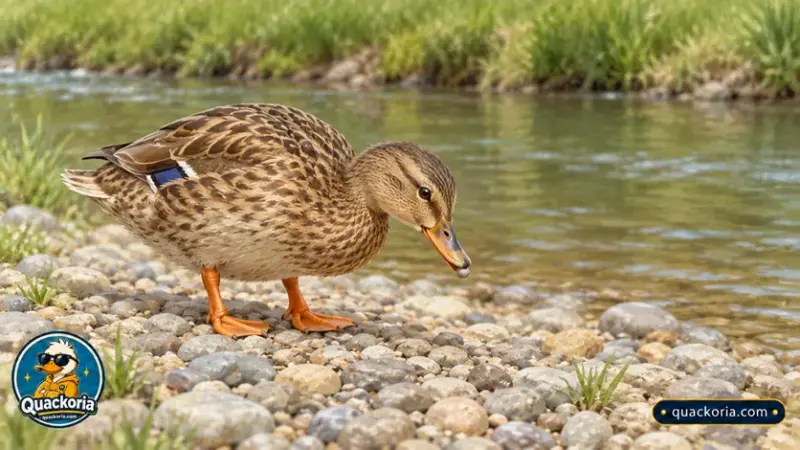
Yes. Ducks have knees — two, complete with kneecaps — and they bend the same way yours do; they are hidden against the body under the feathers. The joint halfway down the leg that seems to bend backwards is the ankle, and a duck stands on its toes.
Key takeaways
- The visible backward-bending joint is the ankle; the knee is higher, bends forward, and is covered by feathers.
- The "shin" below the ankle is the tarsometatarsus, "a single fusion of ankle and foot bones found only in birds and certain dinosaurs"; the drumstick is the tibiotarsus.
- Birds have an ossified patella; no study has examined a duck's kneecap specifically.
- Ducks have four toes — three webbed forward, a small raised hind toe — and a heat exchanger in the leg that keeps the feet from freezing.
- The waddle comes from a splayed thigh bone adapted for paddling; anatomists call it costly, but the best-known measurement of a waddle's energy cost is in penguins, and it surprised everyone.
Yes. A duck has two knees — with kneecaps, as birds generally have — and they bend the same way yours do. You cannot see them because they sit up against the body under the feathers. The joint halfway down the leg that appears to bend backwards is the ankle, and the “shin” below it is a fused foot bone: a duck stands, walks and waddles on its toes.
The joint you can see is the ankle
This is the mistake everyone makes with every bird. Reid Park Zoo puts it plainly: “The joint that you might consider to be their ‘knee’ is actually their ankle joint. Their knee is higher up on the leg, and does bend in the same direction ours does.” The North Dakota Game and Fish Department says the same — “What appears to be a backwards bent knee is actually their ankle or heel”, and “Their knee does bend forward like a human’s but you usually can’t see it because it’s covered by feathers” — and draws the conclusion: “They do not stand on feet, but rather on their toes.” The biologist and broadcaster Ben Garrod, writing for BBC Wildlife, describes where the knees went: “the knees are actually tucked right up against the body, nestled among the wings and feathers.”
The leg, from hip to toe
Follow a duck’s leg down and the bones are ours, rearranged. The thigh bone, the femur, is short and is held almost level with the ground; a 2014 study of bird walking in PLOS ONE describes birds’ “unusually flexed postures at mid-stance, with a highly flexed hip and horizontal femur”, and notes that bird walking is “often characterized as ‘knee driven’, where most of the hindlimb movement is achieved by knee flexion”. Below the knee comes the tibiotarsus, the bone of the drumstick — a University of Kentucky poultry guide explains that “the femur holds the thigh meat, and the fibula/tibia combination holds the meat of the drumstick.” Then the ankle, and below it the long bone that looks like a shin. Garrod names it: the tarsometatarsus, “a single fusion of ankle and foot bones found only in birds and certain dinosaurs.” In the poultry guide’s words, “The metatarsus of a chicken is known as the shank, and the chicken walks on its toes.” The scientific term for that stance is digitigrade; we are plantigrade, walking on the whole sole.
Yes, there is a kneecap
Birds have a patella. A 2014 paper in the journal PeerJ on the kneecaps of emus and their relatives explains that “The patella itself forms within the main extensor tendon of the knee, and is found in many clades of tetrapod vertebrates”, and that in birds “the patella is usually ossified (as far as it has been investigated…)” — a real bone, in other words, in the species that have been looked at. The ostrich, uniquely, has two in each knee. We could find no study that has examined a duck’s kneecap specifically; the statement that ducks have one rests on what is known of birds generally, which is how anatomists treat it. Garrod’s line on why the bone exists applies to every knee: kneecaps are “sesamoid bones, meaning that they grow within a tendon, probably to protect the sinews from general wear and tear.”
Four toes, three of them webbed
Below the ankle a duck has four toes. Ducks Unlimited: “Ducks and geese have palmate feet, where only the three front toes are webbed and the hind toe (called the hallux) is small and elevated.” Cormorants and boobies, by contrast, web all four. The foot is also where a duck manages the cold, with a heat exchanger in the leg — “The warm arterial blood flowing to the feet is cooled by venous blood flowing back to the body where it is warmed again” — which is the subject of why don’t ducks’ feet freeze, along with the open question of why they stand on one leg.
Why ducks waddle
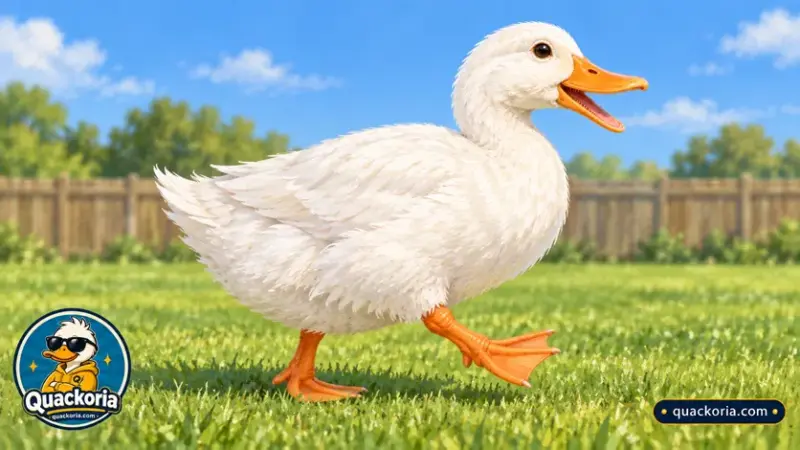
The waddle is not clumsiness; it is the price of a leg built for paddling. A 2020 Harvard dissertation on duck hind limbs by Kari Taylor-Burt, which studied mallards among other species, summarises the anatomy: “The abduction (or splay) of the duck femur is thought to be an adaptation for swimming”, and “Because of reduced femoral retraction, ducks increase stride length with a lateral waddle”. The thigh is splayed and does not swing far, so the duck sways to lengthen its step. Where the legs sit on the body varies, and Ducks Unlimited’s description corrects a common assumption: “In dabbling ducks and geese, the legs are located near the middle of the body, providing the birds with good balance for standing and walking”, while “The feet of diving ducks are located near the back of their body. This makes walking difficult, but is beneficial for diving and swimming.” A mallard waddles; a canvasback, in Ducks Unlimited’s word, finds walking “difficult”. One domestic breed has almost escaped the waddle: Metzer Farms says Indian Runner ducks “stand upright and do not waddle, they run” — see the Indian Runner duck — and the difference between the two wild groups is in dabbling vs diving ducks.
Is waddling wasteful?
The anatomists say yes, in principle: Taylor-Burt calls the waddle “costly both because of the energy lost to the lateral movements and the longer swing phase relative to other birds”, citing earlier work. A direct measurement of that cost in a walking duck, of the kind that exists for penguins, we could not find; what has been measured is the mechanics. A 2008 study in the Journal of Experimental Biology filmed a range of duck breeds and found that “Ducks walked as inverted pendulums with near-passive swing legs” up to a moderate speed — a passive, pendulum-like leg swing that, the same study found, humans give up at their top walking speeds by driving the leg forward with high step frequencies. A 2024 study in Scientific Reports that walked four mallards over sand adds that “mallards adopt a semi-squatting posture” and that “The typical waddling of a duck requires non-sagittal movements”. The best-known measurement of what a waddle costs is in penguins, and the result surprised everyone: a 2000 paper in Nature found that “waddling actually conserves mechanical energy” and that penguins walk expensively “because their short legs require them to generate muscular force rapidly.” Whether that holds for a duck is a fair guess and not yet a finding.
A note for keepers: the hock
Duck keepers call the visible joint the hock, and it is where leg trouble shows. Metzer Farms, describing ducklings short of niacin, writes that “their hocks swell and their legs develop a bowed shape” — a swollen ankle, in the anatomy above, not a knee. Feeding to prevent it is in raising ducklings week by week. To see every bone in place, open the duck anatomy explorer; to put a duck’s legs to work, play Quack Dash.
Frequently asked questions
Do ducks have knees?
Yes, two, hidden under the feathers against the body. Reid Park Zoo: "Their knee is higher up on the leg, and does bend in the same direction ours does."
Why do ducks' knees bend backwards?
They don't. The joint that bends backwards is the ankle; birds walk on their toes, so the ankle sits where you expect a knee.
Do ducks have kneecaps?
Birds generally have an ossified patella, a bone that forms in the tendon over the knee. We could find no study of a duck's kneecap in particular.
Why do ducks waddle?
Because the thigh bone is splayed and swings less than in other birds — an adaptation for swimming — so the duck sways to lengthen its stride. Diving ducks, with legs set far back, walk worst.
What is a duck's hock?
The keeper's word for the visible ankle joint. Swollen hocks in ducklings are a sign of niacin deficiency.
Sources
- Reid Park Zoo — Why do birds' knees bend backwards?
- North Dakota Game and Fish Department — A look at bird legs
- BBC Wildlife / Discover Wildlife — Do birds have knees? (Ben Garrod)
- Scott Hartman — Bird knees (skeletal drawing blog)
- Grossi et al. (2014), Walking like dinosaurs: chickens with artificial tails provide clues about non-avian theropod locomotion, PLOS ONE
- eXtension / University of Kentucky — Avian skeletal system (Jacquie Jacob)
- Regnault, Pitsillides and Hutchinson (2014), Structure, ontogeny and evolution of the patellar tendon in emus and other palaeognath birds, PeerJ 2:e711
- Ducks Unlimited — Webbed wonders (J. Michael Checkett)
- Taylor-Burt, K. R. (2020), How to waddle with a paddle: a study of duck hindlimb anatomy, kinematics, and muscle function, PhD dissertation, Harvard University
- Usherwood, Szymanek and Daley (2008), Compass gait mechanics account for top walking speeds in ducks and humans, Journal of Experimental Biology 211
- Han et al. (2024), Mallard hindlimbs locomotion system respond to changes in sandy ground hardness and slope, Scientific Reports 14
- Griffin and Kram (2000), Penguin waddling is not wasteful, Nature 408
- Metzer Farms — Indian Runner ducks
- Metzer Farms — Are my ducklings' leg problems due to a niacin deficiency?