Quackoria Learn
Tufted Duck: The Park-Pond Diver With the Yellow Eye
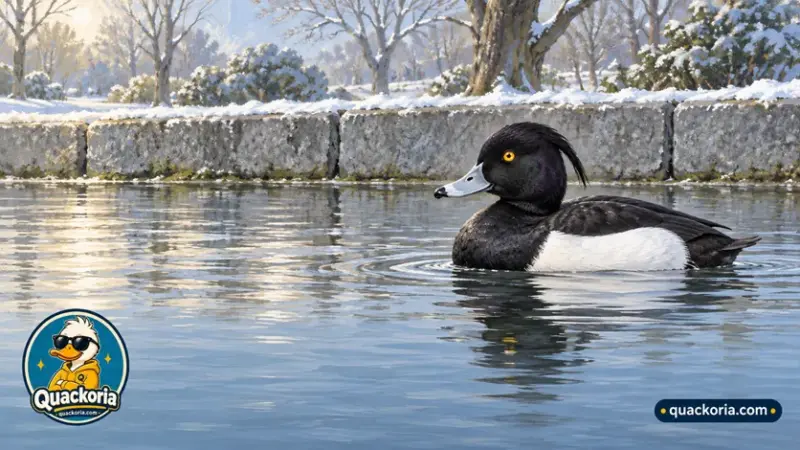
The tufted duck is a medium-sized diving duck of Europe and Asia: the male black with white sides, the female dark brown, both with a yellow eye and a tuft at the back of the head. In the UK it breeds on lakes, gravel pits and park ponds and is joined each winter, the BTO says, by over 100,000 birds from as far away as central Russia; in North America it is a rare but regular vagrant among scaup.
Key takeaways
- BTO: the UK has around 18,000 breeding pairs, joined in winter by over 100,000 birds from as far away as central Russia.
- Cornell: in Europe, tufted ducks are second only to mallards in using reservoirs, city park ponds and fishponds.
- Cornell: tufted ducks spend 20 seconds underwater on average and dive 3–14 metres (10–46 feet) deep.
- BTO: the tufted duck's colonisation of the UK, which began in 1849, was aided by the spread of the zebra mussel.
- Cornell: egg dumping can leave as many as 22 eggs in a single tufted duck nest, all raised by one female.
The tufted duck, Aythya fuligula, is the black-and-white diver of European lakes, reservoirs and park ponds, with a yellow eye and what Cornell calls a “stylish tassel of feathers at the back of the head” in both sexes. The Wildlife Trusts call it “our most common diving duck nesting on flooded gravel pits, lakes and reservoirs”, and the BTO finds it “in the middle of our busiest towns and cities.” In North America it is a rare stray, usually found among scaup.
How to recognise a tufted duck
The RSPB describes a “medium-sized diving duck, smaller than a Mallard”. The male is “black on the head, neck, chest and back, and white on the sides”, with a tuft Cornell calls “a dashing curl that echoes the curve of the head”. eBird describes the female as “dark brown overall with short crest, paler flanks, staring golden-yellow eyes”. The tuft is not a fixed mark: Audubon says it “may be long or short, sometimes missing altogether”. Cornell does not describe the male’s non-breeding plumage; the Animal Diversity Web says such males “resemble females with a brown tint and a less prominent tuft or no tuft at all.” In flight both sexes show a bold white wing stripe. Cornell gives 40–47 cm (15.8–18.5 in) and 600–1,020 g (21.2–36.0 oz); the Wildlife Trusts give 41–45 cm, a 70 cm wingspan and 760 g, and the BTO 853.4 g. On voice, Cornell describes the displaying male’s “soft series of whistles” and the female’s “harsh, grating call as well as short, barking flight calls”.
Tufted duck or scaup?
eBird says a tufted duck in North America is “almost always found singly among flocks of scaup”, so scaup are the birds to rule out. Start with the back: the male greater scaup “lacks a tuft and has a finely patterned back that appears light gray”, and the lesser scaup also has “a peaked (rather than rounded) head”. eBird’s summary covers both sexes: “Compared with scaup, Tufted Duck always shows very dark blackish back, and even nearly tuftless females are darker than scaup with more limited white patch on face.” The WWT says females “can sport similar white face markings, but the bill pattern and body shape differentiates them.” Cornell lists two more look-alikes: the ring-necked duck, whose male has “a strongly peaked head (with no tuft)” and “two prominent white marks on the bill”, and the ferruginous duck, whose female has “a long, sloping forehead/bill profile, a dark eye, and a prominent, well-defined white patch under the tail.”
Where and when you will see one
In the UK, all year. The BTO: “The UK has a small breeding population of around 18,000 pairs, but during the winter months these are joined by over 100,000 birds from as far away as central Russia.” Its figures table gives 17 thousand pairs for 2016, against the 18,000 of its text, and 140 thousand wintering birds for 2012–17. The RSPB says it breeds “across lowland areas of England, Scotland and Ireland”, with winter arrivals “from Iceland and northern Europe” (more on such journeys in duck migration). Cornell says that in Europe only the mallard makes more use of human-made water such as reservoirs, city park ponds and fishponds.
For the American reader it is a find. Cornell: “Tufted Duck is a rare but regular visitor to North America, with records from 30 U.S. states and all 10 Canadian provinces.” Audubon says birds arrive “from both directions, reaching the northeast from Europe and Iceland, reaching Alaska and the Pacific Coast from Asia”, and “are still considered rare everywhere except western Alaska”; eBird calls the species a “Rare winter vagrant”.
What it eats, and how
As a diver (see dabbling vs diving ducks), it usually feeds, Cornell says, by “spending 20 seconds underwater on average and going 3–14 meters (10–46 feet) deep.” Molluscs head the menu: “Tufted Ducks eat lots of mussels, clams, snails, and other mollusks when they’re available. They also eat aquatic plants, crustaceans, aquatic insects, grains, and even potatoes.” The Wildlife Trusts give a greener list, “waterweed, plant seeds and water insects”. In a Scottish study cited by Cornell, “Tufted Ducks laid their eggs just as midge larvae reached their peak on the lake floor”, so the ducklings had hatched by the time the adult midges emerged.
Nesting and ducklings
Cornell places the nest “on the ground, usually within 20 meters (66 feet) of water” and describes it as “A depression on the ground, lined with grasses, other vegetation, and down feathers.” Cornell, the BTO and the Wildlife Trusts give a clutch of 8–11; the Animal Diversity Web gives 6 to 14, on average 8 to 10. The eggs are “Grayish-green, without markings” to Cornell and “olive-brown to olive-gray” to the Animal Diversity Web. Incubation is 23–28 days for Cornell, 25 for the BTO and 26–27 for the Animal Diversity Web. Some nests hold more than one female’s eggs: tufted ducks “sometimes also lay eggs in their neighbors’ nests”, Cornell says, and “This tactic can result in as many as 22 eggs in a single Tufted Duck nest, with that female caring for all the young after they hatch.” The young fledge at 45–50 days according to Cornell and the BTO, and at 49 to 56 days according to the Animal Diversity Web.
Do tufted ducks eat zebra mussels?
Yes, and the BTO ties the bird’s spread in Britain to the mussel: “The colonisation of the UK by Tufted Ducks, which began in 1849, was aided by the spread of the zebra mussel Dreissena polymorpha.” The Animal Diversity Web says “The most preyed upon molluscs are zebra mussels”, and Cornell reports tufted ducks “eating up to three times their body weight in mussels in a single day, according to a study in the Netherlands.”
The fullest account comes from the IJsselmeer and Markermeer in the Netherlands, in a chapter of The Zebra Mussel in Europe. Its authors found that “Dreissena was indeed the most important prey item during winter months (November-March)”; their table puts the mussel at 95.0 per cent of the tufted duck’s diet by mass, and they worked with “daily rations in the field of 3,200 gFW for tufted duck”, a weight of food, where Cornell’s Netherlands figure is a body-weight multiple. Peak numbers of tufted ducks feeding on the mussels between November and February were 60–85,000, with a maximum of 150,000, and the feeding happened in the dark: “The roosting concentrations dissolved between 1-1.5 h after sun-set, invisible to the human eye”, and “Most birds returned to the roosts already 1 h before sunrise”.
How tufted ducks are doing
Globally, Cornell says, “IUCN lists Tufted Duck’s conservation status as Least Concern”, with an estimated 2.6–2.9 million birds and a “stable population trend”. In the UK it is Green-listed by the BTO, the RSPB and the Wildlife Trusts. The BTO’s own figures are mixed: it lists the species as “Near Threatened” among Species of European Conservation Concern, and by its figures the UK breeding population rose 9 per cent from 1995 to 2024 while the wintering population fell 21 per cent from 1998 to 2023. The BTO’s longevity record for a ringed bird is 24 years, 3 months and 13 days, against a typical life expectancy of four years (more in how long do ducks live).
If the black-and-white diver on your lake could be a tufted duck or a scaup, run it through which wild duck did I see?, and see duck habitats for the waters ducks like this use.
Frequently asked questions
Are tufted ducks found in the US?
Only as rare visitors. Cornell calls the tufted duck "a rare but regular visitor to North America, with records from 30 U.S. states and all 10 Canadian provinces", and Audubon says it is "still considered rare everywhere except western Alaska".
How do you tell a tufted duck from a scaup?
Look at the back first. Cornell says the male greater scaup "lacks a tuft and has a finely patterned back that appears light gray", while eBird says the tufted duck "always shows very dark blackish back".
What do tufted ducks eat?
Mostly molluscs where they can get them. Cornell says "Tufted Ducks eat lots of mussels, clams, snails, and other mollusks when they're available", as well as aquatic plants, crustaceans, insects, grains "and even potatoes".
Do tufted ducks eat zebra mussels?
Yes. The Animal Diversity Web says "The most preyed upon molluscs are zebra mussels", and a study on the IJsselmeer and Markermeer in the Netherlands found that "Dreissena was indeed the most important prey item during winter months (November-March)".
How many tufted ducks are there in the UK?
The BTO says "The UK has a small breeding population of around 18,000 pairs, but during the winter months these are joined by over 100,000 birds from as far away as central Russia." Its figures table gives 140 thousand wintering birds for 2012–17.
Sources
- Cornell Lab of Ornithology, All About Birds — Tufted Duck Overview
- Cornell Lab of Ornithology, All About Birds — Tufted Duck Identification
- Cornell Lab of Ornithology, All About Birds — Tufted Duck Life History
- Cornell Lab of Ornithology, All About Birds — Tufted Duck Similar Species Comparison
- Cornell Lab of Ornithology, All About Birds — Tufted Duck Sounds
- National Audubon Society — Tufted Duck, Guide to North American Birds
- eBird, Cornell Lab of Ornithology — Tufted Duck
- RSPB — Tufted Duck
- BTO — BirdFacts: Tufted Duck
- The Wildlife Trusts — Tufted duck
- WWT — Ducks found in UK wetlands
- Animal Diversity Web, University of Michigan — Aythya fuligula
- Wageningen University & Research eDepot — How Dreissena sets the winter scene for water birds: dynamic interactions between diving ducks and zebra mussels (The Zebra Mussel in Europe)