Quackoria Care
Keeping Ducks Cool in Summer: Heat Stress, Shade and the Emergency
Ducks shrug off winter and, Metzer Farms says, handle heat pretty well too. The signs of heat stress in order, what cools a bird, and when to call the vet.
Key takeaways
- Metzer Farms says ducks handle heat pretty well, given shade and water. Poultry do not sweat (Penn State); a hot bird pants and holds its wings away from its body.
- Penn State: heat stress typically begins above about 80 °F, birds need not change their behaviour at 55–75 °F, body temperature about 105 °F — figures for poultry in general; ducks are not mentioned.
- The duck-specific sign (Metzer): hot ducks sometimes sit, pant, and forget to drink. The UK code defines heat stress by prolonged panting.
- Shade has to fit the whole flock and let air move under it: trees, a solid roof with open sides, shade cloth, or a tarp set high and open on all sides.
- Cool water on the feet and legs is how the Open Sanctuary Project and PoultryDVM cool an overheated duck.
- Emergency: shade, cool (not ice-cold) water on the feet and legs, a fan, as little handling as possible — and call the vet at once.
What you need
- Shade the whole flock fits under at once
- A second waterer, in shade
- A shallow pool to stand in
- Hardware cloth over any window or door opened for air
- Vegetables or fruit frozen into ice cubes
Ducks are famous for shrugging off winter, and Metzer Farms says they can handle heat pretty well too — given shade and water. This is what heat does to a duck, what the signs look like in the order they appear, and what actually cools a bird — as opposed to what merely looks like it should.
One honesty note before the figures. The heat thresholds published for poultry are general poultry figures: Penn State Extension’s table, the one used here, does not mention ducks. Ducks are not chickens; where a figure is a general poultry or chicken figure, it is labelled as one below, and where a duck-specific source exists, that is what is used.
Why a duck struggles in heat
The Open Sanctuary Project says ducks tend not to be as likely to develop heat exhaustion as chickens or turkeys. They still need help in hot weather, for three reasons.
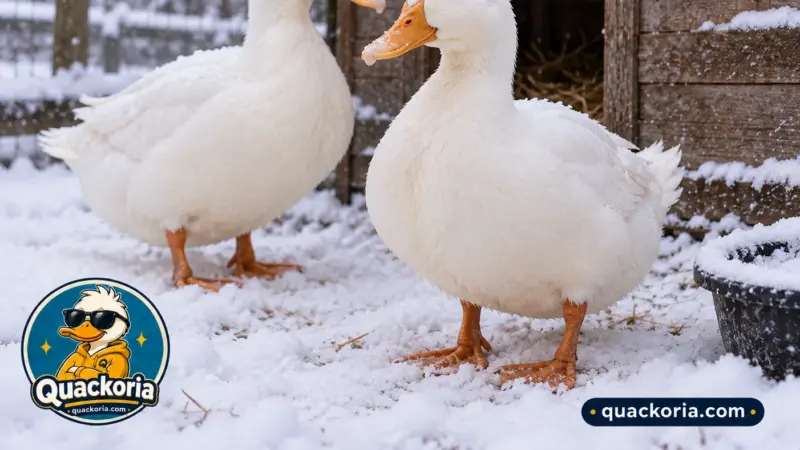
The coat. A duck wears a waterproof outer layer over a thick layer of down, and it does not take it off in summer. That is why a duck sits contentedly on ice. Penn State Extension says poultry shed body heat from wattles, shanks and the unfeathered areas under the wings — and a duck has no comb or wattles. We cover the coat itself in why ducks don’t get wet.
No sweat. “However, poultry do not sweat,” as Penn State Extension puts it. A hot bird pants — which, by the same source, removes heat by evaporating water from the moist lining of the respiratory tract — and holds its wings away from its body (Open Sanctuary Project).
A high running temperature. Penn State Extension says birds maintain a body temperature of about 105 °F (40.6 °C). Panting itself, the same page notes, generates body heat and costs the bird water.
The thresholds — and whose they are
Penn State’s hot-weather guidance gives a clear ladder. It is written for poultry in general and does not mention ducks or waterfowl, which is why it is presented here as a reference and not as a duck rule:
| Ambient temperature | What Penn State reports (poultry in general) |
|---|---|
| 55–75 °F (13–24 °C) | Birds do not need to change their behaviour to hold their body temperature; 65–75 °F ideal |
| 75–85 °F (24–29 °C) | Feed intake drops slightly; egg size and shell quality may suffer towards the top of this range |
| Above 80 °F (27 °C) | Heat stress typically begins; panting starts at about 80 °F |
| 85–90 °F (29–32 °C) | Heat stress very apparent from about 85 °F; feed intake falls further; egg size and shell quality deteriorate; egg production suffers |
| 90–95 °F (32–35 °C) | Danger of heat exhaustion in layers and heavier birds; cooling necessary |
| 95–100 °F (35–38 °C) | Heat exhaustion likely; emergency measures may be needed; water consumption high |
| Over 100 °F (38 °C) | Survival is a concern; monitor birds regularly |
Whether ducks follow the same ladder is not published. The Open Sanctuary Project says ducks are less likely than chickens to develop heat exhaustion, and that the temperature at which a duck is likely to develop heat-related illness falls as humidity rises. Treat 80 °F as the point at which to start paying attention, and anything over 90 °F — where Penn State says cooling is necessary — as a day that needs managing, sooner when it is humid.
The duck-specific sources do not give a number at all, and that is worth knowing. Metzer Farms says ducks “can handle the heat pretty well” and gives no threshold. The UK welfare code defines heat stress by the sign rather than the thermometer: ducks should not be exposed to strong direct sunlight or hot surroundings “long enough to cause heat stress as indicated by prolonged panting”. The RSPCA standard says ducks must have a thermally comfortable environment at all times, requires keepers to have DEFRA’s booklet Heat Stress in Poultry – Solving the Problem, and requires enough shelter for free-range ducks in summer to avoid crowding. So: watch the birds, not just the forecast.
What heat stress looks like, in order
Metzer Farms’ description of a hot duck names the dangerous part: “Sometimes because they are hot, they tend to sit, pant, and forget to drink water.”
The progression, from the first sign to the emergency, as the Open Sanctuary Project describes it:
- Wings held away from the body. The Open Sanctuary Project describes a duck that is too hot, but not yet suffering from heat exhaustion, standing with its wings held away from its body.
- Open-billed breathing. The bill parts, at first only slightly. This is panting, and the UK code takes “prolonged panting” as the sign of heat stress.
- Gaping — the open-mouth breathing becomes more exaggerated panting, possibly with the neck extended, and breathing gets faster. PoultryDVM also lists continually lifting the wings up and down.
- Sitting down and not drinking. The duck appears lethargic and may develop diarrhoea; PoultryDVM lists standing motionless for long periods. This is where Metzer’s warning applies: a duck that has stopped moving stops going to the water.
- Collapse, or seizures. These are the advanced stages, and an emergency. See below.
At stage 1 or 2 the Open Sanctuary Project’s advice is to change the duck’s surroundings — shade, water, moving air — before the condition progresses. From stage 3 the duck is heading into heat exhaustion: cool it as described below and call your vet. Stage 5 needs you now.
Shade: what counts and what does not
Metzer Farms calls shade a must, and the UK code says that for ducks on range “Shade and shelter from extreme weather conditions should always be available.” What matters is that air can still move under it.
A tarpaulin works if air can move under it. The Open Sanctuary Project suggests shade tarps or other shade structures where a space has none, and Penn State’s one condition on shade is that it should not restrict air movement. So set a tarp high, well above head height, and leave it open on all sides rather than pulling it low over a small run.
What works:
- Trees and shrubs. Penn State says shade trees should stand where they do not restrict air movement. If the run can include one, or be moved to one, do that first.
- A solid roof with open sides — a lean-to, a table, a raised pallet on blocks. Shade underneath, air through the sides.
- The shaded side of a building in the afternoon.
- Shade cloth — the woven mesh sold for plants — lets air through; the Open Sanctuary Project suggests t-posts and shade cloth as a quick temporary shade structure.
Two rules for any of them. Shade must move with the sun, or there must be enough of it that some is always in the right place — a patch that is perfect at 10am is in full sun at 3pm. And the whole flock must fit in it at once, lying down, without crowding: the RSPCA standard asks for enough summer shelter to minimise crowding, which itself risks further heat stress.
Water: drinking and standing in it
Two different jobs.
Drinking
Penn State’s table records water consumption as high from 95 °F, and Mississippi State University Extension’s poultry specialist says drinking water cooler than the air helps lower a bird’s body temperature. Metzer’s advice is to keep containers in shade, and it says that in summer it may be necessary to refill “several times a day”. If you have one waterer, add a second in a different shaded spot so the whole flock can drink at once.
Change it rather than top it up. The Open Sanctuary Project notes that water kept in a shady area stays cool longer.
And remember the stage-4 problem: a duck that has stopped moving is not going to walk to water. On a hot afternoon, bring water to where the birds are sitting.
Standing in it
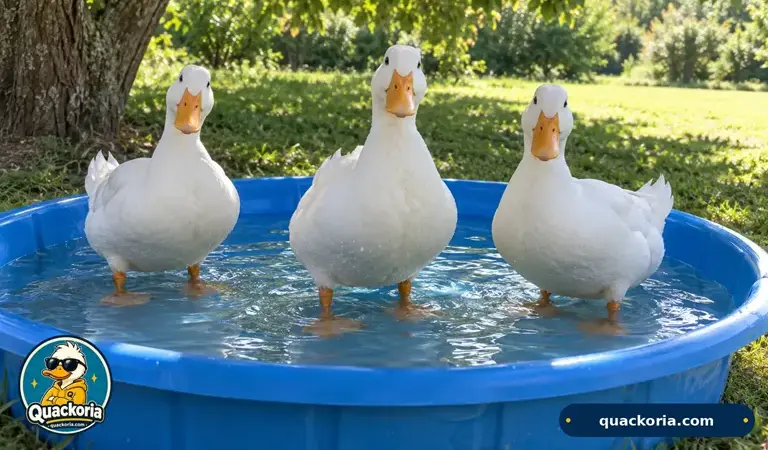
A duck’s lower legs and feet are unfeathered, and Penn State lists the shanks among the places poultry shed body heat. Cool water on the feet and legs is how the Open Sanctuary Project and PoultryDVM cool an overheated duck (see the emergency below), and for everyday cooling the Open Sanctuary Project suggests open containers of cool water to splash in and Metzer a plastic paddling pool of fresh water.
Water to stand in does not need to be deep. A shallow tray, a paddling pool, a large plant saucer — anything the bird can walk into and stand in, in the shade. The RSPCA’s minimum for water ducks can get their whole body into — at least 50 × 100 cm and at least 10 cm deep, from 21 days old — is a welfare floor for bathing, and deep enough to stand in. Details of what water a duck needs and how to keep it from becoming mud are in duck water needs.
Put the pool in the shade, where the water stays cool longer.
The house in summer
A duck house that was snug in January is an oven in July. Two things change.
Ventilation goes up. Open every vent, window and door that can be opened while still keeping the house secure — hardware cloth over an open window gives air without giving a fox a way in. The duck house guide covers the mesh and the predator-proofing; the UK code asks that ventilation be adequate to protect the birds from overheating, and the summer version of the rule is that air must move through the house, not just into it. One opening is a vent; two on opposite walls is airflow.
Nobody goes in during the day. The UK code says birds should not be confined for too long during daylight, or kept in direct sunlight while confined. Leave the pop door open during daylight so the birds can choose, and make sure the run has better shade than the house does, or they will choose the house.
Metzer adds the reason ventilation matters beyond temperature: in stagnant air, a build-up of ammonia can cause eye problems.
Laying drops in a heatwave — expected, not a fault
Penn State’s table records what heat does to laying poultry; it does not mention ducks: towards the top of the 75–85 °F band, egg size may be reduced and shell quality may suffer; at 85–90 °F, egg production suffers. A duck that lays every day in May and every other day in a July heatwave is not necessarily ill. Mississippi State’s poultry specialist says hens can fully recover from heat stress, though prolonged heat stress without intervention reduces egg production.
Thin shells and smaller eggs in hot weather are the same story. Keep the layer feed and the oyster shell available and the water cool. Penn State notes that electrolytes can be added to the water to replace those lost during heat stress; anything beyond that is a question for a vet.
If laying does not recover when the temperature does, something else is going on — see when do ducks start laying eggs for the other reasons a duck stops.
Feeding in heat
Birds eat less in hot weather: Penn State’s table shows feed consumption falling from 75 °F, and Mississippi State’s poultry specialist says chickens choose to eat less when it gets really hot. Its advice is a balanced diet in the early morning, when temperatures are not as extreme, rather than at midday; do not worry about a reduced appetite on a hot afternoon.
Metzer suggests vegetables, fruit or mint leaves frozen into ice cubes and added to the water troughs, and treats such as watermelon, strawberries, cantaloupe and cucumber to help keep ducks hydrated. They are a treat, not a diet: Mississippi State’s specialist warns that treats must not be the only food birds eat, and the feeding guide has what is and is not safe.
The emergency: a duck already down
A duck that is gaping with its neck extended, lethargic, collapsed or having seizures in the heat is an emergency. The Open Sanctuary Project’s advice is to call your vet immediately and to lower the bird’s temperature gradually. In order:
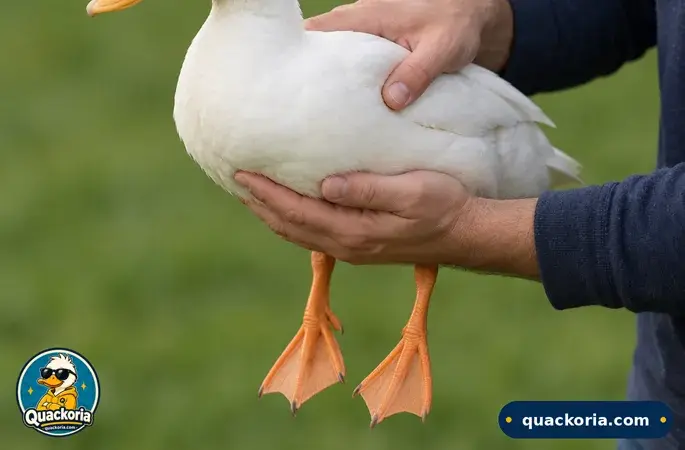
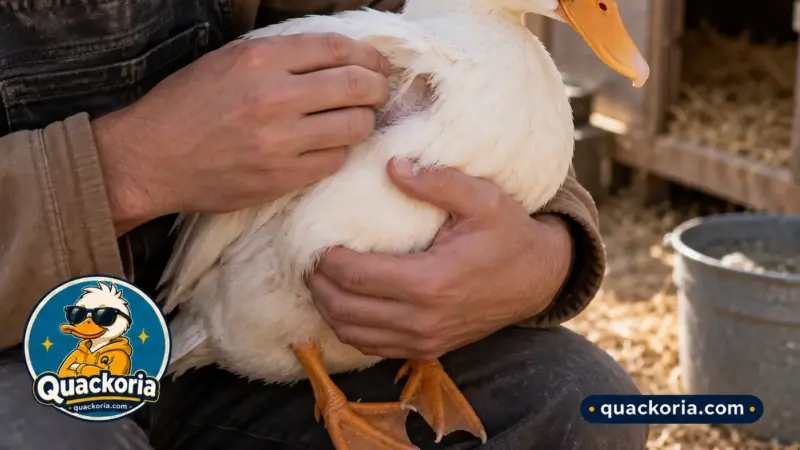
- Move it to shade, with as little handling as possible (Open Sanctuary Project) — carried properly, low, wings held; see how to hold a duck. Do not make it walk.
- Cool the feet and legs. The Open Sanctuary Project mists the feet and legs with cool (but not ice-cold) water; PoultryDVM dips the webbed feet slowly into a cool bath. For an overheating hen, Mississippi State’s specialist submerges the lower body in cool, not icy, water, with the head kept above water. If the duck cannot stand, hold it with its feet in the water.
- Keep the water off the feathers. The Open Sanctuary Project says that when cooling birds you should typically avoid wetting feathered areas of the body, as this could be counter-productive.
- Put water within reach and let it drink on its own; do not pour water into its bill. How to deal with dehydration is a question for your vet (Open Sanctuary Project).
- Move air over it — a fan, as the Open Sanctuary Project and PoultryDVM both advise, or a breeze.
- Leave it alone in the shade with water once it is breathing normally, and keep the rest of its day as stress-free as possible (Open Sanctuary Project).
Not ice-cold water: the Open Sanctuary Project stresses lowering the temperature gradually. The one use of ice among these sources is PoultryDVM’s: small ice packs under the wings for up to 60 seconds, then removed for a few minutes, and repeated.
Do not wait to see whether it recovers before calling the vet. The Open Sanctuary Project says heat-related illness can be life-threatening, and that a bird cooled without veterinary help may still need treatment for electrolyte imbalances and secondary problems.
Breeds and heat
Penn State’s table puts the danger of heat exhaustion first in “layers and heavier birds” — a general poultry figure, not a ranking of duck breeds, and none of the sources here ranks duck breeds by how they cope with heat. Muscovies are the one breed a source does compare: the Cornell Duck Research Laboratory says “Muscovies tolerate hot weather much better than common ducks.” The same bird is the exception in the other direction — the Open Sanctuary Project says Muscovies tend to be more sensitive to the cold than other breeds — which is covered in keeping Muscovy ducks.
Planning a hot day
When the forecast says 90 °F or more:
- Fill and shade the waterers before it gets hot, and add a second
- Fill the pool and put it in the shade
- Open the house, and prop the pop door
- Feed early, in the cool of the morning, not at midday
- Check the birds mid-afternoon — the panting test — and bring water to any that are sitting
- Skip any handling, moving or cleaning that can wait
The winter version of this article — where the same insulation is the duck’s great advantage — is keeping ducks in winter. Together they are most of what a keeper needs to know about weather, and the whole year, season by season, is laid out in a duck keeper’s year.
This is husbandry guidance, not veterinary advice. If a bird is ill or injured, find an avian vet.
Frequently asked questions
At what temperature do ducks get too hot?
Penn State Extension says heat stress in poultry typically begins when the air climbs above 80 °F (27 °C), and that at 55–75 °F birds do not need to change their behaviour to hold their body temperature — but the guidance is for poultry in general and does not mention ducks. No duck-specific threshold is published; the Open Sanctuary Project says the danger point falls as humidity rises. Watch the birds: prolonged panting is the sign the UK welfare code uses.
What are the signs of heat stress in ducks?
In order, by the Open Sanctuary Project's account: wings held away from the body, open-mouth breathing, more exaggerated panting possibly with the neck extended, lethargy, then collapse or seizures. Metzer Farms adds that hot ducks sometimes sit, pant, and forget to drink water.
Do ducks need shade?
Yes, and enough for the whole flock to lie in at once. The UK code says shade and shelter from extreme weather should always be available to ducks on range, and the RSPCA asks for enough summer shelter to avoid crowding. Trees, a solid roof with open sides, shade cloth, or a tarp set well above head height and open on all sides are what work, as long as air can move under them.
Why have my ducks stopped laying in the heat?
Penn State's table, for poultry in general, records egg size and shell quality suffering towards 85 °F and egg production suffering from 85–90 °F. A duck laying every other day in a heatwave is not necessarily ill; if laying does not recover when the weather cools, look for another cause.
How do you cool down a duck with heat stroke?
Move it to shade with as little handling as possible, mist its feet and legs with cool (not ice-cold) water or dip the feet slowly into a cool bath, keep the water off its feathers, put a fan on it, and call your vet at once (Open Sanctuary Project, PoultryDVM). Lower its temperature gradually; do not use ice-cold water.
Sources
- Penn State Extension, Hot Weather Management of Poultry
- Metzer Farms, Summer Heat Care: Keeping Ducks Cool and Hydrated
- DEFRA, Code of recommendations for the welfare of livestock — ducks
- RSPCA welfare standards for domestic/common ducks (2023)
- The Open Sanctuary Project — Potential Duck Health Challenges (Heat Exhaustion)
- The Open Sanctuary Project — Summer And Hot Weather Considerations For Animal Sanctuaries
- The Open Sanctuary Project — Creating A Good Home For Ducks
- PoultryDVM — Heat stress in Pet Ducks
- Mississippi State University Extension — Protect backyard chickens, livestock from extreme heat (2026)
- Cornell Lab of Ornithology — Muscovy Duck overview
- Cornell University Duck Research Laboratory — Domestic Ducks