Quackoria Tools
Duck Anatomy Explorer: Tap a Part, Learn What It Does
Bill, lamellae, speculum, preen gland, the feet that do not freeze — fifteen parts of a duck, each with a sourced fact and the article that goes further.
How to use it
- Tap a numbered marker on the duck, or one of the parts listed under it. The panel below shows what that part does.
- Use Next part and Previous to walk through all fifteen in order — useful on a projector or with a class.
- Every panel ends with a Read more link to the full Quackoria article and the sources the fact comes from.
- The explorer works from the keyboard: Tab to a marker, Enter to open it.
What the explorer shows
Fifteen parts of a duck, from the nail on the tip of the bill to the web between the toes, each with the one thing worth knowing about it and a link to the article that tells the rest. The drawing is a plain side view of a generic dabbling duck — the shape of a mallard, a Pekin or a Campbell — rather than any one breed, and the facts are the ones that hold across breeds. Every panel names its sources at the bottom, and they are published studies, universities and extension services, the Cornell Lab, welfare codes and, for telling drakes from ducks, a waterfowl hatchery.
The parts are grouped the way you would meet them looking at a real duck: the head first (bill, lamellae, nostrils, eye, ear), then the body (neck, feathers, wing, speculum, preen gland, tail), then the legs and feet, and finally the down that a duckling is born with. One of the fifteen is not strictly a part at all: “half a brain awake” is a thing the brain does rather than a place, and it earned its number because it is the fact most people find hardest to believe.
Five things the drawing cannot show
The interesting anatomy of a duck is mostly invisible from the outside, which is why each panel is more than a label. The lamellae along the bill are a strainer, not teeth, and the reason ducks do not have teeth is the same reason no bird does. The feathers keep water out mainly by their structure, and the preen oil’s main job is to keep that structure in order — International Bird Rescue calls the idea that the oil itself makes feathers waterproof “a common myth”, and why ducks don’t get wet sets out the evidence on both sides. Inside each leg, arteries and veins run side by side and exchange some heat, and, probably, less blood is sent down to the foot in the first place: the foot runs cold and loses little heat, and on ice it stays just above freezing — more on why ducks’ feet do not freeze. The eye has four kinds of colour cone to our three, the shortest tuned to violet rather than ultraviolet, which is the honest version of the claim that ducks see better than we do. And one half of the brain can sleep while the other watches, with the eye on the waking side open — the experiments behind how ducks sleep showed that birds can detect approaching predators while half asleep.
Male and female
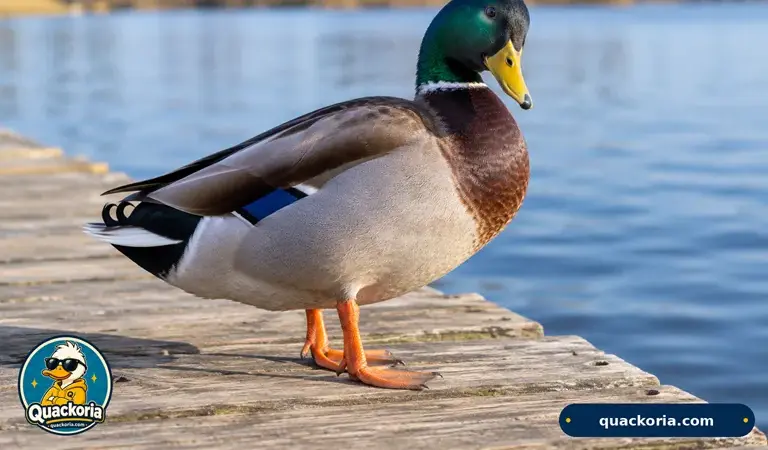
The drawing shows a drake, because the curled tail feather is the easiest external difference to draw. On a female the tail is plain, the voice is the loud quack, and in mallard-pattern breeds the plumage is mottled brown. The explorer’s tail panel covers the drake feather; for the full set of signs and the ages they appear at, male vs female ducks and the sexing tool go further.
For classrooms
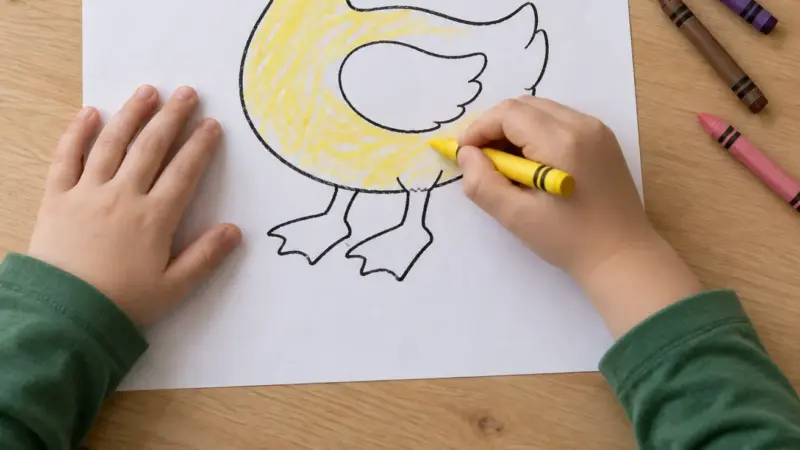
The explorer works without a mouse: every marker can be reached with the Tab key and opened with Enter, and the “next part” button walks through all fifteen in order, which makes it usable on a projector. The facts are short enough to read aloud. If you want a version to colour, the colouring pages use the same drawing, and the duck FAQ answers the questions that usually come up next.
Frequently asked questions
What are the ridges inside a duck's bill?
Lamellae — thin, comb-like plates along the inside edges of the bill that strain food out of water and mud. They are not teeth; no living bird has teeth.
What is the speculum on a duck?
A panel of iridescent feathers on the trailing edge of the wing — blue with white borders on a mallard — present on both sexes. It is one of the quickest ways to identify a brown duck.
Where is a duck's preen gland?
At the base of the tail, on top. The duck spreads its oil through the feathers with its bill. The oil keeps the feather structure in condition; the structure itself is what keeps water out.
Why don't ducks' feet freeze?
The foot runs cold, so it loses little heat: the artery and veins in the leg exchange some heat, and the primary study judged it probable that less blood is sent down. Below freezing, more blood appears to be sent down to keep the tissue from freezing. In the 1975 study, the temperature under the skin of one mallard's foot stayed several degrees above freezing in fluid at −8 °C while the birds' core stayed at 39.9 °C.
Is the drawing a particular breed?
No. It is a generic dabbling duck — the shape of a mallard, a Pekin or a Campbell — drawn as a drake so the curled tail feather can be shown.
Where these figures come from
Every number this tool produces traces back to one of these. Where they disagree with each other, the tool says so rather than picking a favourite.
- eXtension / poultry.extension.org — External Anatomy of Ducks (US extension)
- RSPCA welfare standards for domestic and common ducks (UK welfare standard)
- Jane & Bowmaker (1988), Tetrachromatic colour vision in the duck, J. Comp. Physiol. A 162
- Martin (2007), Visual fields and their functions in birds, Journal of Ornithology 148
- Rattenborg, Lima & Amlaner (1999), Half-awake to the risk of predation, Nature 397
- Cornell Lab of Ornithology — Mallard life history
- Cornell Lab Bird Academy — How feathers are built
- Srinivasan et al. (2014), Quantification of feather structure, wettability and resistance to liquid penetration, J. R. Soc. Interface
- Cornell Lab of Ornithology — Mallard identification
- Giraudeau et al. (2010), Effects of access to preen gland secretions on mallard plumage, Naturwissenschaften
- Metzer Farms — Male vs Female: How to Identify Adult Ducks (US hatchery)
- Kilgore & Schmidt-Nielsen (1975), Heat loss from ducks' feet immersed in cold water, The Condor 77
- Midtgård (1989), Circulatory adaptations to cold in birds, NATO ASI Series 173
- DEFRA — Code of Recommendations for the Welfare of Livestock: Ducks (UK welfare standard)
- RSPCA — Domestic/common ducks: standards justification (UK welfare standard)
- Banta et al. (2004), Partitioning heat loss from mallard ducklings swimming on the air–water interface, J. Exp. Biol. 207
Last reviewed: September 16, 2026