Quackoria Learn
What Is a Group of Ducks Called?
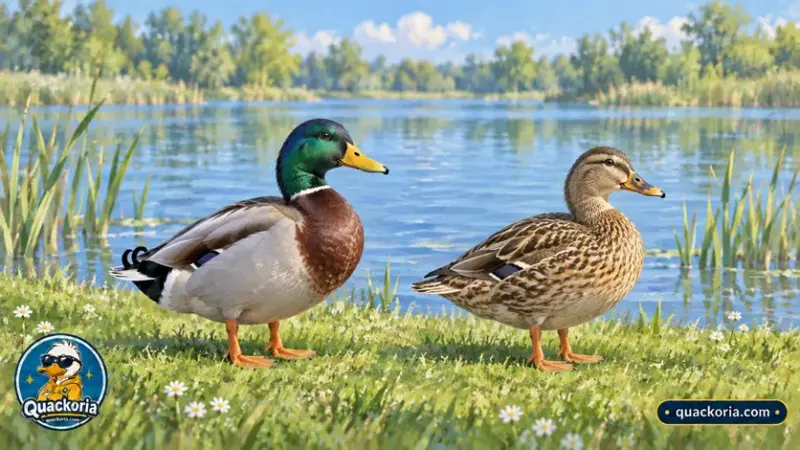
A group of ducks is called a flock, and on the water a raft or a paddling. Everything else you may have read — a badelyng, a dopping and the rest — descends from a 500-year-old list of hunting terms that lexicographers say almost nobody has ever used.
Key takeaways
- Flock and raft are the words ornithologists and wildlife agencies actually use; Cornell writes of "large rafts by the thousands to tens of thousands" of canvasbacks.
- Merriam-Webster gives raft as "an aggregation of animals (such as waterfowl) resting on the water", and names paddling and badelyng as the other water words.
- The strange terms trace to the Book of Saint Albans, printed in 1486, during a fashion for "terms of venery" that mostly died out in the 16th century.
- A brace is a hunter's pair, a clutch is the eggs, a brood is the ducklings that hatch from them, and a pair is usually a bond of four to eight months.
- Geese have a gaggle on the ground and a skein in flight; swans have a wedge in flight and a bank on the ground.
A group of ducks is called a flock. On the water it is also a raft, or a paddling, and in a good dictionary that is where the list ends. Everything else you may have read — a badelyng, a dopping and the rest — comes from a 500-year-old list of hunting terms, and lexicographers are blunt about the fact that almost nobody has ever used such words outside a list.
The words people actually use
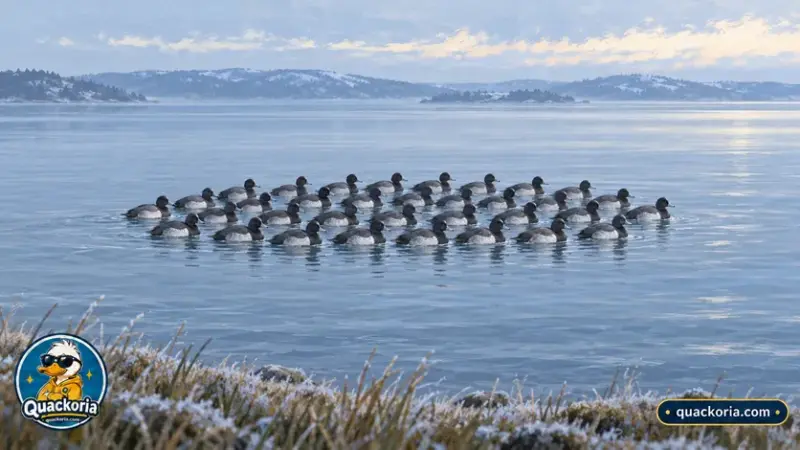
Ornithologists, wildlife agencies and duck hunters use two words. The first is flock, which has been English for a very long time: Merriam-Webster’s first known use is the 13th century, from the Old English flocc, and the Middle English Dictionary quotes a word list from around 1350 with “A flok of cranes”. Cornell’s Lab of Ornithology writes that “Ducks are strong fliers; migrating flocks of Mallards have been estimated traveling at 55 miles per hour.” The second is raft, for ducks sitting together on open water. The US Fish and Wildlife Service’s identification guide says redheads “Usually spend the day in large rafts in deep water”, and that wigeon “often raft up offshore until late afternoon”. Cornell says canvasbacks “gather in large rafts by the thousands to tens of thousands”, and Ducks Unlimited’s hunting writers talk about birds that “will raft up on the reservoir”. If you want a word that a biologist will recognise, those are the two.
Raft and paddling, on the water
Merriam-Webster’s entry for raft gives, as its third sense, “an aggregation of animals (such as waterfowl) resting on the water”, with the example “a raft of ducks” — and it dates the word itself to the 15th century. The dictionary’s own guide to collective nouns adds the second water word: “Ducks on the water are called a paddling (for obvious reasons) and a raft, as they float together like a raft. There are no specific terms for ducks on the ground or in the air, though another collective noun for groups of ducks we see in print is badelyng—a corruption of paddling.” One caution: the dictionary’s own entry for paddling has no duck sense and gives the noun paddle a first known use of about 1612, while a dictionary of collective nouns dates badelyng to 1486, so the two words are related rather than one being clearly the parent of the other.
Where the odd ones come from
The strange terms — a badelyng of ducks, a dopping of sheldrakes — go back to the Book of Saint Albans, printed in 1486 in the Hertfordshire town of that name. St Albans Museums describe it as a collection of “advice on hawking, hunting and heraldry”, printed “on what may have been the third printing press in England”, and note that it “is often credited to Dame Juliana Berners of Sopwell”. The hunting section ends with a list that a University of Toronto catalogue of early lexicons records as “the compaynys of beestys and fowlys”, the companies of beasts and fowls. Merriam-Webster explains the fashion behind it: “There was, at that time, something of a fad for ‘terms of venery,’ or names for groups of game animals”, and “Though there was a rage for terms of venery, most of them fell out of use in the 16th century.”
Most never came into use at all. The dictionary’s test is that “a word hasn’t fully entered the language until it’s used consistently in running prose without any sort of parenthetical explanation or gloss, and many of these terms haven’t.” The word researcher Michael Quinion puts it more plainly: “nobody seems to have used them in real life (and some are now mysterious, such as cete of badgers or dopping of sheldrake, because we no longer have the vocabulary to appreciate them).” So a badelyng of ducks is a real entry in a real 1486 list, and a word you can enjoy; it is not a word a duck scientist will use.
Brace, brood, clutch and pair
A few duck words are precise and worth knowing. A brace is a hunter’s pair: Merriam-Webster gives “two of a kind : pair”, traced through the Anglo-French for a pair of arms, and the word too dates from the 15th century. A clutch is the eggs — Ducks Unlimited: “The set of eggs that a hen lays is known as a clutch.” A brood is the ducklings that hatch from it and travel with the hen; the American Heritage Dictionary defines it as the young of certain animals, “especially a group of young birds hatched at one time and cared for together”, and Cornell gives the mallard’s clutch size as one to thirteen eggs with one or two broods a year. A pair is exactly that, and it is usually temporary: Ducks Unlimited notes that “Most species of ducks form pair bonds that last only four to eight months, often with a new mate each year”, while geese and swans pair for life. Our guide to whether ducks mate for life covers the difference.
Geese and swans, for comparison
The neighbours have better words. Geese on the ground are a flock or a gaggle — “a word which is specific to geese and comes from the Middle English verb gagelyn, which means ‘to cackle'” — and a skein of geese is “a group of geese in flight”. Swans in flight are a wedge, “likely because of the shape a group of swans takes in flight”, and a group of swans on the ground can be a bank. If you are not sure which of the three big white or grey birds you are looking at, duck vs goose vs swan sorts them out.
Why ducks raft up at all
The word raft exists because of a real behaviour. The US Fish and Wildlife Service says of lesser scaup that “It is not unusual to see this species in groups or rafts that are composed of thousands of individuals during the winter”, and Cornell notes that greater scaup “tend to congregate in homogenous, single species rafts.” A US Geological Survey biologist quoted by Bay Nature on the great winter rafts of San Francisco Bay gives the first reason: “Rafting among San Francisco Bay diving ducks is primarily about food. The rafts form where the prey is–mainly bivalves like clams and mussels.” The article’s author, Joe Eaton, adds the second: “There’s also an element of safety in numbers.” The word is used mostly of diving ducks on open water; the difference between the two groups is in dabbling vs diving ducks.
The rest of the vocabulary — drake, hen, duckling — is on what a male duck is called, and where the big flocks go in autumn is the subject of duck migration. For the full stock of duck questions in one place, see the duck FAQ, and if you would rather guess than read, the duck quiz will test what stuck.
Frequently asked questions
What is a group of ducks called?
A flock. On the water it is also called a raft, which Merriam-Webster defines as "an aggregation of animals (such as waterfowl) resting on the water", or a paddling.
What is a group of ducks in flight called?
A flock. Merriam-Webster notes that "There are no specific terms for ducks on the ground or in the air"; the words skein and wedge belong to geese and swans.
What is a badelyng of ducks?
An old collective noun for ducks, recorded in a 1486 list of hunting terms and related to paddling. It is real, but it has never been in ordinary use.
What is a group of ducklings called?
A brood. The eggs they hatch from are a clutch; Ducks Unlimited: "The set of eggs that a hen lays is known as a clutch."
Why do ducks gather in rafts?
Food and safety. A USGS biologist quoted by Bay Nature on San Francisco Bay's winter rafts says "The rafts form where the prey is", and the article adds that "There's also an element of safety in numbers."
Sources
- Merriam-Webster — raft
- Merriam-Webster — flock
- Merriam-Webster — brace
- Merriam-Webster — Collective nouns: geese, ducks, swans and their location
- Merriam-Webster — Collective nouns: a murder of crows (terms of venery)
- Merriam-Webster — Collective nouns: a melody of harpers and a poverty of pipers
- Middle English Dictionary (University of Michigan) — flok
- St Albans Museums — The Book of St Albans
- Michael Quinion, World Wide Words — Animal group terms
- Lexicons of Early Modern English (University of Toronto Libraries) — The Book of St Albans
- Merriam-Webster — paddling
- Encyclopedia.com — badelyng, badling (Dictionary of Collective Nouns and Group Terms)
- US Fish and Wildlife Service — Ducks at a Distance: a waterfowl identification guide (Bob Hines)
- US Fish and Wildlife Service — Lesser scaup
- Cornell Lab of Ornithology, All About Birds — Canvasback life history
- Cornell Lab of Ornithology, All About Birds — Greater scaup
- Cornell Lab of Ornithology, All About Birds — Mallard overview
- Cornell Lab of Ornithology, All About Birds — Mallard life history
- Ducks Unlimited — Reservoirs of waterfowl (Wade Bourne)
- Ducks Unlimited — Life in the egg (Bruce Batt)
- Ducks Unlimited — Understanding waterfowl: courtship and pair bonding (Mike Brasher)
- Wordnik (American Heritage Dictionary) — brood
- Bay Nature — Rafting time for diving ducks (Joe Eaton)