Quackoria Learn
What Is a Male Duck Called?
Key takeaways
- Drake means "a male duck" and dates from the 14th century; it is a different word from the drake that means dragon.
- Duck is both the species and the female; hen is "broadly : a female bird", which is why hatcheries and wildlife agencies use it.
- Hens quack and drakes rasp: Cornell says "Males don't quack; they make a quieter, rasping sound."
- Every common breed except the Muscovy grows a curled tail feather in the drake within about eight weeks; its absence proves nothing.
- Each summer the drake moults into hen-like eclipse plumage and is flightless for a month or so — three to four weeks by Cornell's estimate, 30 to 45 days by Ducks Unlimited's.
A male duck is called a drake. The female is simply a duck, or a hen to keepers and hunters, and the young are ducklings. The word drake has been English since about 1300, the curled feathers on his tail are the easiest way to spot him, and for a few weeks every summer he stops looking like a drake at all.
Drake, duck, hen, duckling
Merriam-Webster defines drake as “a male duck”, traces it to Middle English with a cousin in Old High German, and gives a first known use in the 14th century; the Online Etymology Dictionary puts the word at around 1300 and notes it is “unrecorded in Old English, but it might have existed”. It is not the same word as the drake that means dragon, which comes from the Old English draca. Duck is older still — “before the 12th century”, from the Old English dūce — and the dictionary lists two meanings side by side: the bird in general, and “a female duck”, with a note to compare drake. Hen, in Merriam-Webster’s words, is “a female chicken especially over a year old” and “broadly : a female bird”, which is why duck keepers, hatcheries and the US Fish and Wildlife Service all call a female duck a hen. Duckling, “a young duck”, is recorded from the 15th century.
How to tell a drake from a hen
Listen first. Cornell’s Lab of Ornithology: “The standard duck’s quack is the sound of a female Mallard. Males don’t quack; they make a quieter, rasping sound.” The Fish and Wildlife Service’s identification guide says the same of mallards — “Hens have a loud quack; the drake’s voice is a low-pitched kwek-kwek” — and notes that among pintails “The drakes whistle; the hens have a coarse quack.” It holds for the domestic breeds, which descend from the mallard: Metzer Farms, a California duck hatchery, says that “By eight to ten weeks males have a deep, raspy voice while females maintain the loud QUACK.”
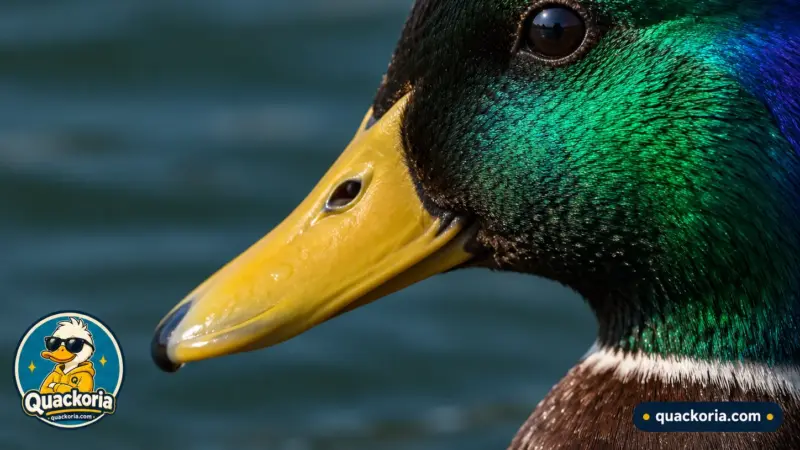
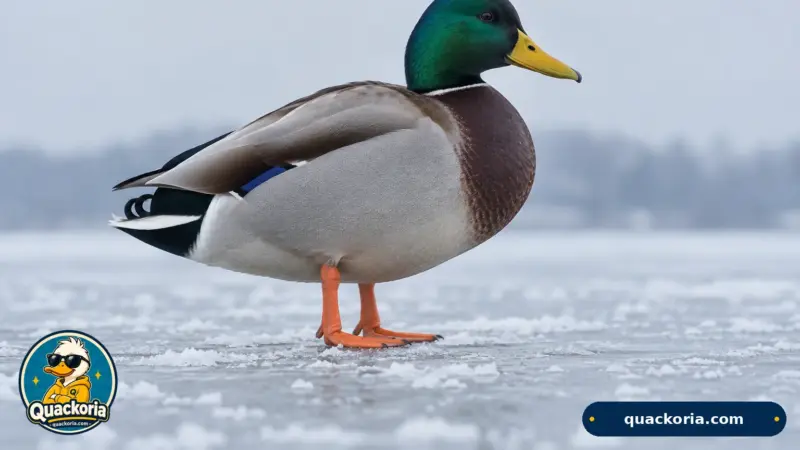
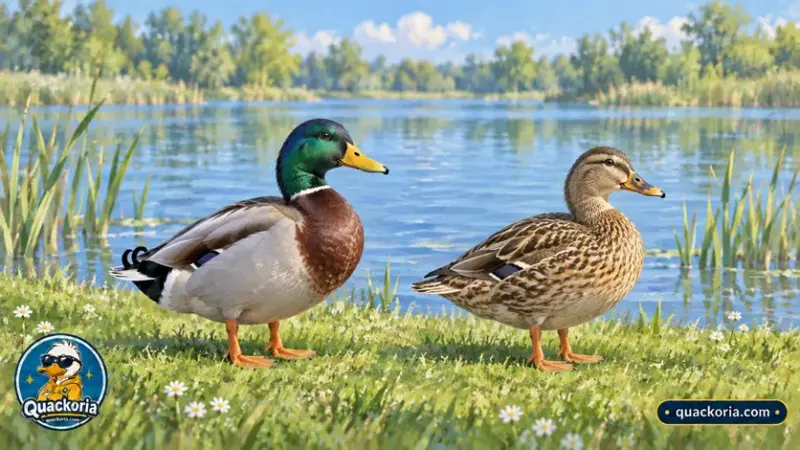
Then look at the tail. Metzer: “A male duck of all common breeds (except the Muscovy) grows a distinctly curled feather in its tail”, and “The curly feather appears within about eight weeks.” The University of Kentucky’s extension guide calls these the sex feathers. The curl proves a drake; its absence proves nothing, because as Metzer adds, “The lack of a curly feather, however, does not indicate a female as it could have been pulled or molted.” Size helps a little — “Male ducks are usually bigger than females” — and in wild mallards the colours settle it: Cornell describes the breeding male’s “iridescent green head, yellow bill, white collar around neck, brown breast, and a grayish body”, and the female as “mottled brown, with an orange-and-black bill”. The full method, breed by breed, is in male vs female duck, and the boy-or-girl checker walks you through it for your own bird.
The drake who looks like a hen: eclipse plumage
Every summer the drake loses his finery. Cornell: “Mallards, like other ducks, shed all their flight feathers at the end of the breeding season and are flightless for 3–4 weeks. They are secretive during this vulnerable time, and their body feathers molt into a concealing ‘eclipse’ plumage that can make them hard to identify.” The Fish and Wildlife Service guide puts it simply: “Nearly all drakes lose their bright plumage after mating, and for a few weeks resemble females. This hen-like appearance is called the eclipse plumage.” Ducks Unlimited adds that “For a short time, male mallards lose the iconic green head feathers, causing them to look like a female mallard” apart from a few masculine features. So a drab duck with a curled tail in August is a drake between suits.
The Muscovy drake
The Muscovy is the one domestic duck that is not a mallard: Cornell notes that “The Mallard is the ancestor of nearly all domestic duck breeds (everything except the Muscovy Duck)”, and the Kentucky guide says the Muscovy “is often referred to as a duck, but it is actually a different species”. Its drake has no curled tail feather. What he has instead is size — “The male Muscovy Duck is the largest duck in North America, but the female is only half his size” — a hiss rather than a quack (Cornell: “males make hissing sounds while raising the crests on their heads”), and, in the Kentucky guide’s words, “characteristic fleshy outcrops around the eyes called caruncles”. Our Muscovy duck page has the rest.
When a duckling becomes a duck
There is no ceremony, only feathers. Metzer’s rearing guide says that “Once they are fully feathered (7-9 weeks of age) they can stay outside all the time”, and Ducks Unlimited describes wild mallard broods at seven to eight weeks as “almost full grown” and “capable of making short flights around the marsh”; Audubon gives the age at first flight as 52 to 60 days. By then a drake-to-be already sounds like one. The week-by-week story is in ducklings.
What a drake does, and does not, do
A drake’s job in the wild is short. Ducks Unlimited says mallards “form new pair bonds annually, which typically last for 6–8 months”, and that “Males typically leave the female mid-incubation but remain nearby seeking additional breeding opportunities with other females” whose nests have failed. The hen does the sitting and the rearing. Whether that counts as mating for life is answered in do ducks mate for life, and the drake’s rasp is explained in why do ducks quack. For the words that cover more than one bird — flock, raft, brood — see what a group of ducks is called.
Frequently asked questions
What is a male duck called?
A drake. Merriam-Webster defines it as "a male duck" with a first known use in the 14th century.
What is a female duck called?
A duck, or a hen. The dictionary lists "a female duck" as a sense of duck itself, and hen as "broadly : a female bird".
What is a baby duck called?
A duckling, a word recorded from the 15th century. Ducklings are fully feathered at about seven to nine weeks and fly at about 52 to 60 days.
How can I tell a drake from a hen?
By voice and tail. Only the hen gives the loud quack; the drake of every common breed except the Muscovy grows a curled tail feather by about eight weeks.
Do Muscovy drakes have a curled tail feather?
No. The Muscovy is a separate species; its drake is much larger than the hen, hisses rather than quacks, and has fleshy red caruncles around the eyes.
Sources
- Merriam-Webster — drake
- Merriam-Webster — duck
- Merriam-Webster — hen
- Merriam-Webster — duckling
- Online Etymology Dictionary — drake
- Cornell Lab of Ornithology, All About Birds — Mallard overview
- Cornell Lab of Ornithology, All About Birds — Mallard identification
- US Fish and Wildlife Service — Ducks at a Distance: a waterfowl identification guide (Bob Hines)
- Metzer Farms — Male vs female: how to identify adult ducks
- University of Kentucky Cooperative Extension — ASC-198 Selecting ducks (Jacquie Jacob and Tony Pescatore)
- Metzer Farms — Brooder setup and care for ducklings, goslings and chicks
- US Fish and Wildlife Service — Ducks at a Distance (Project Gutenberg text)
- Ducks Unlimited — Mallard annual life cycle
- Ducks Unlimited — Understanding waterfowl: brood ecology (Johann Walker)
- Cornell Lab of Ornithology, All About Birds — Muscovy duck
- Cornell Lab of Ornithology, All About Birds — Muscovy duck life history
- National Audubon Society — Mallard field guide