Quackoria Learn
Muscovy Duck: The Domestic Duck That Is Not a Mallard
Key takeaways
- Cairina moschata, a species of Mexico, Central and South America domesticated in the Americas — not a mallard breed. Crosses with mallard-type ducks are infertile mules or hinnies (Metzer).
- 35-day incubation, no loud quack, no drake feather, and males much larger than females — almost twice the size by Metzer, 30–50% heavier by the Cornell Duck Research Laboratory.
- Metzer scores it 1 for calm, Excellent for mothering, foraging and flight; 100–150 eggs a year.
- Quieter than other ducks, by Metzer Farms' account, and one that flies and perches — cover the run or clip a wing.
The Muscovy is the one domestic duck that is not a duck in the usual sense: a different species, from South America rather than a mallard ancestor, with a red face, claws, no loud quack, a 35-day hatch and the best mothering of any bird on the chart. Metzer Farms calls it quieter than other ducks.
Every other breed on this site — Pekin, Campbell, Runner, Cayuga, Rouen, Call, Welsh Harlequin — descends from the wild mallard, and they share the mallard’s quack, its habits and eggs that take about 28 days to hatch (Cornell Duck Research Laboratory), give or take a day or so for Mallards and Runners (Metzer Farms). The Muscovy differs on all three. It was domesticated separately, in the Americas — Cornell’s Lab of Ornithology says it was already being kept by native people in Peru and Paraguay when the early Spanish explorers arrived — from a wild bird that still perches in trees along tropical rivers. This page is about the breed itself: what it is, where it came from, and how it differs. For the day-to-day of keeping one, keeping Muscovy ducks is the companion guide.
Muscovy duck at a glance
| Trait | Figure | Source |
|---|---|---|
| Species | Cairina moschata — not a mallard breed | Animal Diversity Web, Cornell Lab |
| Origin | Mexico, Central and South America; Metzer: “the swamps and rivers of Brazil” | Metzer, Animal Diversity Web |
| Adult weight | 6.5–13 lb (2.9–5.9 kg); males “almost twice the size of females” | Metzer |
| Eggs a year | 100–150 | Metzer |
| Egg weight | 75–85 g (Metzer); wild birds’ eggs glossy white, sometimes tinted (Cornell Lab) | Metzer, Cornell Lab |
| Temperament | 1 on Metzer’s scale — very calm | Metzer |
| Mothering | Excellent — the only breed Metzer rates so | Metzer |
| Foraging | Excellent | Metzer |
| Flight | Excellent | Metzer |
| Voice | Usually silent; males hiss and puff in courtship, females give a quiet quack or croak (Cornell Lab); “no loud Quack” (Metzer) | Cornell Lab, Metzer |
| Incubation | 35 days | Cornell, Metzer |
| Rarity | Not on The Livestock Conservancy’s priority list; Metzer’s chart says Abundant (White) and No Rank (Black) | The Livestock Conservancy, Metzer |
Metzer’s egg range runs from no artificial light to 17 hours of light. The chart with all twenty-one breeds is on the breed comparison tool.
A different species
The Muscovy is Cairina moschata, a wild duck of Mexico, Central and South America, and the one domestic duck whose domestication happened in the Americas rather than the Old World. The wild bird is still common in its native range, Animal Diversity Web says, though wild populations seem to be declining. The Cornell Lab of Ornithology describes it as a large, dark duck with white wing patches that nests in tree cavities, living from northern Mexico to Argentina; truly wild birds reach north only as far as south Texas, feral populations exist in Florida, and domesticated birds turn up in parks and on farms across much of North America. Metzer Farms, which sells the domestic form, places its origin in “the swamps and rivers of Brazil”.
The differences are practical ones. The eggs take 35 days to hatch instead of 28, as Cornell’s Duck Research Laboratory and Metzer both state. The birds are usually silent, Cornell’s Lab of Ornithology says — the females give a quiet quack or croak when frightened and the males hiss and puff during courtship — so a mallard-type duck’s voice test for sexing does not apply. There is no curled drake feather (Metzer Farms). And a Muscovy crossed with any mallard-descended breed produces sterile hybrids — mules or hinnies, depending on which way round the cross is made (Cornell Duck Research Laboratory): Metzer puts it flatly that the progeny are infertile and cannot reproduce. Mule ducks are raised for meat — the Cornell laboratory says they have more lean meat than Pekins — but they are the end of the line.
What a Muscovy looks like
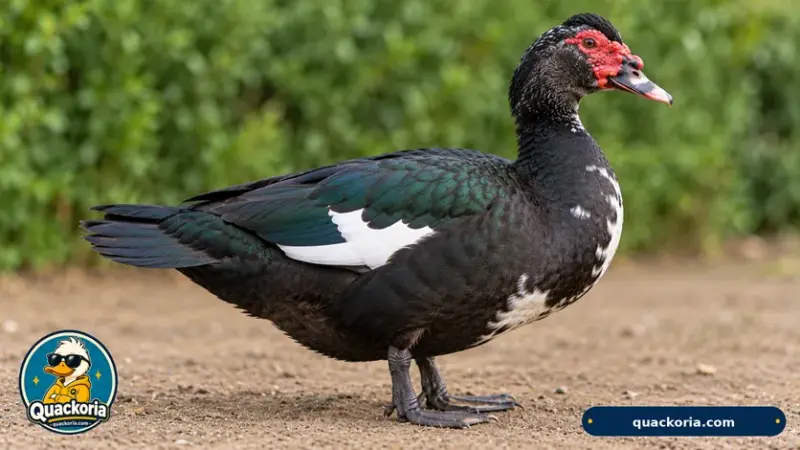
Big and heavy-bodied, with a long neck that Cornell’s Lab of Ornithology says can make a Muscovy look like a small goose, and a face nobody forgets. Around the eyes and over the bill both sexes carry bare red or red-and-black skin with fleshy bumps — the caruncles — which are larger and more extensive on drakes and grow with age. The plumage of the wild type is black with a green gloss and white wing patches; domestic Muscovies come in white, black, blue, chocolate, pied and several other patterns. Muscovies have an erectile crest on the fore-crown (British Waterfowl Association), which drakes raise as a dominance display to other males (Animal Diversity Web); the tail is fairly long, and the feet carry sharp claws for gripping branches — the wild bird perches and nests in trees, and Metzer says domestic Muscovies will often perch in trees, though their nests are always on the ground. Metzer recommends gloves for handling, and how to hold a duck explains how to hold one.
Size is the sexing sign. Metzer says the sexes begin to differ by three weeks and that adult males are almost twice the size of females, as the British Waterfowl Association also says; the Cornell Duck Research Laboratory puts the male at 30–50% heavier. A Nigerian study of 1,020 adults, cited on the breeds guide, classified birds correctly 98.5% of the time on body weight, wing length and body length. Customer reports on Metzer’s page put males at 10–11.7 lb and females at 6–6.5 lb by eleven to thirteen weeks. The sexing tool has a separate Muscovy path for this reason.
Eggs and mothering
Metzer’s chart gives 100–150 eggs a year of 75–85 g, none of them bluish — a moderate layer beside a Campbell or a Runner. What sets the Muscovy apart is what happens next. Metzer rates its mothering Excellent, the only breed on the chart to earn the word, and says a broody Muscovy “will do an excellent job of hatching and raising her young” and that “There is no breed of duck that does a better job of hatching and raising their young”; if the ducklings are taken away at three to five weeks she will probably produce one or two more broods in the season. The British Waterfowl Association says the Muscovy’s parenting skills are prized and that domestic birds are often used as broodies for incubating other waterfowl eggs. The broody duck guide covers the 35-day sit, and the day-by-day timeline dates the milestones for a Muscovy hatch.
Temperament and noise
Metzer scores the Muscovy 1 — as calm as its scale goes — and describes it as calmer and quieter than other ducks, with no loud quack. This is the breed for a garden with close neighbours: Cornell’s Lab of Ornithology calls Muscovies “usually silent”. Two cautions belong beside that. Metzer notes that Muscovies, especially the males, are very strong. And the British Waterfowl Association says wild drakes often fight over food, territory or mates.
Keeping Muscovies
Three things differ from a mallard-type flock. They fly — Metzer rates flight Excellent and notes it helps them escape predators — so either the run is covered, one wing is clipped — Metzer’s advice is one wing only, which leaves the bird unbalanced when it tries to fly, and the feathers grow back — or you accept that they will perch where they like. They perch: the British Waterfowl Association says wild Muscovies often roost in trees at night, and Metzer says domestic ones will often perch in trees. And they swim less: Oklahoma State University’s breed register says they do not swim much, because their oil glands are underdeveloped compared with most ducks. A Muscovy still needs water deep enough to put its whole head under — the British Waterfowl Association says all waterfowl do, to keep eyes and nostrils clear — but Metzer says ducks do not have to have swimming water, so a tub is enough and a pond is a luxury. Their foraging is excellent — Metzer’s word — and Cornell lists insect larvae and adults, spiders, worms and seeds among the wild bird’s foods.
Meat is the other reason the breed is kept. Metzer says Muscovies have been bred for excellent meat production, leaner than Pekin, with a very large breast on the males. For space, feed and housing, keeping Muscovy ducks goes through it in detail — with one caution: the RSPCA’s welfare standards for common ducks leave Muscovies out, saying the two species are likely to have different management requirements.
Is the Muscovy right for you?
Yes, if you want a quiet, calm, self-sufficient duck that will hatch and raise its own young, forage hard, and give a good carcass, and you can live with a bird that flies and roosts where it likes. Choose something else if you want the most eggs, a duck that stays where you put it, a bird that quacks, or a mallard-type look. And do not expect to breed it to your Pekins: the Cornell Duck Research Laboratory says natural matings between Muscovies and common ducks usually have a very low fertility rate, and any ducklings are sterile. The beginner’s guide to duck breeds sets the Muscovy beside the common mallard-type breeds, and duck, goose or swan explains where it sits in the wider waterfowl family.
Frequently asked questions
Is a Muscovy a real duck?
Yes, but a different species (Cairina moschata) from every other domestic duck, which all descend from the mallard. It differs from them in practical ways: its eggs take about 35 days to hatch instead of about 28, it is usually silent rather than quacking, it has strong claws for perching, and the drake has no curled tail feather.
Do Muscovy ducks quack?
Rarely, and quietly. Cornell's Lab of Ornithology says Muscovies are usually silent: the females give a quiet quack or croak when frightened and a soft shrill call to their ducklings, and the males hiss and puff during courtship. Metzer describes them as calmer and quieter than other ducks, with no loud quack.
How can you tell a male Muscovy from a female?
Size. Metzer says the sexes begin to differ by three weeks and adult males are almost twice the size of females; the Cornell Duck Research Laboratory puts the male at 30–50% heavier. The caruncles on the face are also larger on drakes.
Can Muscovy ducks fly?
Yes, well — Metzer rates their flight Excellent. Cover the run, clip one wing, or accept they will perch where they like.
Can you breed a Muscovy with a Pekin?
Rarely, and never onward. Metzer says the chances are poor that the two will cross; when they do, the ducklings — mules from a Muscovy drake, hinnies from a Pekin drake — are infertile and cannot reproduce.
Sources
- Metzer Farms — Compare Duck Breeds
- Metzer Farms — Using Lights to Increase Duck Egg Production
- Metzer Farms — Sexing Ducks and Geese
- Cornell University Duck Research Laboratory — Hatching Duck Eggs
- RSPCA welfare standards for domestic and common ducks
- Metzer Farms — Muscovy Ducks
- Animal Diversity Web, University of Michigan — Cairina moschata
- Cornell Lab of Ornithology — Muscovy Duck
- British Waterfowl Association — Muscovy (wild)
- Oguntunji & Ayorinde (2014), Sexual size dimorphism in Muscovy duck, Acta Agriculturae Slovenica 104
- Cornell Lab of Ornithology — Muscovy Duck Sounds
- Cornell Lab of Ornithology — Muscovy Duck overview
- Cornell Lab of Ornithology — Muscovy Duck life history
- Cornell University Duck Research Laboratory — Domestic Ducks
- British Waterfowl Association — Muscovy (domestic)
- British Waterfowl Association — Ponds
- Oklahoma State University — Breeds of Livestock: Muscovy Ducks
- Metzer Farms — FAQ
- Metzer Farms — Male vs Female: How to Identify Adult Ducks
- The Livestock Conservancy — Conservation Priority List
- Metzer Farms — Hatching Instructions