Quackoria Learn
Are Ducks Smart?
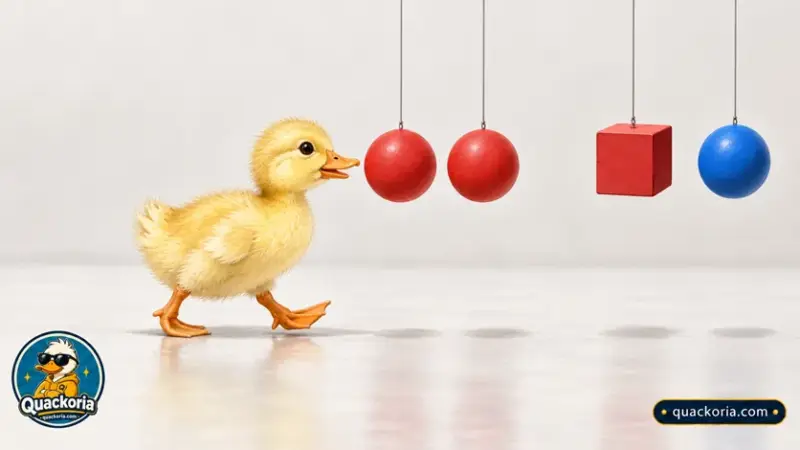
Yes, ducks are smart in at least one measured way, and smarter than "bird-brain" allows. In 2016 Oxford researchers showed that mallard ducklings less than a day old can learn an abstract idea — same versus different — from a single 25-minute look, with no training and no reward. Most of what owners believe beyond that has never been tested.
Key takeaways
- Martinho and Kacelnik (2016, Science): 77 of 113 ducklings, 68 per cent, followed the relationship they had imprinted on rather than the objects — in Kacelnik's words, "the first demonstration of a non-human organism learning to discriminate between abstract relational concepts without any reinforcement training."
- Mallard embryos learn the hen's call in the egg, and imprinting peaks at 13 to 16 hours after hatching.
- Ducks sleep with one eye open and half the brain awake, and do it more when they are exposed at the edge of a row.
- Ducks were not in the 2016 neuron-count study that overturned "bird-brain"; that work was on parrots and songbirds.
- Recognising individual people, tool use and counting have not been studied in ducks; keepers' reports are observation, not evidence.
Smarter than “bird-brain” allows. In 2016 Oxford researchers showed that mallard ducklings less than a day old can learn an abstract idea — “same” versus “different” — from a single 25-minute look, with no training and no reward, something that until then had been demonstrated in only a few animals after long drilling. Ducks also learn their mother’s voice before they hatch and can sleep with half their brain on watch. What they cannot yet be credited with is most of what owners believe: recognising individual people, solving problems, counting. Nobody has tested it in ducks.
The Oxford duckling experiment
The study, by Antone Martinho and Alex Kacelnik, appeared in Science. Its abstract explains the problem: “The ability to identify and retain logical relations between stimuli and apply them to novel stimuli is known as relational concept learning. This has been demonstrated in a few animal species after extensive reinforcement training, and it reveals the brain’s ability to deal with abstract properties.” The ducklings were shown a moving pair of objects — two that matched, or two that did not, in shape or in colour — for 25 minutes, in the window when a duckling imprints on whatever moves. Then they were offered new pairs. “Newly hatched domesticated mallards briefly exposed to a pair of objects that were either the same or different in shape or colour later preferred to follow pairs of new objects exhibiting the imprinted relation.” Of 113 ducklings that took part, 77 followed the relationship rather than the objects: 68 per cent, far beyond chance. Kacelnik’s summary: “To our knowledge this is the first demonstration of a non-human organism learning to discriminate between abstract relational concepts without any reinforcement training.” Martinho gave the reason it makes sense for a duckling: “When a duckling is young, it needs to be able to stay near its mother for protection, and an error in identifying her could be fatal.” A follow-up by the same group in 2019 found ducklings imprinting on another abstract property, heterogeneity — whether the objects they saw were multi-coloured or single-coloured — and concluded that “young precocial animals form complex multidimensional representations of the target object, involving abstract properties”.
Learning before hatching
The ducklings were building on something they had started in the egg. Ducks Unlimited describes it: “While still in the egg, waterfowl embryos learn to recognize the sound of their mother’s voice through a process known as imprinting.” The experiments behind that sentence, by Gilbert Gottlieb, found that mallard embryos exposed to the hen’s assembly call learn its features and prefer it after hatching, and that they do so in the dark of the nest — embryos given premature visual stimulation in one experiment failed to learn the call, while the same embryos learned it during periods of darkness. The imprinting itself then peaks fast: a study in the journal Wildfowl notes that “Under experimental conditions the strongest and most complete imprinting by Mallard ducklings has been found to occur at the age of 13-16 hours. This interval has been called the critical period.” Imprinting is often described as the opposite of intelligence, a reflex that will attach a duckling to a boot. The Oxford result says the reflex is doing arithmetic. The whole process is in duckling imprinting, and the weeks that follow are in ducklings.
Sleeping with half a brain
A second piece of documented cleverness is about vigilance. In a 1999 paper in Nature, Niels Rattenborg and colleagues reported that “Birds have overcome the problem of sleeping in risky situations by developing the ability to sleep with one eye open and one hemisphere of the brain awake”, and that “birds can detect approaching predators during unihemispheric slow-wave sleep, and that they can increase their use of unihemispheric sleep as the risk of predation increases.” The ducks slept in rows of four; a review of the work by the same group records that “Ducks slept in linear groups of four birds such that two were in the centre and two were on the periphery of the group”, and the ducks at the exposed ends slept one-eyed far more often than the ducks in the middle, keeping the open eye turned outward. Full details are in how do ducks sleep.
The bird-brain question
The insult is out of date, though not because of ducks. A 2016 study in PNAS counted the neurons in the brains of 28 bird species and found that “the brains of parrots and songbirds contain on average twice as many neurons as primate brains of the same mass, indicating that avian brains have higher neuron packing densities than mammalian brains.” A raven or a kea, it reported, has about 1.2 billion neurons in its forebrain, more than a capuchin monkey. No duck was in the sample — the nearest relative studied was the red junglefowl, the wild chicken — so the finding says that a small bird brain can be a dense one, not that a duck’s is. Ducks are not corvids or parrots, and nobody should claim they are.
Do ducks recognise people?
Keepers say yes. Metzer Farms, a hatchery, writes that “When ducks know when to expect food and interaction, they begin to recognize and respond to their caretaker more readily”, and that “Ducks quickly learn to associate people with positive experiences”. The Open Sanctuary Project observes that “Ducks are clever and become bored after some time with provided enrichment”, and suggests clicker training as enrichment, with tasks such as learning to “choose a specific shape or color of an object or ring a bell”. What is missing is a test. Individual face recognition has been demonstrated in pigeons — a 2012 study “shows that pigeons can reliably discriminate between familiar and unfamiliar humans, and that they use facial features to tell people apart” — and in crows, which “quickly and accurately learns to recognize the face of a dangerous person and continues to do so for at least 2.7 years.” For ducks, we found no equivalent study; the sensible position is that ducks plainly learn who feeds them, and whether they do it by face, shape, voice or routine is unknown.
Trainable, herdable, and hard to fool
Two kinds of evidence from working life round the picture out. Indian Runner ducks are used to train sheepdogs, because, as Metzer puts it, “Runners have a personality we classify as ‘nervous’ and have a habit of staying together in a flock – where one goes, the others do, too”, and “Because this type of behavior resembles the flocking instinct of sheep, they are used to train herding dogs.” The Livestock Conservancy adds that where the breed comes from, “Flocks of ducks, trained to stay in sight of a herder’s long bamboo pole with cloth strips attached to one end, were driven out to rice paddies and fields during the day”. You can try it in Duck Herder, and the breed is on Indian Runner duck. Hunters supply the other testimony: Ducks Unlimited writes that “Ducks and geese that receive too much hunting pressure can become wise to the ways of waterfowlers”, that “These ‘educated’ birds learn to avoid areas where hunters are likely to be present”, and that late in the season “hunting pressure makes ducks decoy-shy.” That is experience rather than experiment, but it is the experience of people who spend a great deal of money trying to outwit ducks and often fail.
What is not known
Tool use, problem-solving puzzles, counting: we could find no published studies in ducks. Not failed studies — none. Most of what is known about bird intelligence comes from crows, parrots, pigeons and chickens, and the duck’s reputation as a simple bird may owe more to who gets studied than to what ducks can do. The one place ducks have been examined closely, the first day of life, they surprised the examiners. Test your own knowledge against theirs in the duck quiz, and see how a duck compares with a goose and a swan in duck vs goose vs swan.
Frequently asked questions
Are ducks intelligent?
In the one domain tested carefully — the first day of life — yes: newly hatched ducklings grasped an abstract relationship with no training. Beyond imprinting, prenatal learning and vigilant sleep, little has been measured.
Do ducks recognise their owners?
Keepers say they do, and ducks clearly learn who feeds them. No study has tested whether ducks recognise faces the way pigeons and crows have been shown to.
Are ducks smarter than chickens?
Nobody has compared them properly. The famous neuron-density study included a junglefowl but no duck, so even the brain-size comparison is missing.
Can ducks be trained?
Yes. The Open Sanctuary Project suggests clicker-training ducks to "choose a specific shape or color of an object or ring a bell", and Indian Runner ducks are used to train sheepdogs.
What is the smartest thing a duck can do?
On present evidence, learn a concept in minutes. Oxford ducklings shown a matching pair of objects later followed new matching pairs — and mismatched pairs if that was what they had seen.
Sources
- Martinho and Kacelnik (2016), Ducklings imprint on the relational concept of "same or different", Science 353(6296) — University of Oxford record
- Martinho and Kacelnik (2016), full text (PDF)
- ScienceDaily — Newborn ducklings can acquire notions of 'same' and 'different' (2016)
- PBS NewsHour — Ducklings make way for abstract thought, Oxford study finds (2016)
- Martinho-Truswell, McGregor and Kacelnik (2019), Animal Cognition 22(5)
- Ducks Unlimited — Understanding waterfowl: the five senses (John M. Coluccy)
- Gottlieb, Tomlinson and Radell (1989), Developmental intersensory interference, Infant Behavior and Development
- Bjärvall, A., The hatching and nest-exodus behaviour of mallard, Wildfowl 19 (WWT)
- Rattenborg, Lima and Amlaner (1999), Half-awake to the risk of predation, Nature 397
- Neuroscience for Kids (Eric Chudler, University of Washington) — Bird brain: sleeping with one eye open
- Lima, Rattenborg, Lesku and Amlaner (2005), Sleeping under the risk of predation, Animal Behaviour 70
- Olkowicz et al. (2016), Birds have primate-like numbers of neurons in the forebrain, PNAS 113(26)
- ScienceDaily — Pigeons recognise familiar humans (Stephan, Wilkinson and Huber, 2012)
- Marzluff et al. (2010), Lasting recognition of threatening people by wild American crows, Animal Behaviour 79(3)
- Metzer Farms — How to raise friendly ducks
- The Open Sanctuary Project — Creating an enriching life for ducks
- Metzer Farms — Indian Runner ducks
- The Livestock Conservancy — Runner duck
- Ducks Unlimited — Waterfowler's notebook: managing hunting pressure (Wade Bourne)
- Ducks Unlimited — 10 strategies for decoy-shy ducks (Wade Bourne)