Quackoria Stories Mill Pond Stories
Pip and the Sunken Bell
When the old Mill Pond bell vanishes in a storm, Pip tries to search like a diving duck—until the water shows him that his own way of looking may be exactly what the pond needs.
On mornings when Mill Pond was still, Pip liked to believe that nothing happened without him noticing.
He noticed the first silver moth over the sedges. He noticed which stone the sun warmed before all the others. He noticed when the old mill wheel gave its sleepy wooden groan, even though it had not turned flour for longer than Gideon the heron could remember.
And every morning, before the mist lifted, Pip noticed the bell.
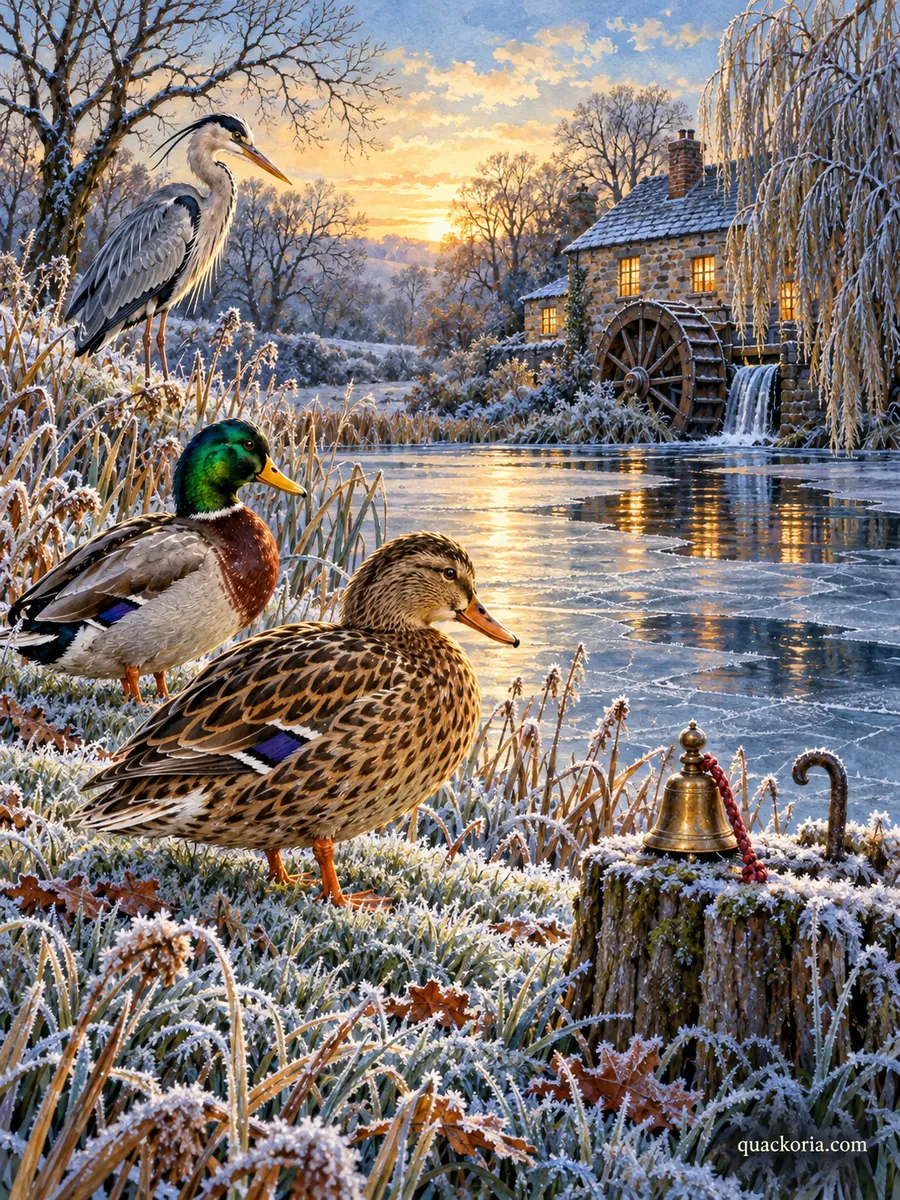
It hung from a bent iron hook at the end of the old landing: a little brass bell, green at the rim with age, tied to a faded red cord. Once, people had rung it to tell the miller that a boat was coming through. Now Nell rang it with her bill on the first morning of winter, Gideon rang it when a traveller needed help, and Pip rang it whenever he thought the pond was being too quiet.
Which was often.
“The pond does not require a bell every time you have an idea,” Nell told him.
“How else will it know?” asked Pip.
Nell gave him the look she kept for questions that had answers but did not deserve them.
The duck who disappeared
The traveller arrived on a cold bright morning, riding low in the water as if the pond had invited him closer than everyone else.
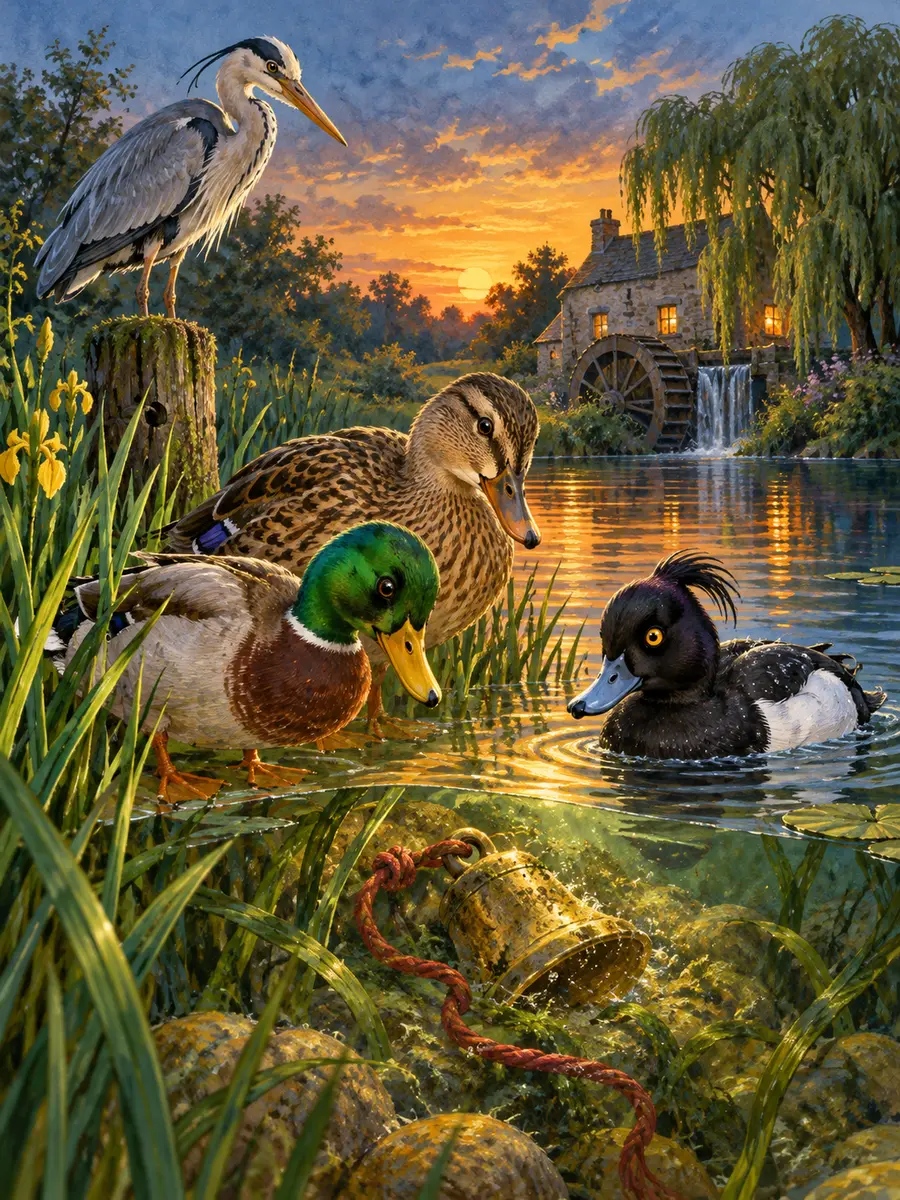
He was smaller than Pip, black across the head and back, white along the sides, with a neat feather crest that swept behind him. His yellow eye made him look as though he had just remembered a brilliant secret.
“Toby,” he said, after Gideon had lowered his long head from the post to ask his name. “Tufted Duck. I am stopping for breakfast.”
“There are good seeds under the willow,” Pip offered.
“Thank you,” said Toby. “I was thinking deeper.”
He took one easy breath, pressed his feathers close, and vanished.
There was no fuss. No great leap. One moment Toby was a duck on the pond; the next he was a dark shape slipping through green water. A necklace of bubbles followed him between the stems. He returned several wing-lengths away with a tiny water snail held delicately at the end of his bill.
Pip stared.
Toby swallowed his breakfast. “Something wrong?”
“Do it again.”
Toby did.
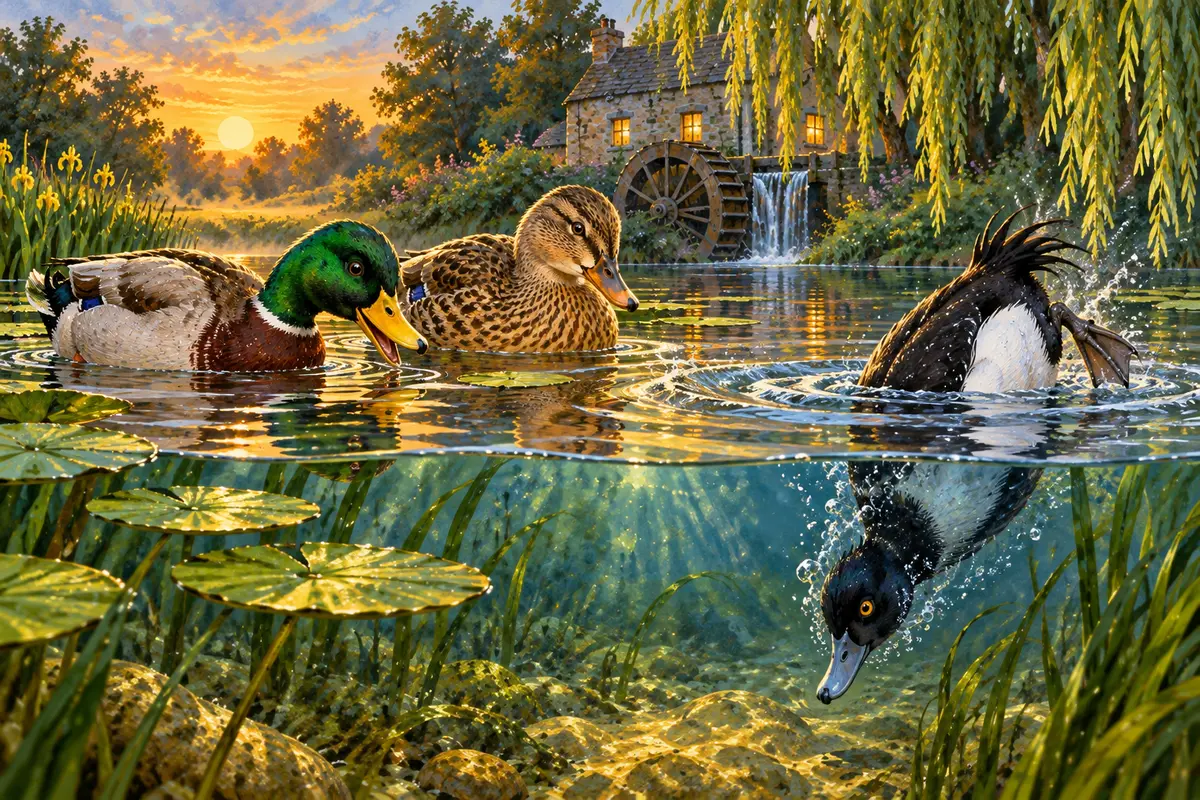
Pip watched the bubbles until they disappeared. He looked at Toby’s compact body and broad feet. Then he looked at himself: his high-floating chest, his orange legs, his perfectly respectable Mallard tail.
“I can do that,” Pip said.
Nell, who had heard those five words before, moved a little farther away.
Pip paddled to the deepest part of the pond. He lifted his chest, pointed his bill down and kicked as hard as he could.
His head went under. His shoulders followed. His tail rose like a small flag.
Then the pond pushed him back up.
He tried with more speed. He tried after a run. He tried closing one eye, then both, in case Toby’s secret depended on not seeing the water coming. Each attempt ended with Pip on the surface, wet around the face and exactly where he had started.
“You are very good at tipping,” Toby said kindly.
“I am not tipping. I am beginning a dive.”
“How long does the beginning last?” Nell asked.
Pip shook droplets from his head. “Until I have worked out the middle.”
For the rest of that day, he followed Toby. When Toby dived, Pip counted the bubbles. When Toby surfaced, Pip asked what he had seen: stones, roots, dark ribbons of weed, the old brick channel that carried water beneath the mill wall. Toby described a world that Pip had crossed every day and never entered.
By sunset, Pip wanted only one thing in all of Mill Pond.
He wanted to disappear.
The night the bell fell
The wind arrived after dark.
It came over the hill with its arms full of rain, shoved at the willow and flattened the reeds in silver waves. The pond rose against the banks. Water drummed on the mill roof and thunder rolled through the valley so slowly that Pip felt it through his feet.
Nell led him into the shelter of the thickest reed bed. Toby tucked close on the other side. Gideon crouched low on his post, wings open just enough to balance when the gusts struck.
“The bell!” Pip shouted.
At the end of the landing, the little brass bell swung wildly. Its red cord snapped straight, loosened, then twisted around the hook. Each gust pulled it farther.
“Leave it,” said Nell. “The landing is not safe.”
The hook bent.
For one bright instant, lightning turned the whole pond white. Pip saw every raindrop, every reed, Gideon’s spread feathers—and the bell falling.
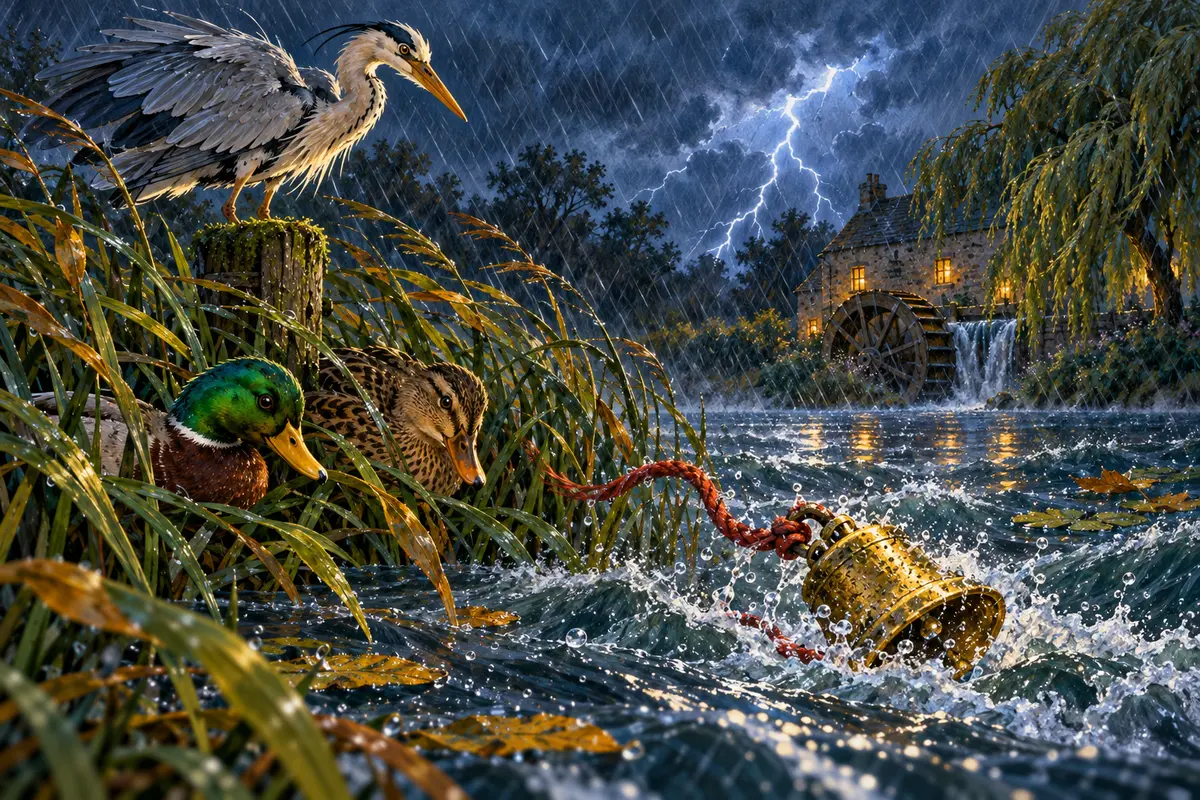
It hit the water once. A wave lifted it. The red cord made a crooked line across the surface.
Then the pond took it into the dark.
No one rang the bell that night. There was only the storm, making every sound at once.
By dawn, the wind had gone. It left broken twigs, yellow leaves and a pond twice as wide as the one Pip knew. The landing leaned. The iron hook pointed at nothing.
Pip swam to the empty place beneath it.
“We will find it,” Nell said.
Gideon stepped down from his post and studied the brown water. “If we find it today. The overflow channel is running. Anything loose may be carried under the mill wall before evening.”
Pip looked at the deep pool. Yesterday, it had been a place to practise. Today, it held something that belonged to all of them.
Beside him, Toby took a breath.
“I will search below,” he said.
“So will I,” said Pip.
A search in the wrong place
They began where the bell had fallen.
Toby worked in widening circles. He dived beneath the floating leaves, searched along the old landing piles and came up to report what he found. A spoon. Two smooth stones. Half a flowerpot. No bell.
Gideon flew once around the pond, slow and high, looking for a flash of brass in the shallows. Nell followed the banks, checking every place the red cord might have caught.
Pip tried to dive.
He forced his head and shoulders under. He kicked until his feet slapped the surface. For a moment he saw green darkness and a storm of his own bubbles. Then his chest lifted and the world threw him back into daylight.
Again.
This time he filled his lungs, thinking more air would make him stronger. It made him float better.
Again.
He rushed forward, folded himself down and managed one full heartbeat beneath the surface. When he came up, a leaf was stuck to his head.
Nell plucked it off.
“Pip.”
“I nearly had it.”
“You nearly had a leaf.”
“The bell is down there.”
“Perhaps. Toby is looking down there.”
Pip glanced across the pond. Toby vanished again, exactly as he had the day before. It looked effortless. That made Pip angrier than if it had looked hard.
“I can help.”
“You can,” said Nell. “But you are trying to help in Toby’s shape.”
“It is called diving.”
“It is called doing the one thing somebody else is already doing.”
Pip pushed past her and tried once more near the broken landing. The storm current caught his tail. Not strongly, but enough to turn him sideways. He came up spluttering, several body-lengths from where he had gone under.
Nell was beside him at once.
“That is enough.”
“I am fine.”
“Good. Be fine on the surface.”
She said it quietly, which was worse than shouting.
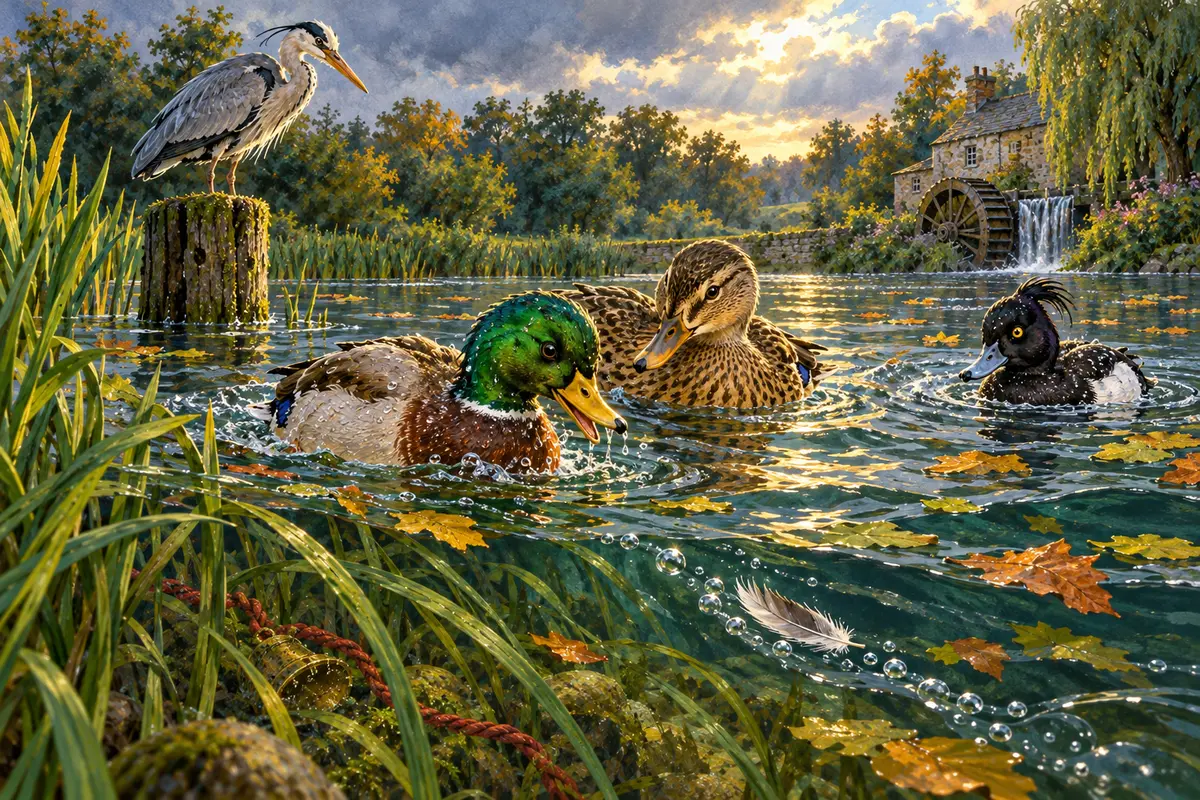
Pip drifted away from the landing. Toby surfaced and shook his crest. Gideon returned with nothing. The pond carried leaves past them in a slow, untidy crowd.
“Deep pool is clear,” Toby said. “I searched the bottom twice.”
“Then the current has it,” said Gideon. “We should look at the channel mouth.”
Pip stared at the water.
The bell had fallen here. Toby had searched here. Therefore, thought Pip, the bell was not here.
It was not a grand thought. It was hardly a thought at all.
But it was the first thought he had made that morning which was not about diving.
What the water was saying
Pip watched a pale feather turn beside him.
It drifted towards the mill channel, as Gideon had said. Then it met a patch of darker water, swung around, and came back along the reed edge.
Pip followed it.
At the broken landing, the surface ran fast. Along the far bank, it ran faster. But behind the reed bed was a quiet loop where leaves gathered and little bubbles rose between the stems.
“Nell,” Pip called. “Do feathers swim upstream?”
“Not when I last asked one.”
“This one came back.”
Gideon stepped from the post to the bank. Toby paddled over. Together they watched the feather make the same slow circle.
“An eddy,” said Gideon. “Water curling behind the reeds.”
“If the bell went towards the channel—” Pip began.
“The cord might have trailed into the curl,” Nell finished.
Toby dived at the outer edge. He returned quickly. “Too tight underneath. Roots everywhere.”
The gap between the reed stems was shallow. Far too shallow for Toby to swim through. It was barely deep enough for Pip’s body, but that had never stopped him feeding there. He knew how to slide between stems without making them shake. He knew how to push aside floating leaves with his bill. He knew how to tip forward and reach into the mud while his feet held him steady.
Pip looked at Nell.
She did not say anything.
She did not need to.
He entered the reeds.
The storm had pressed them into a green roof. Pip flattened his body and nosed beneath. Stems whispered along his back. The water smelled of rain, roots and turned-up mud.
There—a bubble.
Then another.
They came from under a raft of leaves. Pip pushed the leaves aside. Something red flickered below, vanished, then appeared again.
The cord.
He plunged his head under and reached. His bill closed on weed. He came up, spat it away and tried from a different angle.
His head and neck went down. His tail went up.
He was tipping.
He was very good at tipping.
On the third try, the rough red cord touched the sensitive edge of his bill.
Pip closed gently and pulled.
The cord tightened.
Farther out, something moved beneath the water with a dull golden flash.
“Found it!” Pip shouted, which came out as “Ffmm mm!” because the cord was still in his bill.
Nell understood him anyway.
Four ways to find a bell
The bell had not gone into the mill channel. Its cord had looped around a root in the reeds while the heavy brass body rolled back into deeper water. Pip could reach one end. Toby could reach the other. Between them was a knot of pondweed pulled tight by the current.
“Do not all pull at once,” Gideon warned. “You will tighten it.”
He walked along the bank until he stood above the root. His long bill parted the reeds without trampling them.
“Pip, hold the cord where it enters the shallows. Nell, take the slack when he brings it to you. Toby, the weed is wrapped around the bell handle below the drop. Can you loosen it rather than lift it?”
Toby’s golden eye brightened. “That is a better question.”
He dived.
Pip tipped, found the cord again and walked backwards through the shallows. It scraped over a stone and slipped. Nell caught it before it sank, pinning it gently against the mud with the broad edge of her bill.
Gideon lifted a loop clear of the root.
The line went slack.
Below, a cloud of silt billowed around Toby. Pip could see only the white patch of his side, then one black foot pushing at the water. A stem of weed floated up. Then another.
Toby surfaced with pondweed across his crest.
“It is free,” he said. “It is also extremely heavy.”
“Heavy comes after tangled,” said Nell. “One problem at a time.”
They pulled.
Pip walked backwards until his feet found firm mud. Nell gathered the cord so it could not slide away. Gideon lifted it over the reeds. Toby stayed beside the bell, nudging it over stones whenever its rim caught.
For three breaths, nothing seemed to happen.
Then the red line moved.
A golden curve appeared beneath the surface. Water poured from the bell’s mouth. Toby pushed, Pip leaned, Nell held, Gideon lifted—and the bell rolled out of the deep groove into the sunlit shallows.
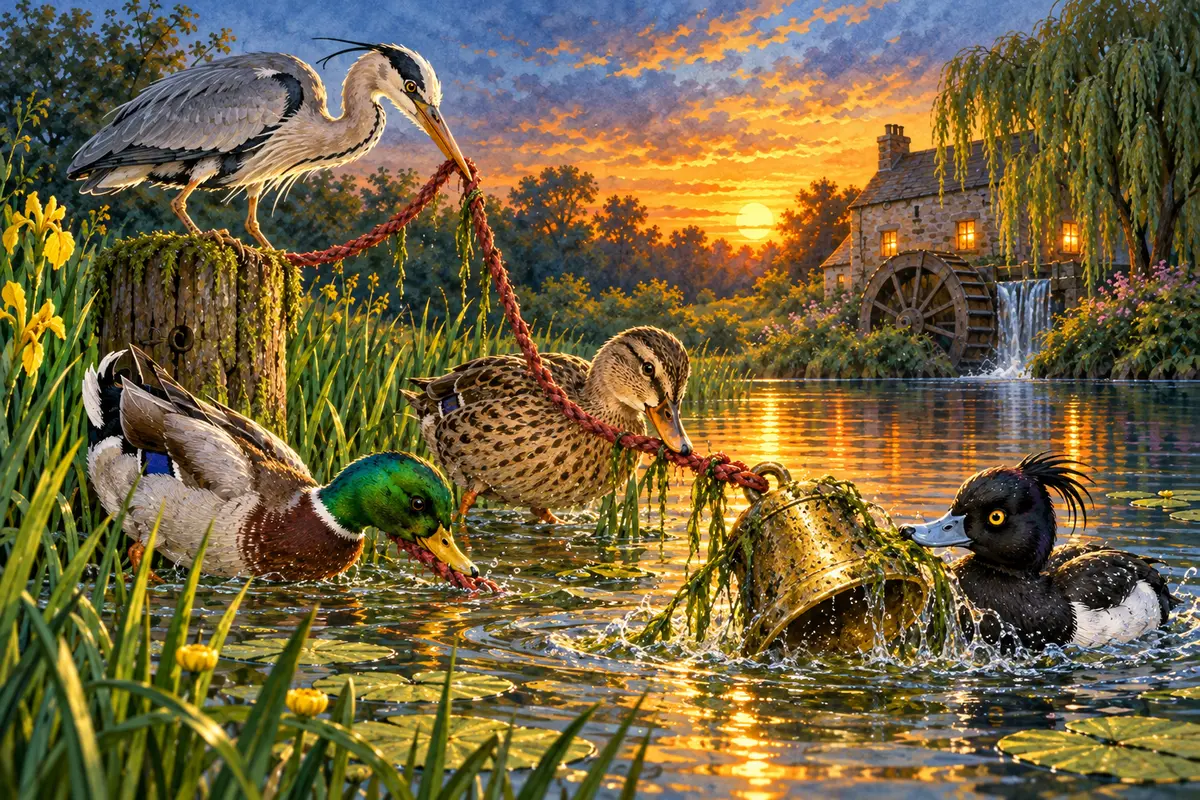
It was scratched. It was muddy. A little more green had come away from the rim.
It was also home.
Pip let go of the cord and laughed so hard that no sound came out. Nell pressed her bill against his shoulder. Toby shook the weed from his crest with as much dignity as the weed allowed. Gideon carried the end of the cord back to the post.
They could not hang the bell from the bent hook. Instead, they set it on the broad stump beside the landing, where the afternoon sun warmed it and tiny streams ran from its rim.
The sound of home
By evening, the high water had begun to fall.
The pond settled. Leaves collected along the banks. The old mill wheel gave one low groan as water pressed through it, and the sound rolled across the reeds like a sleepy answer.
Toby would leave in the morning. Travelling ducks rarely stayed just because a pond had become interesting, though Toby admitted Mill Pond was more interesting than most.
“Will you teach me to dive before you go?” Pip asked.
Nell turned her head.
Pip grinned. “I am joking.”
“Mostly?” said Toby.
“Mostly.”
Toby thought about it. “I could teach you what the deep water looks like. You could teach me how to find breakfast in six inches of mud without getting my crest full of it.”
“That may be impossible,” said Nell.
“Some of us have impressive feathers,” Toby replied.
Gideon lowered his head to the bell. “Pip found the cord. Toby freed the bell. Nell kept it from sliding away. I lifted it over the root.”
“A very long way of saying I found it,” Pip said.
“A precise way of saying no one found it alone.”
Pip considered this. He looked across the pond: the deep pool where Toby could vanish, the shallow reeds where Nell and Pip could feed, the high posts from which Gideon saw the shape of everything. Yesterday, the differences had felt like a list of things Pip could not do.
Today, they looked more like a plan.
“The pond would be a poor place if every bird did the same thing,” Nell said.
“It would be quieter,” said Gideon.
“Too quiet,” Pip decided.
He took the faded red cord in his bill.
The bell was no longer hanging, so he had to brace one foot against its rim and pull sideways. The first attempt made a dull clunk. On the second, the bell tipped.
Its note rang across Mill Pond—scratched, muddy and clear.
The willow gave it back. The mill wall gave it back. Even the dark mouth of the channel returned a small silver echo.
This time, Nell did not tell Pip the pond had been quiet enough.
This time, the pond had earned a bell.
Characters in this story
- Pip — a curious Mallard who acts before his questions are finished
- Nell — Pip’s steady, sharp-eyed Mallard friend
- Toby — a visiting Tufted Duck at home in deep water
- Gideon — the Grey Heron who watches Mill Pond from above