Quackoria Stories Mill Pond Stories
Wren and the Long Way South
Wren has lost her flock, but admitting it feels harder than flying on alone. At Mill Pond, Pip, Nell and Gideon help her turn an impossible journey into a next step she can recognise.
Wren arrived at Mill Pond with a piece of somebody else’s answer.
“Follow the water,” an older bird had told her.
It had sounded wonderfully simple above the wide river. Then rain had swallowed the hills, the flock had turned beyond a stand of trees, and Wren had followed a shining strip of water into a valley where no one was waiting.
Now the water ended at an old stone mill.
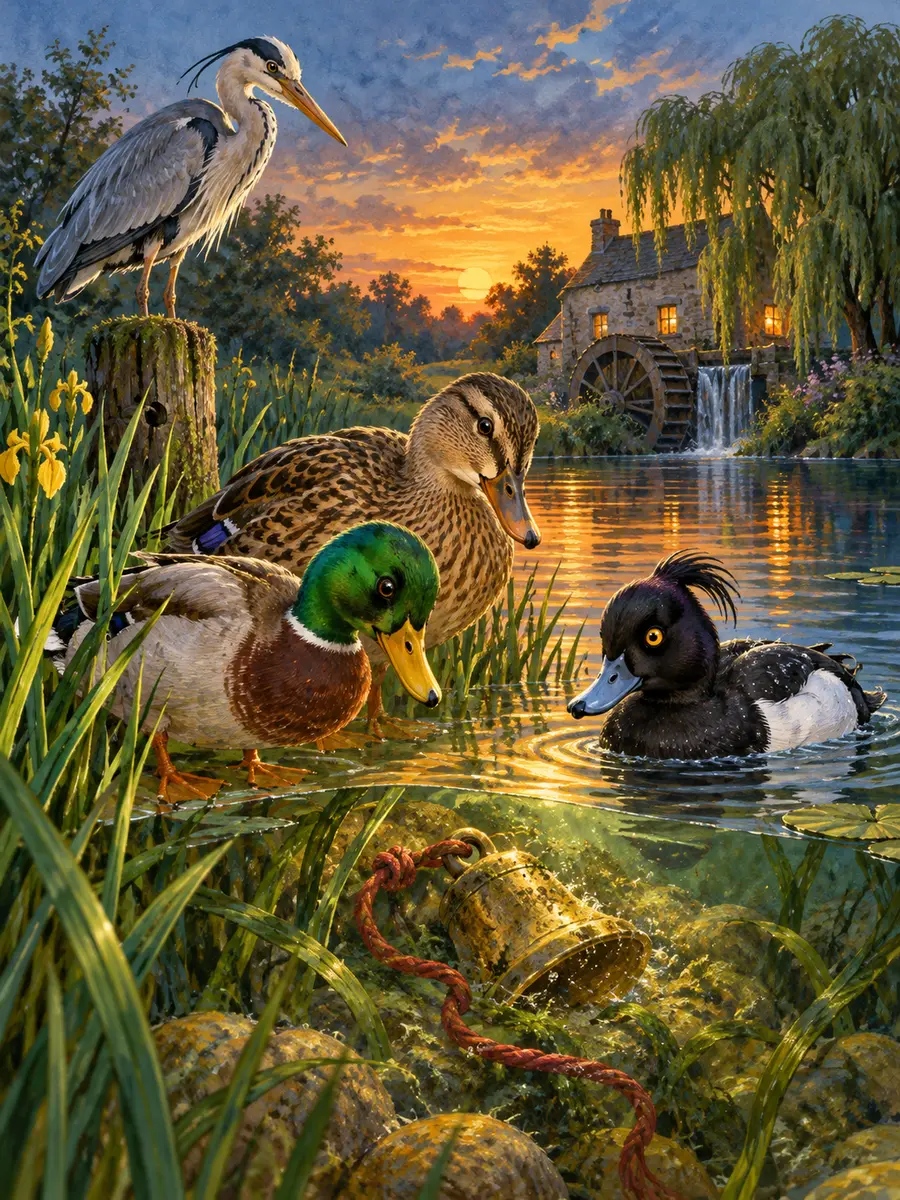
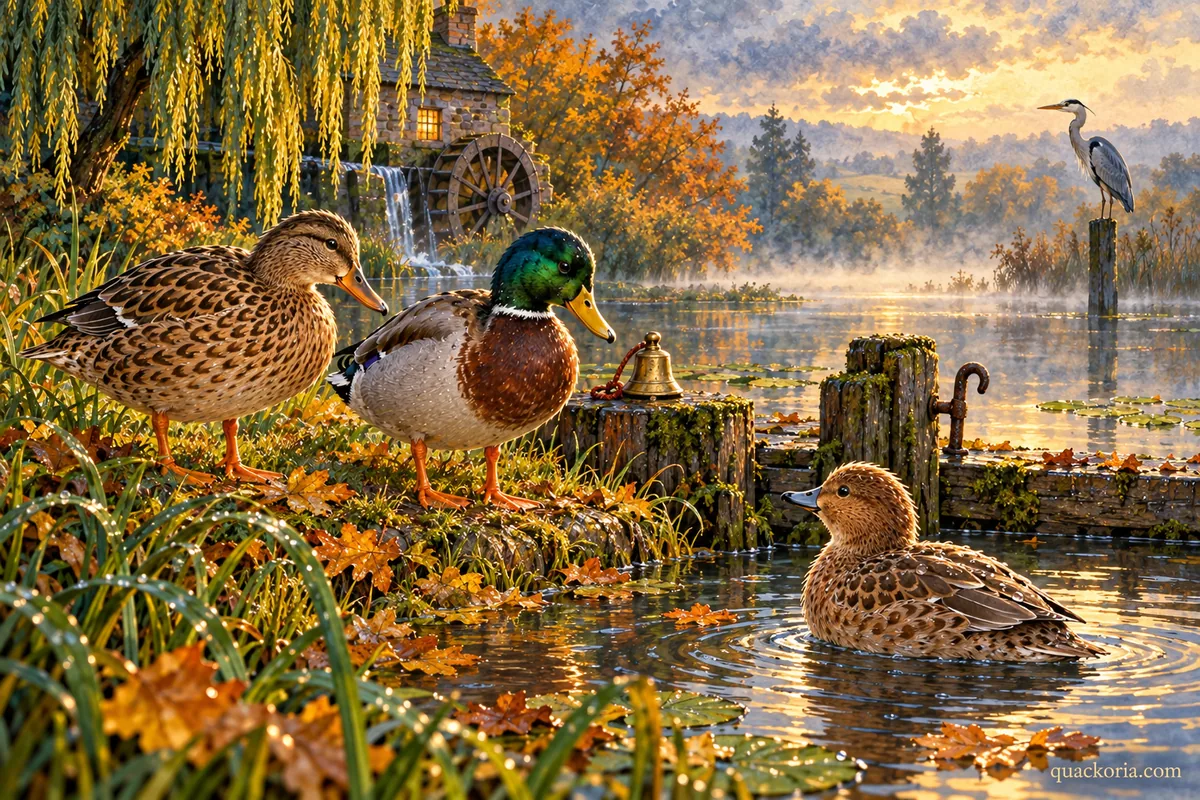
A green-headed duck stood beside a brass bell on a stump. He appeared to be explaining something important to it.
Wren landed with a splash that interrupted them both.
“South?” she asked.
The duck looked behind him.
“Pip,” he said. “Unless you were asking a question.”
She folded her wings too quickly. One feather stuck out. She tucked it away.
“I am travelling south.”
“You have reached a very good pond.”
Wren looked at the mill wall. Water went beneath it into a dark channel scarcely wider than a duck’s outstretched wings.
She had followed the water. She had done exactly what the answer said.
“Yes,” she replied. “I can see.”
A visitor with no questions
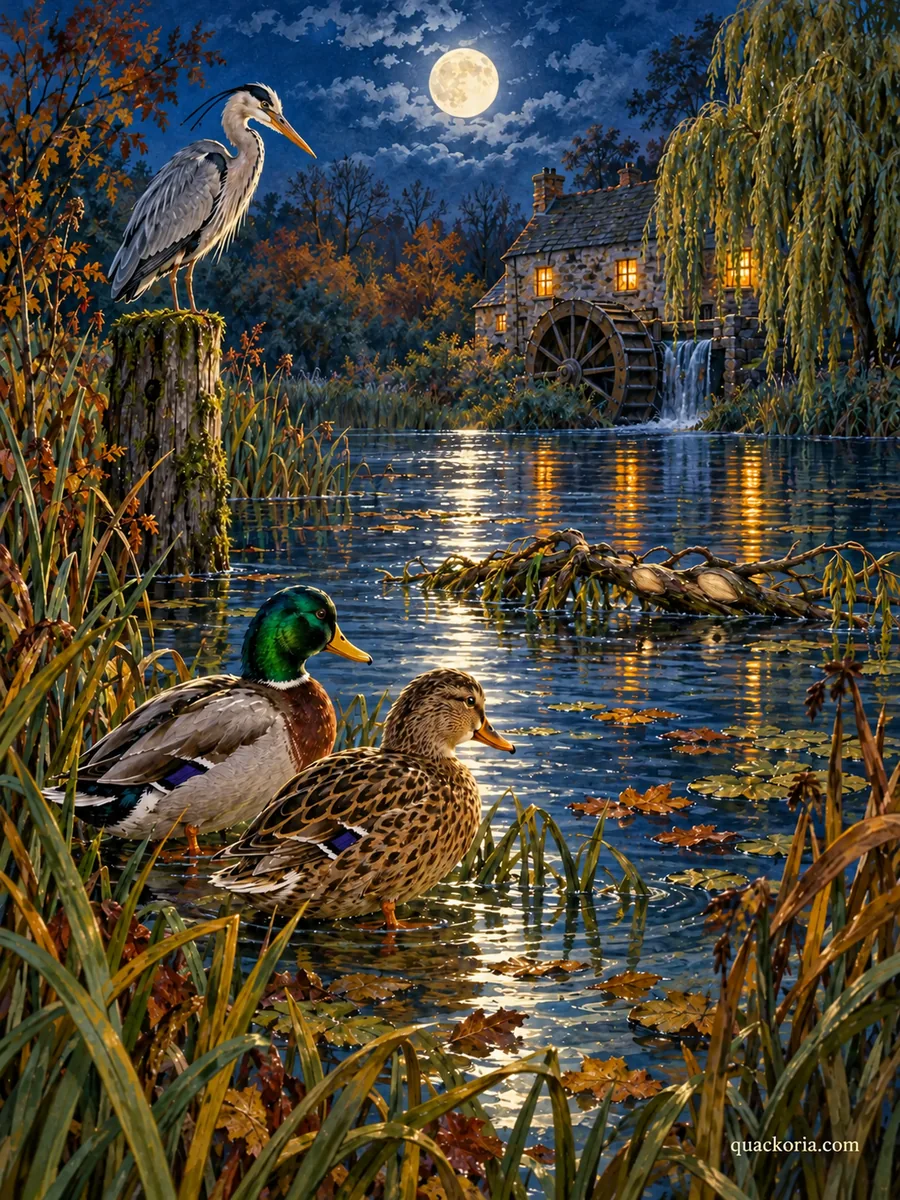
Nell came from beneath the willow, where three Mallards were still resting after a disturbed night. A forked branch lay across the old reed entrance. Its two pale knots looked entirely ordinary in daylight, which Pip found slightly unfair.
He introduced the newcomer before Nell could ask.
“This is—”
“Wren.”
“Wren. Going south.”
Wren was smaller and rounder than Nell, with warm brown feathers, a short blue-grey bill and an expression that kept arriving a moment before her words.
“A Wigeon,” said Gideon from his post.
“Yes.”
“Travelling alone?”
“Only just now.”
She hoped that sounded like a choice.
Nell showed her the shallow margin. Wren drank, washed rain from her face and discovered she was hungry enough to forget being embarrassed. There was short grass on the bank. She climbed out to feed while Pip described the pond.
He described the landing, the deep pool and the mill wheel. He explained why the bell was on the stump and why its hook was bent. He began to explain the previous night’s mysterious eyes.
“They were a branch,” Nell said.
“Eventually,” said Pip.
Wren laughed despite herself. It surprised her to find a laugh still available.
“Where are your flock stopping?” Nell asked.
The laugh disappeared.
“Farther along.”
“Along which water?”
“The main water.”
Pip looked at the pond, which was the main water as far as he was concerned.
Gideon lowered his head. “There is a river beyond the eastern rise. This pond is fed by a smaller stream. They are not the same way through the valley.”
Wren bent to pull at a blade of grass. It was harder to eat now.
“I know,” she said.
She wished she had said something else.
The wrong silver ribbon
By midday, the rain had thinned to mist.
Wren stood on the landing and tried to put the journey back in order. A broad bend. A pale field. Two tall trees standing together. Then the flock turning through rain.
There had been a low whistle ahead of her. She had answered. A gust had pushed at her wings, and by the time she levelled out, the birds in front were gone.
She had seen water shining between trees and taken it for the river.
Now she remembered the older bird’s whole sentence. Follow the water until the pale poplars, then keep with us over the bend.
She had kept the easy part.
“You are looking very hard at a wall,” Pip observed.
“I am thinking.”
“I sometimes do that facing a wall. Fewer distractions.”
She almost smiled again.
Beyond the landing, a gust swept the mist aside. On the western hillside, a narrow line flashed silver.
Water.
“There,” Wren said.
Pip followed her gaze. “That is the meadow ditch.”
“It goes past the hill.”
“Partly.”
But she was already spreading her wings. If she could find the river herself, she would not have to explain how she had lost it. She would not have to watch another bird become careful and kind around her.
She flew towards the silver line.
Pip called after her. The air carried his voice away.
The ditch was smaller from above. It ran between two hedges, widened at a muddy crossing, then disappeared into a pipe beneath the farm track.
Beyond the track there was a field, a hedge and no shining water at all.
Wren circled once. Wind pushed her sideways. She turned back towards the mill before she could make herself keep going.
Returning felt longer than leaving.
She landed beside the willow with her chest working hard. Pip was waiting on the bank. Nell stood a little behind him.
“It ended,” Wren said.
“Yes,” said Pip.
There was no triumph in his voice. That made her feel worse for a moment, then unexpectedly better.
“I thought it was another way.”
“There is another way,” Nell said. “We have not found it for you yet.”
What Wren had left out
The words came while they were all looking at the water.
“I do not know where my flock went.”
No one answered immediately.
Wren had expected surprise. Perhaps a lecture about watching where she was going. Instead, Nell moved a little closer.
“When did you last see them?”
Wren told her about the river bend and the rain. She described the pale field, the pair of tall trees and the whistle she had answered.
“I thought everyone else knew the whole way,” she finished. “They flew as if they did.”
Gideon stepped down from his post.
“Some may know that river well.”
“And the others?”
“You will have to ask them.”
Pip looked at the bent bell hook. “Yesterday I thought keeping watch meant never needing anybody to tell me anything.”
“How did that go?”
“Very noisily.”
Nell gave a small snort.
Wren looked from one to the other. They were not pretending nothing had happened. They were allowing it to be something that had happened, rather than everything she was.
“The poplars,” Gideon said. “Were they on the outside of the bend, with a white bank below them?”
“Yes. One had a broken top.”
“I know a place that fits. I fish near it sometimes.”
Wren’s body lifted before her feet moved.
“Can you take me?”
“When I can see the way clearly.”
The hill was disappearing behind another grey curtain of rain.
Wren looked up at it. Waiting felt dangerous. Every moment might carry the flock farther away.
“I could try above the mist.”
Gideon shook rain from his bill. “I cannot tell you where the top of it is. I can tell you there is food here, and shelter. I am staying until this squall has passed.”
He said it as a decision about himself. Wren found that easier to hear than an order.
Nell led her back to the short grass.
“Eat while we wait.”
Wren took one mouthful. Then another. The rain stitched little circles into the pond.
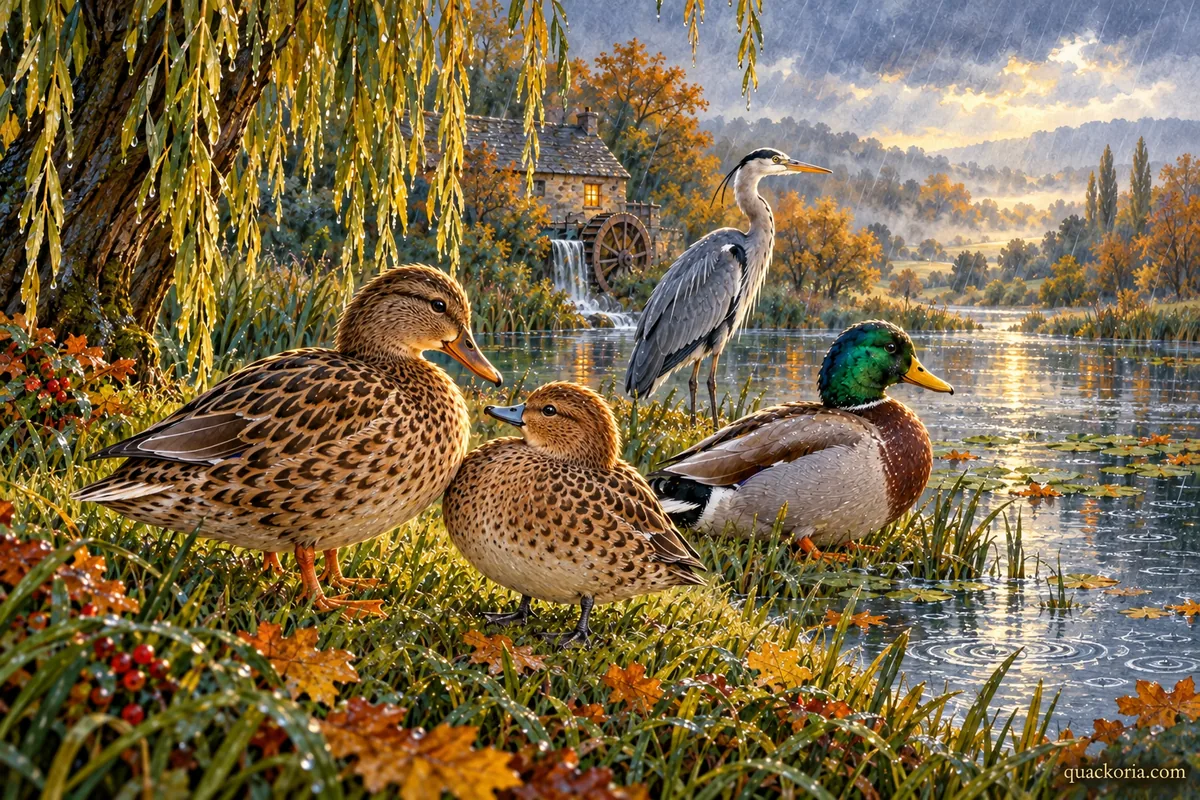
She told them about the place she had left: flat water, cold mornings and reeds that seemed to go on for ever. She had not expected to miss the sound of wind in those reeds. At Mill Pond it sounded different, broken into smaller whispers by the trees.
“Will you go back?” Pip asked.
“I hope so.”
It was the first answer she had given that day without trying to make it bigger.
Three things she could recognise
In the afternoon, a line of brightness opened beneath the clouds.
Gideon flew to the ridge and returned with news. The river was visible. A group of ducks was feeding on the grass beyond the double poplars. They were too far away for him to recognise as Wren’s companions.
“But they are worth asking,” he said.
Wren stood. Her legs felt steadier.
Pip and Nell would come as far as the low rise. Gideon would lead Wren from there to the river. They would make the journey in two short flights, stopping to look before going on.
“You do not have to come,” Wren told Pip.
“I know. I have spent a great deal of my life looking at this pond. I would like to look back at it.”
They lifted from open water.
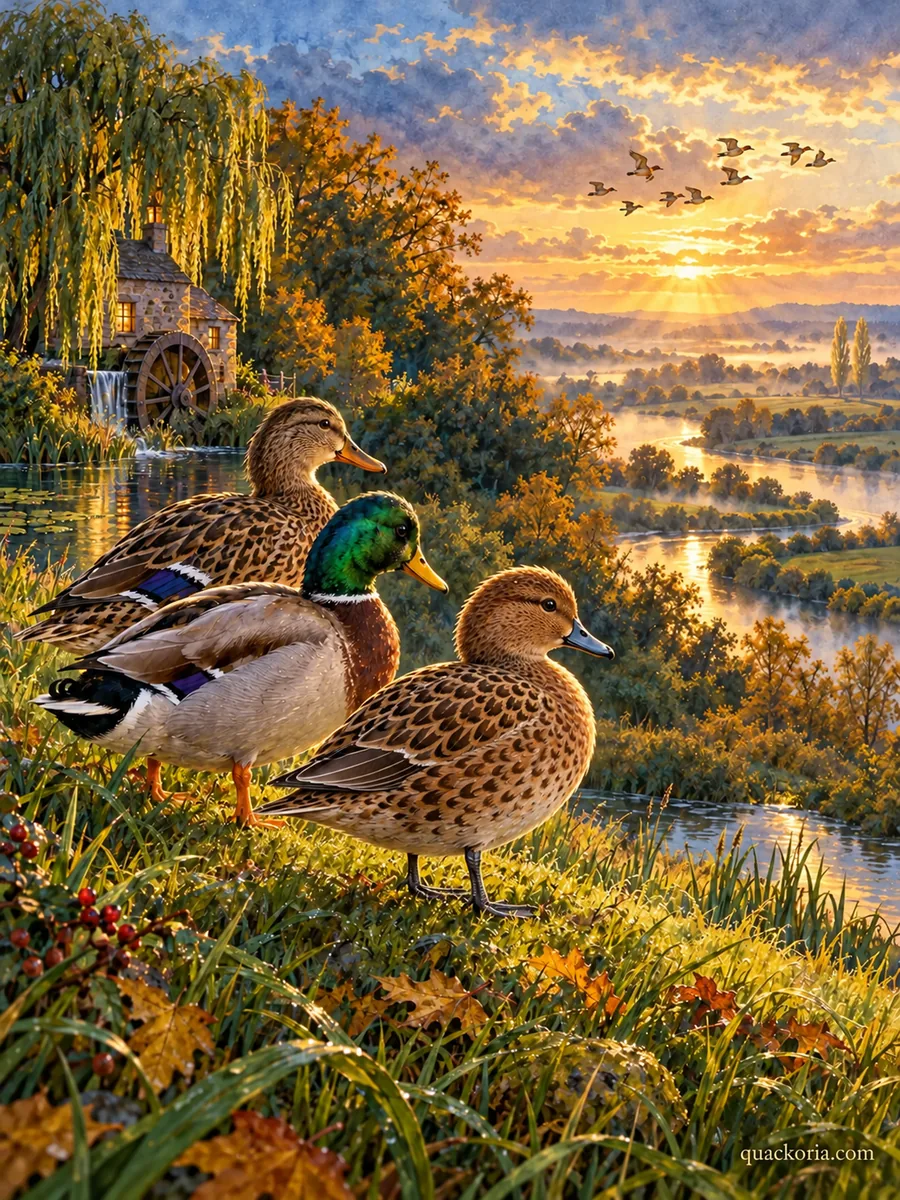
From above, the landing became a brown line. The bell shrank to a warm speck beside it. The crooked branch still guarded the old reed entrance, while the resting ducks made dark commas under the willow.
Wren followed Nell to the rise and landed in wet grass.
The valley opened beyond them.
There was the river, wide and moving. There was the meadow ditch too, thin as a scratch between hedges. From here they could not be mistaken for one another.
She had not needed better eyes at the landing. She had needed a different place to look from.
Gideon pointed towards two pale trees beyond the river bend.
“Do you recognise them?”
Wren studied the pair. One stood straight. The other ended abruptly against the sky.
“The broken top,” she said. “That is it.”
“What else?” Nell asked.
“The white bank below.”
“And between here and there?”
Wren looked carefully. A dark hedge crossed the meadow, but a gap near the river showed a pale muddy track.
“The opening in the hedge.”
Three things she could recognise. The hedge gap, the pale bank, the broken poplar. For the first time since the rain, the distance had pieces she could hold.
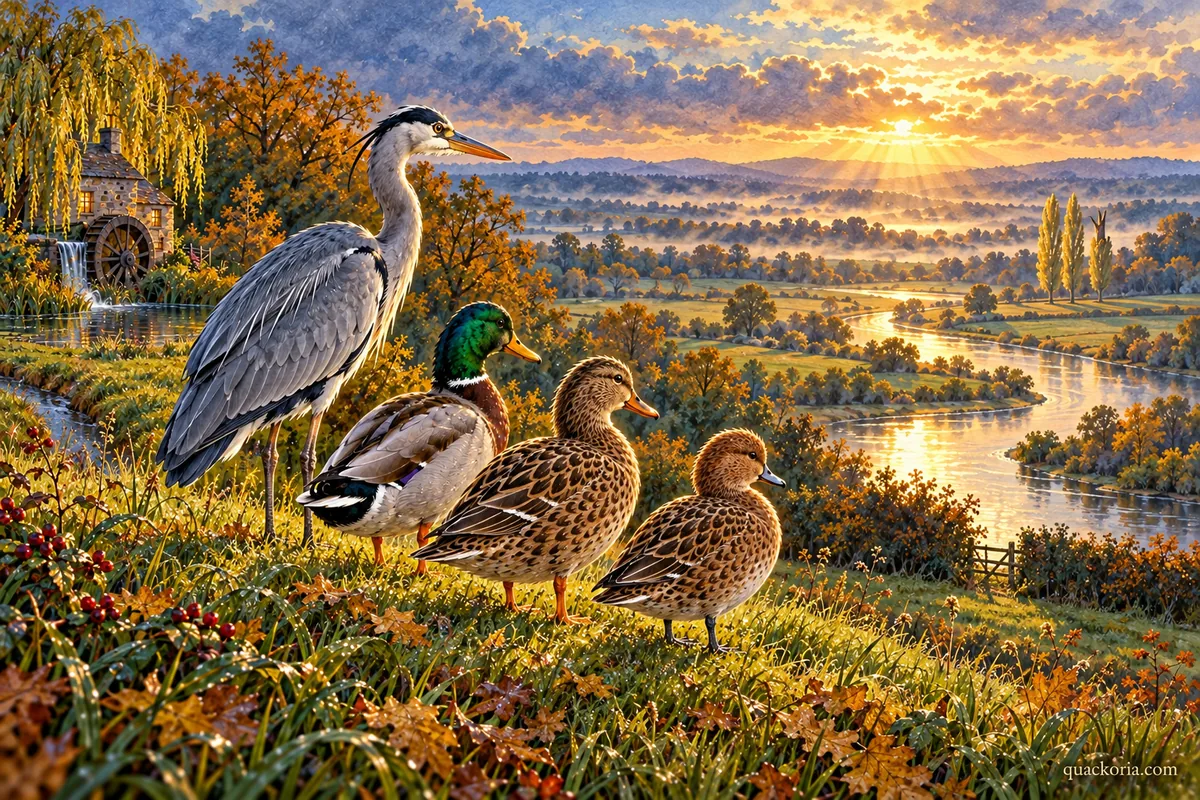
Pip watched a small flock wheel above the river.
“That still looks like a very long way.”
“It is only the next bit,” Wren said.
Then she heard herself and turned towards Gideon.
“Is that right?”
“For this afternoon,” he said, “that is exactly right.”
The flock beyond the bend
Gideon rose first. Wren followed, with the river on the side he had shown her.
At the hedge gap, a gust lifted her left wing. For a heartbeat she saw the ditch flash behind her, a silver invitation to make the same mistake.
She levelled out and looked ahead.
The pale bank. The broken poplar.
Gideon slowed until she was beside him.
“Still with me?”
“Still with you.”
They crossed the bend and descended towards the grassy margin. Below them, brown ducks lifted their heads. A chestnut-headed male with a pale forehead gave a short whistle.
Wren answered before she had time to be afraid of being wrong.
An older brown female pushed through the flock.
“Wren?”
Wren landed so suddenly that she slid a little on the wet grass.
“Mara.”
For a moment, they stood bill to bill. Mara touched the side of Wren’s neck. Wren discovered she was shaking.
“We waited below the bend,” Mara said. “Then moved out of the wind. Where did you go?”
“The wrong water.”
She could have left it there. It was nearly enough. It was the sort of small answer she had been carrying all day.
She looked back at Gideon.
“And when I found a pond, I pretended I knew where I was going. Then I tried another wrong water because I did not want to ask.”
Mara let out a long breath.
“I should have checked who was behind me when we turned.”
Wren stared at her. The older bird was tired too. There was mud on her breast, and a feather near her shoulder sat crookedly. Until now Wren had remembered only how certain she had looked in flight.
“Did you always know the way?”
“This stretch? I know it better than you do. All the way? No.”
A male Wigeon nearby went back to cropping the grass. Another bird shook rain from her back.
The flock had not become less real because someone had admitted that.
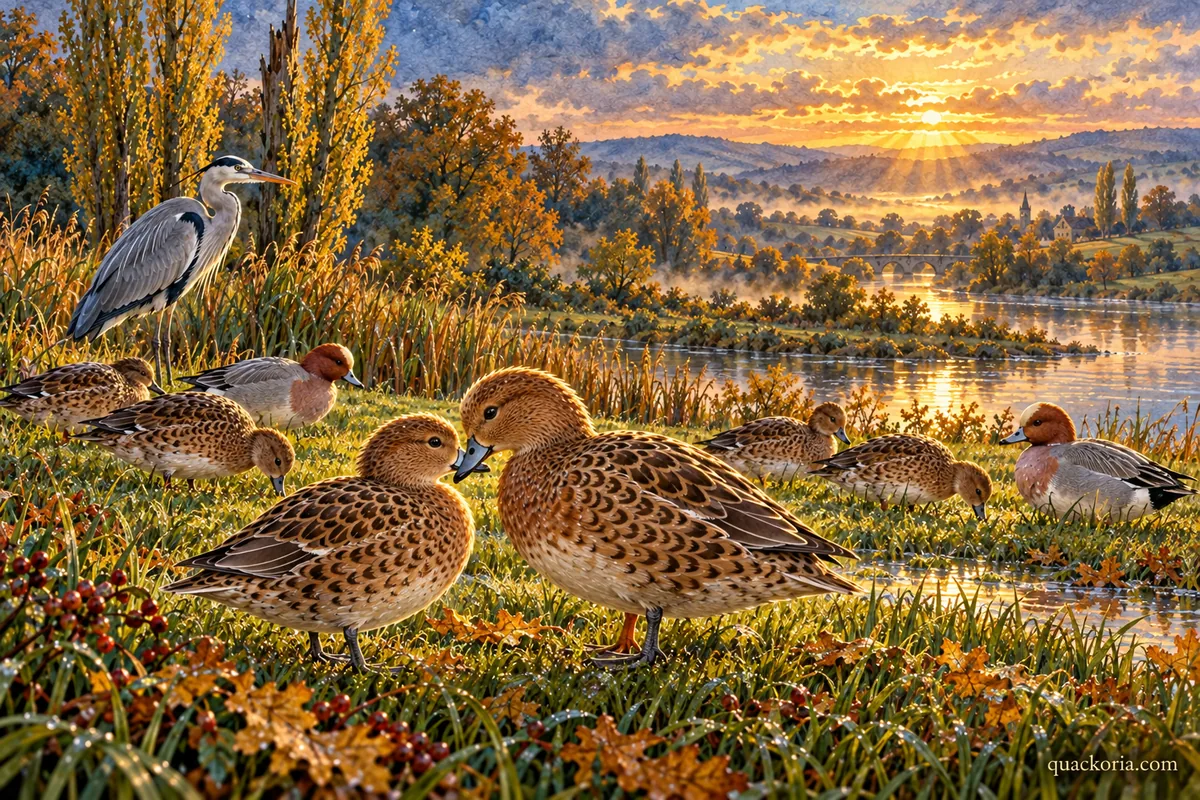
Gideon watched until Wren was settled among them.
“I will go before the light goes,” he said.
Wren stepped towards him. “Will you tell Pip and Nell?”
“That you found your flock?”
“And that they found me.”
He inclined his long head. “Both seem accurate.”
The next stretch of sky
The flock stayed at the river margin that evening.
Wren ate beside Mara and listened as the older birds discussed the next stretch: open water farther down the valley, a sheltered place to feed, and a decision in the morning when they could see what the weather was doing.
She asked which side of the river they would follow.
One bird answered. Another disagreed about the feeding place. They talked until Wren understood both the route they intended and what might make them change it.
No one laughed at her questions.
Later, when the clouds broke and the first stars appeared, she thought about Mill Pond. Pip would probably be telling the bell that a Wigeon had come and gone. Nell would correct at least one part of the account. Gideon would have reached his post.
The little pond had not been the way through the valley. It had still become part of her journey.
At dawn, the river lay clear between its banks. The wind had eased.
Mara came alongside her.
“Ready for the next stretch?”
Wren looked downriver, then back at the birds gathering behind them.
“Which bend do we stay together past?” she asked.
Mara showed her.
They rose from the water in a rush of wings. Wren took her place near the older bird, with room to see ahead and room to look across at the others.
Beyond the first bend, the river shone under a low gold sky.
She did not know every place it would lead her.
“Still with me?” Mara called.
Wren answered clearly.
“Still with you.”
Characters in this story
- Wren — a young female Eurasian Wigeon separated from her travelling flock
- Pip — the curious male Mallard at Mill Pond
- Nell — Pip's steady female Mallard friend
- Gideon — a local Grey Heron who knows the nearby river
- Mara — an older female Eurasian Wigeon travelling with Wren's flock