Quackoria Stories Mill Pond Stories
Nell and the Last Open Water
Nell knows every feeding place and sheltered corner of Mill Pond. When a hard cold spell begins to close them, the friend who usually has an answer must learn how to leave without knowing everything ahead.
Nell knew something was wrong when the willow stopped reaching for her.
Every morning, its lowest twig drew a wavering line beside the bank. Nell liked to pass beneath it on her way to the shallows. On still days the line trembled. In wind it broke into a hundred pieces.
Today it did neither.
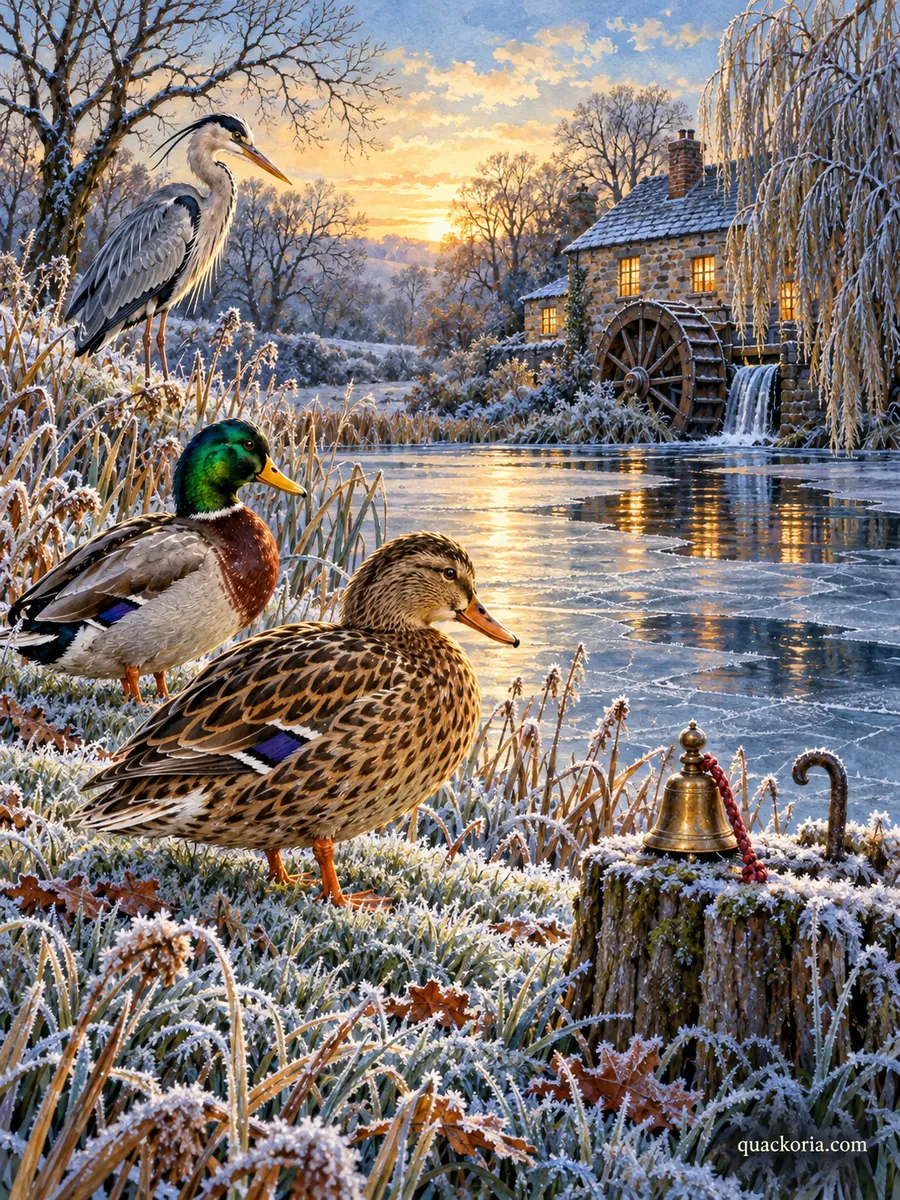
The twig ended at a pale, unbroken surface.
Nell watched a leaf rest on that surface instead of floating through it.
Ice.
Behind her, Pip came splashing out of the open pool.
“The landing has turned white,” he announced.
“So has the bank.”
“I noticed the landing first.”
She almost smiled. Then she looked back at the leaf.
It was a little thing, that stillness beneath the willow. By evening she would understand how much of a pond could begin to change in a little thing.
The shape of the cold
The cold had come quietly after days of hard, clear skies.
Winter’s first bell was already a memory. Rafael had visited again after that morning’s gathering, but today the big Muscovy was at his smallholding upstream. Wren and Mara were somewhere beyond the valley. Toby had not returned.
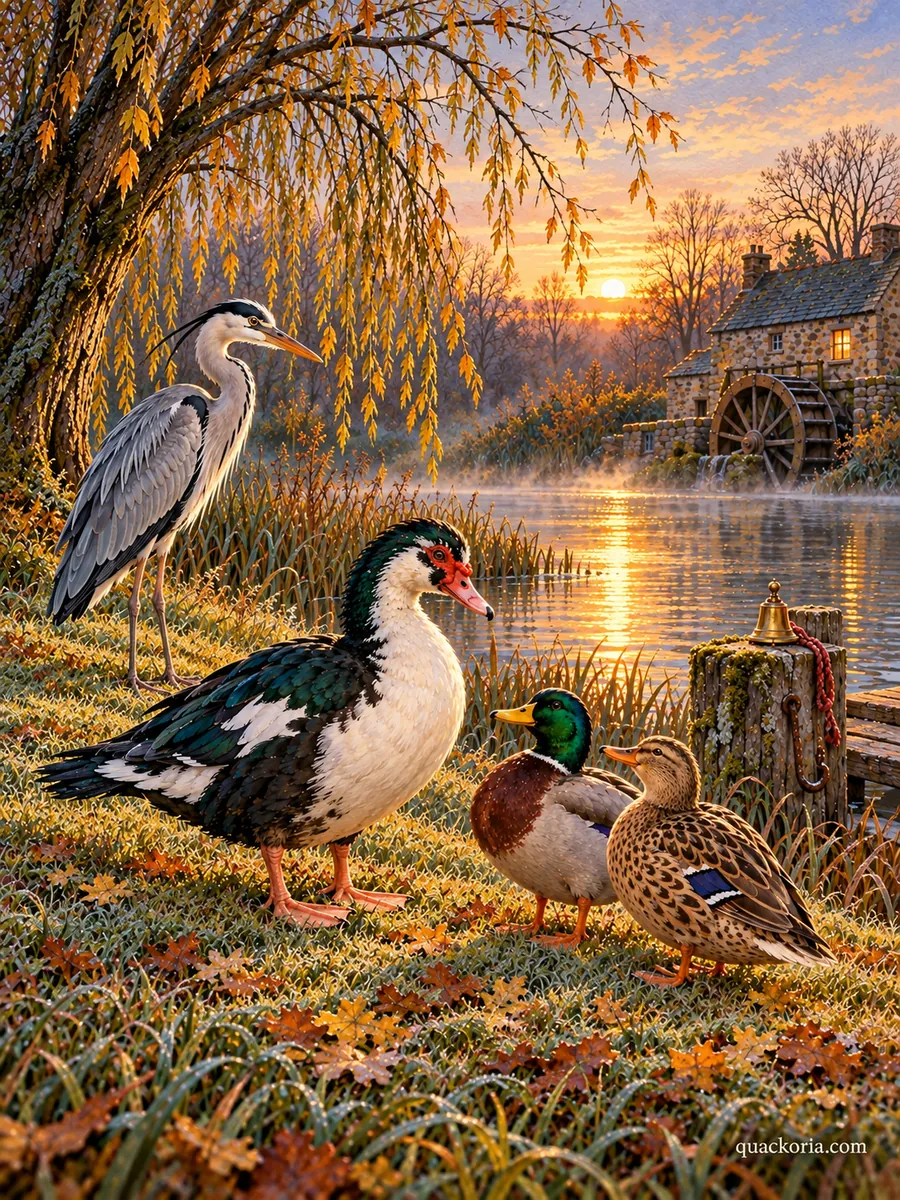
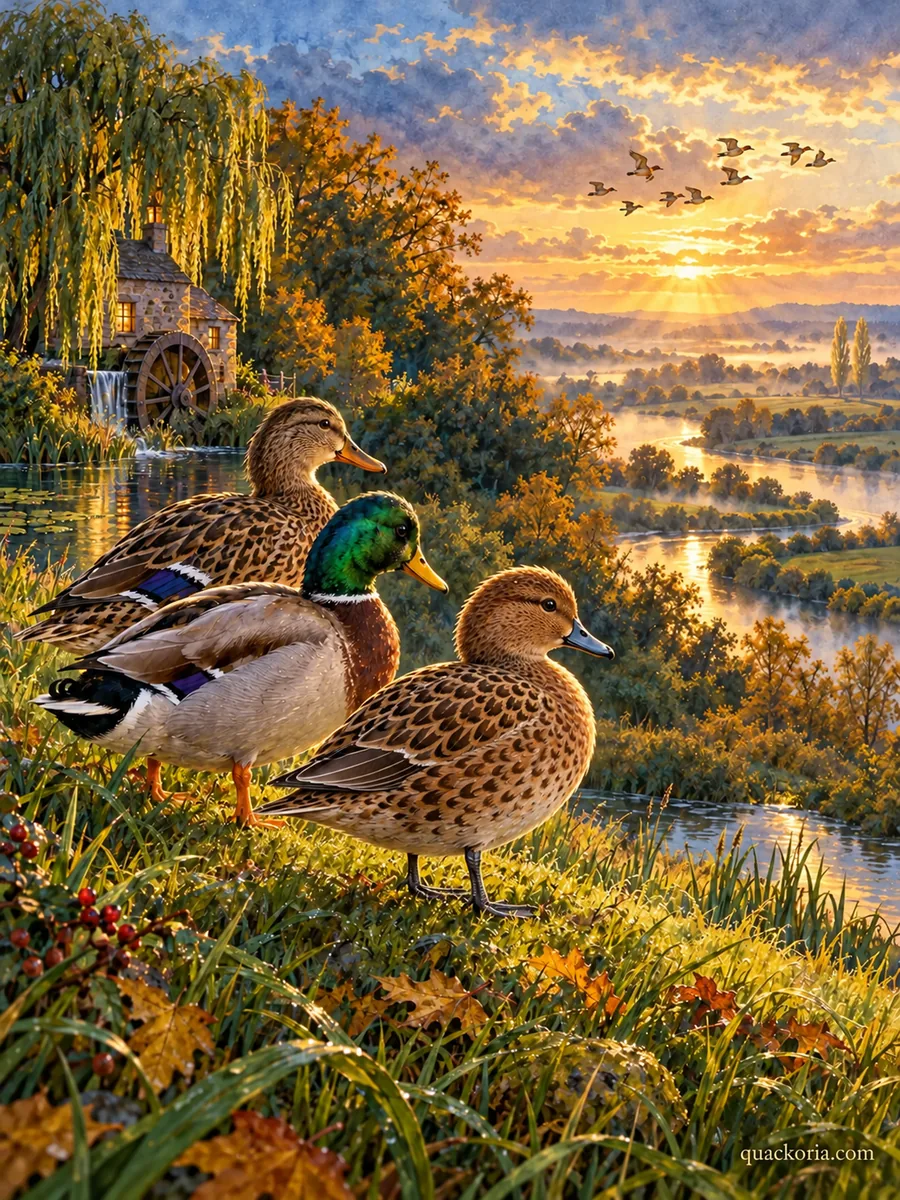
There were five Mallards at Mill Pond: Nell, Pip and the three neighbours who had moved beneath the willow when a branch blocked their old reed entrance.
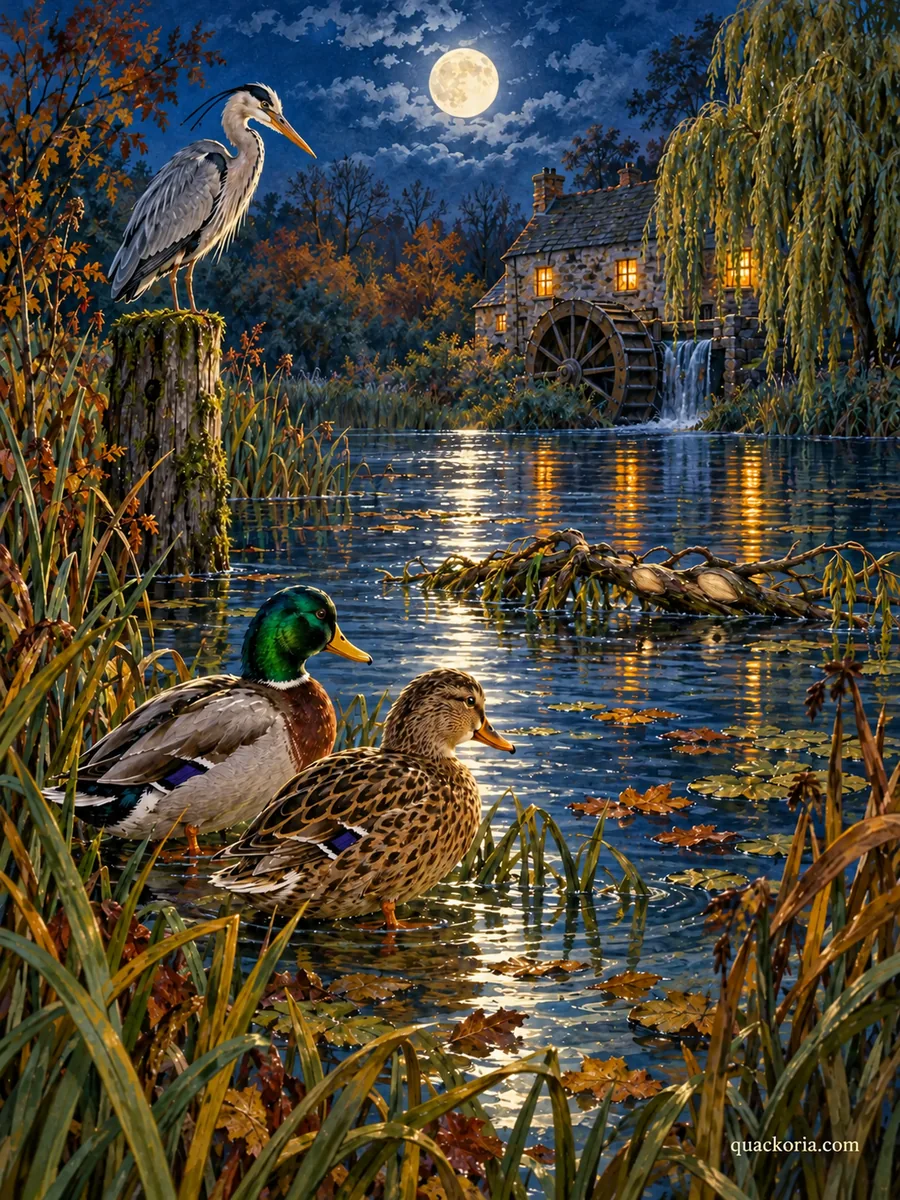
The branch was still there. Its pale knots wore frost now, and dead leaves filled the fork.
Gideon stood at the deep pool’s edge.
“The shallows have begun to close,” he said.
“Only at the edges,” Nell replied.
He looked along the bank. “This morning.”
She disliked the small distance between what she had said and what he had added.
They fed where the water was still open. Pip tipped forward near the willow, came up with a strand of weed and offered the opinion that breakfast had become more difficult to catch.
“Breakfast does not generally try to escape,” Nell said.
“Then it is hiding very well.”
She searched the shallow margin. Yesterday she had reached soft mud here. Today a thin white rim stood between her and the bank. Farther out, the water deepened beyond the easy reach of her bill.
A neighbour tried the other side of the willow and returned without much to show for it.
Nell watched them gather in the open patch.
“We will feed along the feeder stream,” she decided. “There is usually water moving there.”
Gideon nodded once. “Let us look.”
She was grateful he had said look rather than stay.
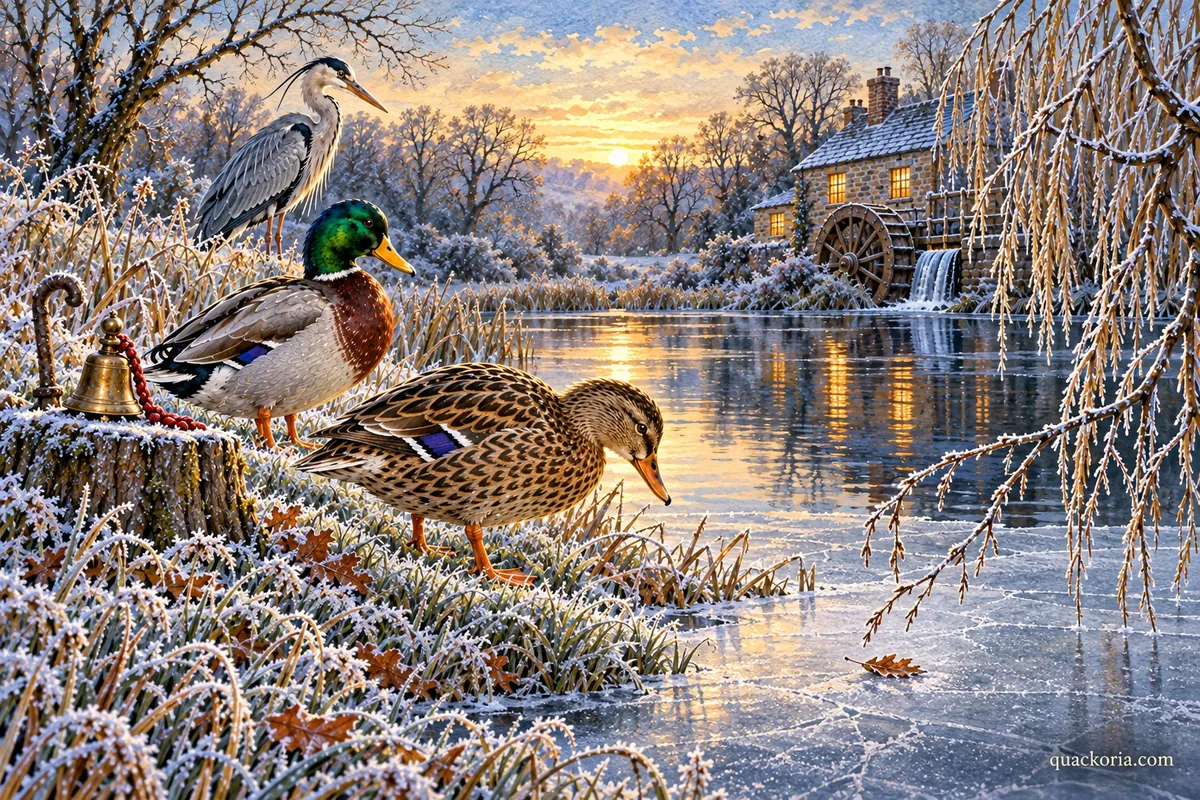
A smaller piece of home
Near the feeder stream, a narrow ribbon of water slipped into the pond between frozen banks.
It was enough for one duck to feed comfortably, or two ducks to feed uncomfortably, or five ducks to discover exactly where their neighbours’ feet were.
They took turns.
Nell waited until the others had tried. She told herself she was giving everyone room. She also knew that, while she was waiting, she did not have to discover how little food remained within reach.
At last Pip moved aside.
“Your turn.”
She put her head down.
A few seeds. A shred of leaf. Cold water over hard ground.
She tried farther along. The bank rose steeply there, and the narrow stream gave her no room to turn without backing into Pip.
“We can try again later,” she said.
One neighbour looked up. “Where shall we rest?”
“Under the willow.”
“The ice is nearly across that corner.”
Nell turned. The neighbour was right.
She had given the answer that belonged to yesterday.
Gideon lifted his wings.
“I will look at the river.”
“Beyond the eastern rise?” Pip asked.
“Where we took Wren. Then farther along if I need to.”
“The river will be open?” Nell asked.
“I shall tell you what I find.”
He flew above the bare willow and disappeared over the rise.
Nell watched until the sky was empty.
There were places she knew in the way she knew the edges of her own body: the warm stone, the mud beneath the reeds, the shallow notch where Pip always pretended he had meant to stumble. A pond was made of those places as much as water.
The river had none of them.
She swam back towards the landing. A thin sound followed her, like somebody folding stiff paper. Along the bank, a new white line was drawing itself across dark water.
She could not tell how quickly it would spread.
She knew she would have to look again.
The answer Nell kept moving
Gideon returned before midday.
“Moving water at the bend,” he reported. “Some ice by the banks. The main river is open, but the wind is crossing it.”
“A good place to stay?” asked Nell.
“A place to inspect. I did not find a sheltered feeding margin on that first pass.”
Pip glanced from the heron to the shrinking open pool.
“We could all go and look.”
“After we feed,” Nell said.
One neighbour lowered her head towards the empty patch she had just searched.
Nell saw the movement.
“After we rest, then.”
Pip came beside her.
“Nell.”
“We should not fly tired.”
“No.”
“And we should know where we are going.”
“Yes.”
He waited. She wished he would argue. Arguments gave her something to push against.
Instead, he looked at the frozen willow corner.
“What are we waiting to get better here?” he asked.
Nell opened her bill.
There was no answer she trusted.
She could hear herself becoming brisk. “You could go with Gideon. Take the others. I will watch the pond.”
“For what?”
“In case somebody comes.”
“We can tell them where we went if we see them later.”
“In case the water opens.”
Pip looked up at the hard white sky.
“Do you think it will?”
She did not.
For a moment, she hated that he had asked so gently.
Then she was tired of hating anything. The cold was taking enough work already.
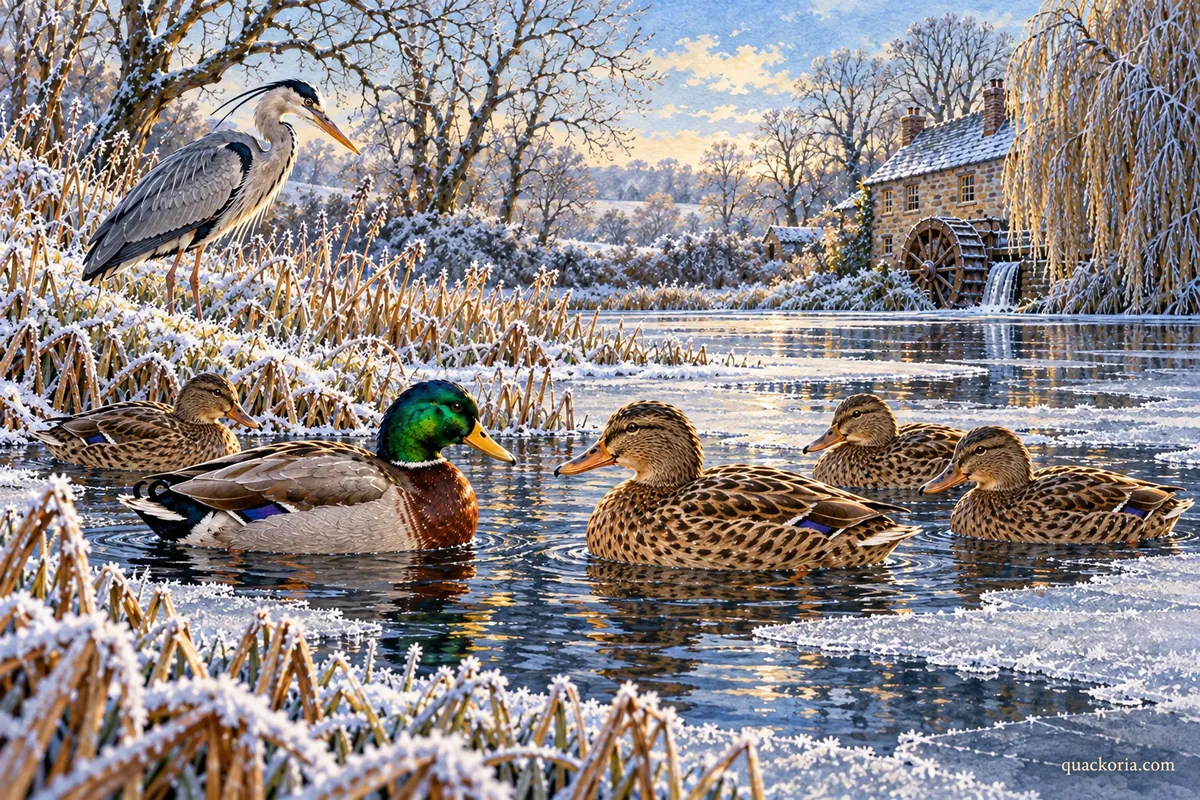
“I know how to live here,” she said.
Pip stayed beside her.
“So do I.”
“I do not know how to leave it.”
He looked towards the rise where they had stood with Wren.
“Perhaps we only have to leave it for today.”
Nell let that small piece of time settle.
For today was something she could imagine. It had a beginning, a daylight journey and birds she knew going with her.
She turned to Gideon.
“We look together,” she said. “Before the light goes.”
What stayed on the stump
They gathered in the largest remaining patch of open water.
Nell counted the neighbours. Three. Pip beside her. Gideon on the bank, ready to lead them over the rise.
“Does anyone need more time before we fly?” she asked.
One neighbour stretched her wings, folded them and shook her head. Another wanted to know whether they would have to cross the whole valley without stopping.
“Only to the river first,” Nell said. “We can see it from the rise.”
The third looked back at the willow.
“I left a pond once,” she said. “There were reeds there too.”
Nell had never asked where the neighbour lived before she came here. She had known which part of Mill Pond she liked and mistaken that for knowing every place she had ever needed.
“Did you miss it?”
“Yes.”
The neighbour waited, giving Nell room for a second question.
There was one she wanted to ask: whether missing it had stopped.
Instead, Nell moved beside her.
“We will stay together,” she said.
“We fly clear of the pond,” she told the others. “No following the channel beneath the mill. We land only when we have looked at the water.”
Pip was staring at the landing.
“The bell,” he said.
It stood on the broad stump, brass dulled by cold, its faded red cord stiff where frost had touched it. The bent hook above it was a crooked mark against the stone wall.
“We cannot take it,” Nell said.
“I know it is heavy. But if Gideon—”
Gideon looked at the bell, then at Pip.
“I am flying with you. I am not carrying that.”
Pip lowered his bill.
“We worked very hard to get it back.”
Nell remembered the cord under water, Toby’s dark shape beneath the surface, Pip walking backwards through the shallows. She remembered how the bell had sounded once it was home.
She wanted it with them too.
That made saying no more difficult, and more necessary.
“It is staying in the place where we put it,” she told him. “We can know that without carrying it.”
He studied the stump for a long moment, fixing its shape in his mind.
Then he came back to the water.
Nell checked the open run before them. There was room to lift away from the ice. Gideon rose first. The neighbours followed, wings beating cold air.
Pip looked once towards her.
She nodded.
They flew.
Below, the pond changed shape as it became smaller. The willow was a dark fan. The landing was a narrow stroke. The bell was a point of brass she could hardly find.
For one wingbeat she almost turned.
Pip stayed level beside her.
She looked ahead.
The river was not a promise
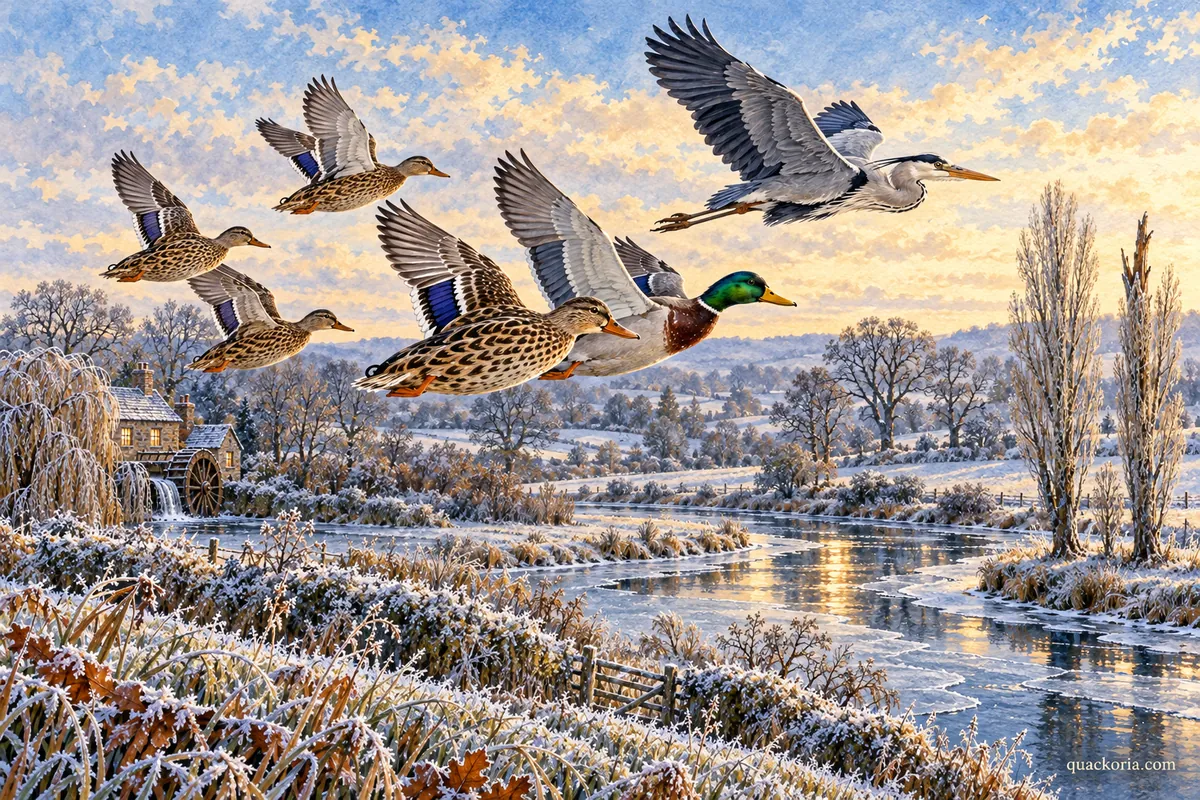
The river shone beyond the eastern rise.
Nell recognised the pale bank and the two poplars, one ending in its broken top. Wren had looked towards those trees as if they held the whole world. Nell had thought, that afternoon, how good it was to have somewhere familiar to stay.
Now the trees were the nearest familiar things ahead of her.
Gideon circled above the bend. They followed him down towards open water, clear of the ice feathering the bank.
For a moment, Nell felt enormous relief.
Then the wind reached them.
It ran across the wide channel without a willow to slow it. Small waves slapped her breast. The river pulled at her feet, and she had to paddle simply to stay near the others.
One neighbour tried the bank edge. Beneath a fringe of ice, the water fell away steeply.
She came back.
“I cannot reach anything there.”
Pip looked at Gideon.
The heron was studying the downstream shore.
“I said the water was open,” he told them. “We still need the right part of it.”
Nell heard no defensiveness in his voice. He had brought them what he knew. The rest remained theirs to find.
“A short flight downriver,” she said. “Stay together.”
From the air she could see how the wind roughened the middle channel. Along its inside edge, a line of alder trees curved behind a low shoulder of bank. Beyond that curve was a darker, smoother patch.
She pointed it out.
Gideon turned with her.
They came down near the mouth of the little inlet, where they could see both the open exit and the shallow margin. Nell did not send the neighbours into the reeds at once.
She looked.
The trees softened the wind. Water moved gently past the mouth without pushing hard into the pocket behind the bank. There was mud within reach, and a bare stretch of firm shore to rest on.
She tried the shallow edge.
Her bill found soft ground. A few seeds came up with it.
Pip was beside her when she lifted her head.
“Breakfast?”
“Late breakfast,” she said.
He tried the margin too. Then the neighbours spread along it, with enough space for five ducks to discover their own feet again.
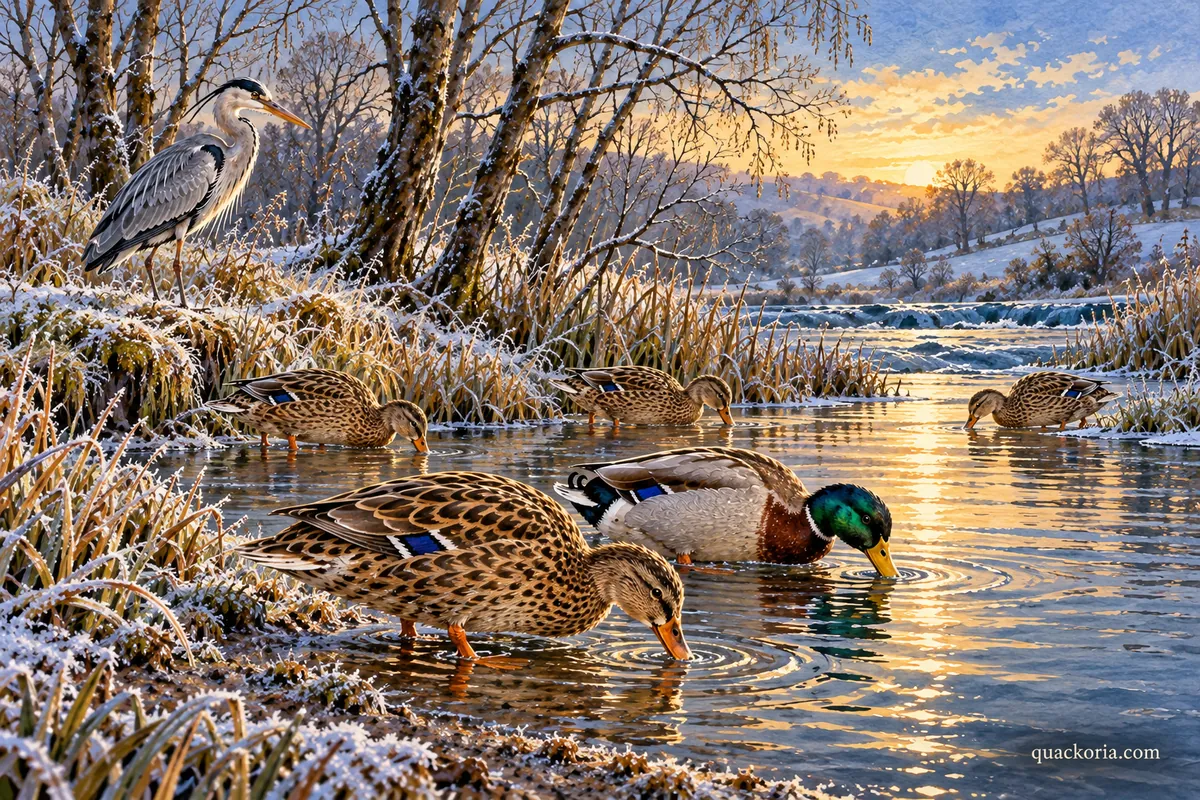
Nell watched each of them feed before she took another mouthful.
She would have to check the place again when the light changed. Tonight might be colder. This little inlet had made no promises either.
For now, the water moved against her feathers, and there was food.
A different morning to learn
By evening, they had found a resting place on the sheltered bank.
Gideon chose firm ground near the inlet mouth. The neighbours settled together. Pip examined a smooth stone, put one foot on it and announced that he had found something almost as comfortable as the landing.
The stone shifted.
“Almost,” he repeated, stepping off.
Nell laughed. It came out before she had decided whether the day allowed it.
Beyond the alders, the river carried the last gold of the sky. It was a different sound from Mill Pond: a longer rush, with little knocks as twigs passed the bank.
She listened until she could tell which sounds stayed and which were travelling on.
“Will we go back tomorrow?” Pip asked.
Nell looked towards the valley they had left.
“When the pond has room for us again.”
“How will we know?”
“We will look when we can. We will ask what the weather has changed. We will not decide tonight.”
He considered that.
“The bell will be there.”
“I hope so.”
He seemed to prefer her honest answer to a brighter one.
One neighbour raised her head. “Nell? Where is the best place to feed in the morning?”
Nell turned towards the inlet.
Once, she would have had an answer ready before the question finished.
“Come and look with me,” she said. “We can find out.”
The neighbour settled again.
Nell tucked a foot into her feathers. Somewhere beyond the dark rise, Mill Pond held its frozen willow, its empty hook and a bell that nobody would ring at dawn.
Here, Pip shuffled closer. Gideon folded his long neck. Three small rounded shapes rested beside the bank.
At first light, Nell would learn where this water caught the sun.
Characters in this story
- Nell — a female Mallard facing the loss of familiar routines
- Pip — her curious male Mallard friend, willing to wait for an honest answer
- Gideon — a Grey Heron who reports what he has seen without promising more
- Three Mallard neighbours — the birds leaving the pond with Nell and Pip