Quackoria Learn
Cayuga Duck: The Black Duck With the Green Shine and the Black Eggs
Key takeaways
- From birds obtained in New York around 1840; in the APA standard from 1874; pushed aside by the Pekin in the 1890s and on the Conservancy's Watch list today.
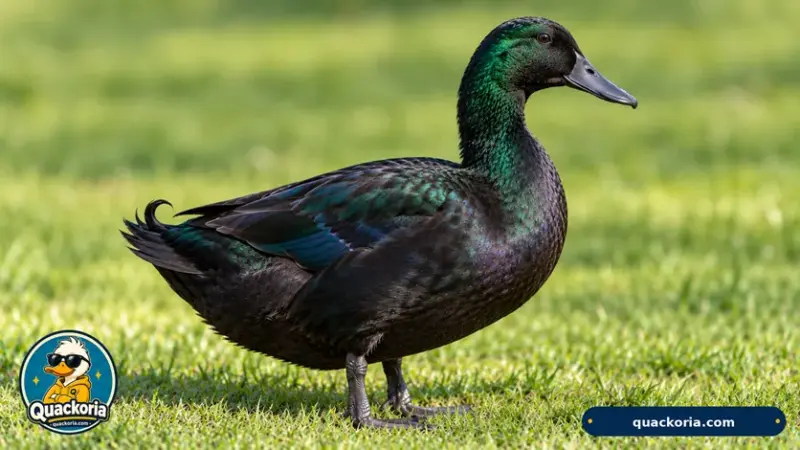
- Black plumage with a green, blue and purple sheen that may go white with age; the eggs start the season black or grey and lighten to white.
- 130–180 eggs a year on Metzer's chart, 100–150 per the Conservancy, 50–100 per the British Waterfowl Association; mothering fair (Metzer).
- The sources disagree on temperament — Metzer 8.8 on its 1–9 nervousness scale, the Conservancy "Docile, Calm" — and the Conservancy calls it a quiet breed.
The Cayuga is the black duck with the green shine: an American breed from the Finger Lakes, accepted into the poultry standard in 1874, pushed aside by the Pekin twenty years later, and still on the Conservancy’s Watch list. It is quiet, hardy, handsome, and lays an egg that can start the season black.
What the Cayuga is known for is the colour, the quiet, and the early-season eggs that can come out of the nest looking dipped in soot. It is a middling layer, a fair mother on Metzer Farms’ rating and a big enough bird for the table, though the Conservancy notes that the carcass “can be difficult to clean because of their dark feathering” — and it lost its place as the Northeast’s meat duck when production shifted to the white-feathered Pekin in the 1890s.
Cayuga duck at a glance
| Trait | Figure | Source |
|---|---|---|
| Origin | New York State, from birds obtained around 1840; in the APA standard from 1874 | The Livestock Conservancy |
| Adult weight | 4.75–6 lb (2.2–2.7 kg) Metzer; males 6.5–8 lb, females 6–7.5 lb TLC | Metzer, TLC |
| Eggs a year | 130–180 (Metzer); 100–150 (TLC); 60–100 (Kentucky) | Metzer, TLC, University of Kentucky |
| Egg weight | 75–90 g | Metzer |
| Egg colour | Black at first, lightening through the season to grey or greenish-blue and finally white (TLC); many eggs some shade of grey, a pure black egg rare (Metzer) | The Livestock Conservancy, Metzer |
| Temperament | 8.8 on Metzer’s scale (1 very calm, 9 more nervous); “Docile, Calm” per TLC — the sources disagree | Metzer, TLC |
| Mothering | Fair | Metzer |
| Foraging | Good | Metzer |
| Flight | None | Metzer |
| Incubation | 28 days, Cornell’s figure for common ducks such as Pekins | Cornell |
| Rarity | Watch | The Livestock Conservancy |
Metzer’s weights are its breeders’ weights during lay, which it says have been controlled for egg production; the Conservancy’s are higher. The whole of Metzer’s chart is on the breed comparison tool.
Where the Cayuga came from
The Livestock Conservancy has the history. The breed descends from birds that John S. Clark obtained in Orange County, New York, around 1840 and took to Cayuga County in the Finger Lakes; the Conservancy says the ducks, like the county, were named after the native people of the area. They became popular in the region, and in 1874 the Cayuga was accepted into the American Poultry Association’s Standard of Perfection — the same year as the Rouen. Production declined in the 1890s, the Conservancy says, when duck production shifted to the white-feathered Pekin. The sources differ on how fast a Cayuga grows: eXtension says the Pekin reaches market weight in eight weeks, where the Cayuga and other heavy breeds take 12 to 16, while the Conservancy says Cayugas fatten easily and can be harvested as early as 8 weeks, though some suggest waiting until 12. The Cayuga survived as a farmyard and exhibition duck — eXtension says Cayugas are raised mainly for exhibition today — and the Conservancy lists it as Watch: for poultry, fewer than 5,000 breeding birds in the US, with 10 or fewer primary breeding flocks, and an estimated global population under 10,000.
What a Cayuga looks like
Black, and then not quite black. The plumage is, in the Conservancy’s description, black with an iridescent green, blue and purple sheen in the sunlight, and Metzer Farms says the sheen is especially evident on the male’s head. The bill is black, the legs and feet black, the eyes dark brown, according to Poultry Hub Australia; Metzer adds that the black legs turn more orange as the birds age. As Cayugas age, white feathers can appear — the Conservancy notes the plumage may develop white mottling with age, and Metzer says Cayugas become almost all white after several years, much quicker in females than males. Ducklings are dark.
Young drakes and ducks are the same colour, so the sexing signs are the usual ones — the drake’s curled tail feather and the female’s louder voice — and male vs female ducks has the ages they appear at. Metzer’s chart rates its flight none, and the Conservancy says Cayugas are not good fliers.
Eggs
The eggs are the party trick. Early in the laying season a Cayuga’s eggs carry a dark pigment on the shell — washable, the British Waterfowl Association says — that can make them black or charcoal grey. The Conservancy describes them as initially black, lightening as the season goes on to grey or greenish-blue and finally white; Metzer Farms says many have varying degrees of grey and “On rare occasions they will lay a pure black egg.” Underneath the colour it is an ordinary large duck egg of 75–90 g on Metzer’s chart.
Numbers are moderate: Metzer’s chart gives 130–180 a year (the upper figure with 17 hours of light), the Conservancy 100–150 large eggs, the University of Kentucky 60–100 and the British Waterfowl Association 50–100. On Metzer’s chart that is fewer than a Khaki Campbell (165–240) and about level with its Jumbo Pekin (140–175) and Runners (100–180). Metzer rates the Cayuga’s mothering fair, and the Conservancy notes that ducks can become more assertive while sitting on eggs; the broody duck guide covers what to do when one goes broody.
Temperament and noise
The sources part company here, and the honest thing is to say so. The Livestock Conservancy calls the Cayuga docile and calm, and easily tamed if hand raised; Oklahoma State’s breed register calls it easy to handle. Metzer Farms, whose scores are averages from the staff who care for its ducks, scores it 8.8 on a scale where 1.0 is very calm and 9.0 more nervous — close to the Khaki Campbell’s 9.0. Both are describing real birds. The Conservancy’s own qualifier is the practical point: if a tame bird matters to you, raise them by hand from ducklings.
On noise there is no disagreement. The Livestock Conservancy calls the Cayuga a quiet breed that is good for urban or suburban settings, with hens noisier than drakes, and Poultry Hub Australia also calls it quiet, which is one of the reasons the breed suits a garden with neighbours. Why ducks quack explains what the sound is for.
Keeping Cayugas
The Cayuga is a bird from upstate New York, and it winters as well as any duck: a dry, draught-free house, water that is not frozen, and bedding to sit on are what it needs, as keeping ducks in winter sets out. It forages well — Metzer rates it good — and on a garden with grass and a pond it finds a share of its own food. Space does not depend on the breed name: the RSPCA’s standards set indoor space by weight, at no more than 17 kg per square metre, and outdoor range per bird, at least 2.5 m² on good pasture and 4 m² where grass cover is poor; the space calculator works it out. Feed is a duck ration with enough niacin — Metzer Farms says waterfowl need two to three times as much as chickens during their initial growth period — per what to feed ducks.
The Conservancy lists the Cayuga as prone to predation, and it is no flier — Metzer’s chart says it cannot fly, the Conservancy that Cayugas are not good fliers — so the house matters: eXtension’s advice is to have the flock roost in a secured place at night with all the doors closed and locked, and to bury hardware cloth at least 12 inches into the ground against diggers. Duck predators covers who takes ducks and what stops each one.
Is the Cayuga right for you?
Yes, if you want a quiet, hardy, striking duck for a garden or a small holding, a moderate number of large eggs, and a breed worth keeping alive — the Cayuga’s Watch status means every flock counts. Choose something else if you want more eggs (a Khaki Campbell: 165–240 a year on Metzer’s chart), a bird at the calm end of Metzer’s temperament scale (a Welsh Harlequin at 1.3, or a Muscovy at 1.0), or a reliable mother (a Muscovy, whose mothering Metzer rates excellent). The beginner’s guide to duck breeds compares them, and the breed quiz is a quicker way to the same answer.
Frequently asked questions
Why are Cayuga eggs black?
Early in the laying season the shell carries a dark pigment, which the British Waterfowl Association says is washable. The Livestock Conservancy describes the colour lightening as the season goes on — grey or greenish-blue, then white — and Metzer Farms says many Cayuga eggs have varying degrees of grey, with a pure black egg rare. Underneath it is an ordinary large duck egg.
Are Cayuga ducks quiet?
By the sources' descriptions, yes: the Livestock Conservancy calls the Cayuga a quiet breed good for urban or suburban settings, with hens noisier than drakes, and Poultry Hub Australia also calls it quiet.
Are Cayuga ducks friendly?
The sources disagree: the Conservancy calls them docile and calm and easily tamed if hand raised; Metzer scores them 8.8 on a 1–9 nervousness scale. If you want tame birds, raise them by hand from ducklings.
How many eggs does a Cayuga lay?
Metzer: 130–180 a year, the upper figure with 17 hours of light. The Conservancy: 100–150 large eggs. The University of Kentucky gives 60–100 and the British Waterfowl Association 50–100.
Why do Cayugas turn white?
With age. The Conservancy notes the plumage may develop white mottling as the birds age, and Metzer Farms says Cayugas become almost all white after several years, much quicker in females than males.
Sources
- Metzer Farms — Compare Duck Breeds
- Metzer Farms — How to Use Lights to Increase Duck Egg Production
- Metzer Farms — Sexing Ducks and Geese
- Metzer Farms — Cayuga Ducks
- Metzer Farms — Niacin: What Is It and Why Do My Ducklings and Goslings Need It?
- Cornell University Duck Research Laboratory — Hatching Duck Eggs
- RSPCA welfare standards for domestic and common ducks
- The Livestock Conservancy — Cayuga Duck
- The Livestock Conservancy — Rouen Duck
- The Livestock Conservancy — Heritage Breeds List (Conservation Priority List definitions)
- British Waterfowl Association — Cayuga
- Oklahoma State University — Breeds of Livestock: Cayuga Ducks
- Poultry Hub Australia (University of New England) — Cayuga
- University of Kentucky Cooperative Extension — Selecting Ducks (ASC-198, Jacob and Pescatore)
- eXtension — Selecting a Duck Breed for Small or Backyard Poultry Flocks (Jacquie Jacob)
- eXtension — Predator Management for Small and Backyard Poultry Flocks