Quackoria Learn
Why Don’t Ducks Get Wet? The Answer Most Sites Get Wrong
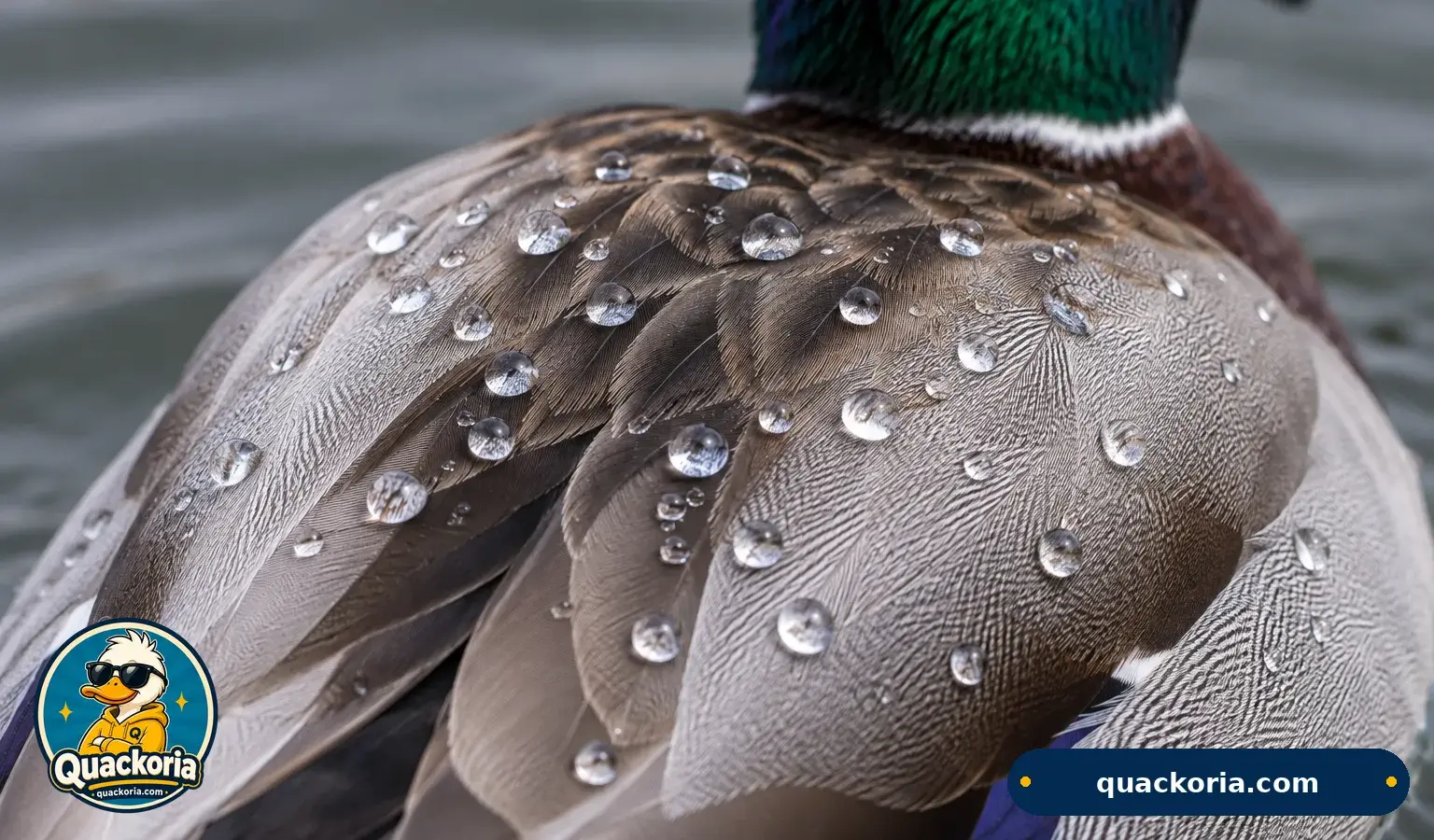
Water rolls off a duck's back mainly because of how its feathers are built. Preen oil keeps that structure in order; ducks with no oil gland get waterlogged.
Key takeaways
- The primary water barrier is feather microstructure: barbs and barbules interlocking into a mesh with gaps too fine for water to pass.
- Preen oil's main job is maintenance. Block a mallard's access to it for 10 days and there is no significant change; block it for 3 months and the plumage degrades and holds more water.
- International Bird Rescue calls the idea that preen oil is what makes feathers waterproof “a common myth”.
- Calculated water breakthrough depth for six aquatic birds' feathers is 1–4 metres, about 1.3 m for the mallard. A duck floating at the surface is nowhere near that pressure.
- Detergent defeats the mesh by lowering water's surface tension — which is why soap on a duck is dangerous, and why rinsing matters in oil-spill rescue.
Water rolls off a duck’s back mainly because of the way its feathers are built, rather than because of the oil on them. That comes with a genuine complication, because ducks whose oil glands were surgically removed did become waterlogged. Both things are true, and the way they fit together is the real answer.
What a duck feather actually is
Start with the structure, because everything else follows from it.
A contour feather has a central shaft, the rachis. Branching off it are barbs. Branching off each barb are barbules — and the barbules carry tiny hooks that catch the barbules of the neighbouring barb, the way two strips of Velcro catch each other. These hooks lock the whole vane into a single smooth surface.
Cornell’s Bird Academy describes the result as “a wind and waterproof barrier”. Down feathers, by contrast, have barbules with no hooks at all — which is exactly why down traps air and insulates instead of shedding water. The two feather types do two different jobs on the same bird.
When a duck preens, it is not just spreading oil. It is running each feather through its bill and guiding the barbules back into place so they fully interlock.
The physics: water sits on top of the air
Here is why the mesh works, and it is more interesting than “the gaps are too small”.
A 2014 study in the Journal of the Royal Society Interface examined feathers from six aquatic bird species and quantified the geometry. Water on a feather sits in what physicists call the Cassie–Baxter state: the droplet rests on the tops of the barbs and on the air trapped between them, touching only a fraction of the actual surface. It is floating on a cushion of air held in place by the structure.
The researchers calculated how much pressure it takes to force water past that cushion and into the feather. The answer, expressed as depth: 1 to 4 metres, with the mallard and the shelduck near the bottom of that range, at about 1.3 metres. A duck sitting on a pond is under a few centimetres of pressure at most, so the margin is large. Diving is a different matter: the predicted depths are towards the lower end of typical diving depths for the birds in the study, and the authors write that “a representative feather is expected to be fully wetted in a typical deep dive”.
And the same paper explains the vulnerability in one sentence. For water on the feathers of all six species, the non-wetting state is the stable one. “By contrast, for other wetting liquids, such as alkanes and common oils, the global energy minimum corresponds to a fully wetted or Wenzel state.” Oil does not defeat the feather by dissolving anything. For oil, the stable state is the wetted one: it soaks into the structure instead of sitting on it.
The measurements
The structural work goes back to Cassie and Baxter, the first to study the water repellency of feathers systematically, and to A.M. Rijke’s papers in the Journal of Experimental Biology in 1968 and 1970. The figures below are from Rijke and William Jesser’s 2011 paper in The Condor, and they are worth seeing because they show the design being tuned across species.
- Contact angle on a smooth feather surface: about 90°.
- Apparent contact angle on the porous feather vane: around 150° for the duck feather Cassie and Baxter measured, and “in the vicinity of 140° or 150°” on the contour feathers of most birds.
- Maximum achievable on any smooth surface: about 114°.
That third figure is the important one. A duck’s feathers repel water better than any smooth coating could. Whatever is happening, it is not simply a layer of wax — a wax layer cannot exceed 114°, and the feather does.
The structural parameter Rijke uses — the barb radius plus half the gap between barbs, divided by the barb radius — sits at about 2.3 in penguins and about 7 or more in most land birds; the duck feather Cassie and Baxter measured gives 5.9. Barb diameters run 20–70 micrometres, spacing 100–400. There is a trade-off built into that scale: a higher ratio repels water better but resists pressure worse, which is why penguins and other diving birds sit at the low end of it and most land birds at the high end. Ducks themselves include surface feeders and divers, and dabblers and divers are built differently.
So what is the oil for?
The preen gland — properly the uropygial gland — sits on the rump at the base of the tail feathers. It is bilobed, it opens through small nipple-like papillae, and it is found in most birds. The duck rubs its head and bill against it and works the secretion through the plumage.
What it secretes is not simple grease. In domestic geese, the waxes are monoesters: 96% of the alcohol component is octadecanol, and the fatty acid side is dominated by branched compounds. Proposed functions include lubrication, plumage maintenance, antimicrobial effects, social signalling and changes to plumage colour as well as waterproofing, though a 2017 critical review in Biological Reviews found real evidence scarce even for the functions most researchers accept.
Now the awkward fact for the pure-structure view. In experiments in 1947 and 1951, published in 1954, W.H. Elder surgically removed the oil glands from ducks at the Delta Waterfowl Research Station — redheads, shovellers and mallards. The result: “The feathers of normal birds were glossy and kept well arranged while those of glandless birds were dry, lusterless, and matted.” When the birds came out of the water, the glandless ducks’ feathers “became completely water soaked, matted, and disarranged”. Three of twelve glandless mallards in captivity died by February while all the intact ones were still alive (among the redheads, losses were heavy in both groups). After the next moult the plumage recovered — and deteriorated again the following winter.
So the oil is doing something essential. The question is what.
The experiment that reconciles it
In 2010 a team published exactly the study needed, in Naturwissenschaften. They blocked captive mallards’ access to their preen glands, and they did it twice with different durations.
Ten days: no significant effect on plumage condition. No significant effect on water retention.
Three months: plumage condition significantly worse, an associated rise in water retention, and a significant correlation between the two.
Their conclusion: the study “shows that preen oil acts to maintain plumage condition and suggests that feather microstructure is essential to maintain plumage waterproofness.”
That is the core of the answer. On this evidence the oil’s main job is not to waterproof the duck but to keep the feathers in the condition that does. Take it away and there was no significant change in ten days. Take it away for three months and the plumage deteriorates and holds more water.
Elder’s own conclusion left room for both: in waterfowl, he wrote, the secretion “maintains the water-repellent quality of feathers either directly or by preserving their physical structure.”
Why serious people call the oil version a myth
International Bird Rescue, which has responded to over 230 oil spills, puts it flatly: “It’s a common myth that the waxy substance from a bird’s uropygial, or ‘preen’, gland is what makes feathers waterproof. This is not the case.” They compare the feather mesh to GORE-TEX, with gaps too small for water at normal surface tension.
They then add, in the same breath, that “the waxy secretion is vital for the long-term health and maintenance of each feather” — which matches the 2010 finding.
A 2024 systematic review in the Journal of Avian Biology reached the same place: most hypotheses from the early 1900s suggested that the oil provided a hydrophobic coating, and subsequent work showed the feather’s hierarchical structure repels water “with or without oil”. Rijke and Jesser’s 2011 analysis is blunter — preen oil is chemically dominated by methylene groups, as polyethylene is, and a drop of water on it measures about 90°, so “preening oil adds a water repellency to feathers that is far from exceptional in quality.”
Set against that, Cornell’s Bird Academy and veterinary sources like VCA still list waterproofing as a function of the oil, and a 2017 critical review in Biological Reviews wrote that it “seems clear” that preen oil improves waterproofing, but that it is unclear “whether this acts by creating a hydrophobic layer or simply by improving plumage structure”. This is a genuine, live disagreement in the literature and we are not going to pretend otherwise. What everyone’s evidence is compatible with is the two-role model: structure barriers the water, oil maintains the structure.
Soap, oil spills, and wet feather
This is the part with practical consequences.
A 2020 review in Science of the Total Environment describes the mechanism precisely: petroleum “compromises the function of the feather structure by lowering the surface tension of water while simultaneously adsorbing to the hydrophobic feather matrix, causing the interlocking barbules to become clogged and their supporting barbs to collapse.” In most of the marine species tested, barbules collapsed and clumped when feathers touched petroleum films on seawater as thin as 3 micrometres or less, and structural damage can show even when the oil on a feather is undetectable by weight.
Detergents are surfactants: lowering water’s surface tension is what they do, which is the first half of that mechanism on its own. That is why washing a duck with soap, or ducks living in water with detergent in it, is genuinely dangerous rather than merely untidy.
Rescue practice reflects it. International Bird Rescue washes oiled birds in a low concentration of dishwashing liquid, chosen partly for its effectiveness at low concentrations — and then rinses them completely, because “any detergent or solution left on the feathers can impair the natural waterproofing process.” The rinse is not tidiness; the organisation rates it “just as important as the wash”.
In kept ducks the same failure has a name: wet feather. Feathers become waterlogged and stop repelling water. The documented causes are muddy or unsanitary conditions, dried mud stripping the feather oil, lice, sooty mould, oil-based products or detergents on the plumage, and preen gland infections. The consequences are loss of buoyancy — a real drowning risk — plus chilling and secondary illness. If your ducks look permanently damp, that is a problem to act on, and common duck health problems covers where it fits among the things that go wrong.
The physiological cost of losing waterproofing is severe. Oiled plumage lets more heat escape and can push up a bird’s metabolic rate to compensate; birds oiled at sea have shown emaciation and depleted fat reserves, and one calculation put an oiled rhinoceros auklet unable to feed at 1.2 days from starvation at sea in winter.
Ducklings, and a claim we could not verify
You will read very often that ducklings get their waterproofing from their mother’s preen oil, rubbed onto them while she broods them.
The idea is old. Elder cites Heinroth (1911) and the Heinroths (1928) for the possibility that young ducks are anointed by their mother before leaving the nest, or pick up enough oil from contact with her feathers. Elder tested it at Delta: four redhead ducklings about three days old, taken from a wild hen, against four of the same size hatched in an incubator, tested singly and as a group in washtubs of ordinary water for 15-minute periods. The wild-hatched ducklings “did not get wet”; the incubator-hatched ones “began jumping to escape within 8 to 10 minutes and showed more wetting of the outer belly down.” Elder did not treat that as an answer: “The basic question remains unanswered: Did these ducklings jump to escape because they were getting wet or did they get wet because they were jumping?” In a second test, in water with a wetting agent added, both groups sank until only their heads were above water, the incubator ducklings in half the time, and the wild-hatched birds, retested over four trials on later days, showed “no progressive decrease in wetting time” of the kind expected if an oil film were being washed off.
What is documented is that ducklings have working glands of their own almost at once. Elder found the gland “functional in the first day of life” in incubator-hatched redhead, canvasback and mallard ducklings, as an earlier study had in domestic ducks, though workers on eiders and tufted ducks did not believe it functional in the first few days. His ducklings whose glands were removed at under ten days old were kept in the hatchery and were “normal in appearance and behavior until the juvenal plumage was assumed in August”; and when they were released on a large outdoor pond in that plumage they “quickly became wet and bedraggled”. And a 2004 study in the Journal of Experimental Biology found that in two- and three-day-old mallard ducklings swimming on cold water the ventral down “remained dry or was wetted only on the surface”, and most held their body temperature above 39°C for an hour on water as cold as 5°C.
So: ducklings’ own oil glands work from the first day in the species Elder checked, and in the 2004 study their down kept the water out at two to three days old. Elder tested whether oil from the mother adds to that, on eight ducklings, without a clear answer. We would not state it as fact.
The practical caution stands regardless — artificially reared ducklings are often given only short, supervised swims at first, because a chilled duckling is a real risk whatever the mechanism. Raising ducklings week by week covers that properly, and what ducklings are covers the biology.
The short version
Water rolls off a duck’s back mainly because hooked barbules lock its feathers into a mesh so fine that water sits on trapped air rather than passing through — a structure that outperforms any smooth coating and, by calculation, would need more than a metre of water pressure to defeat.
The oil from the preen gland keeps that structure in working order. It is not the main waterproofing. It is the maintenance contract: mallards cut off from it showed no significant change after ten days, but after three months their plumage was in worse condition and held more water.
Both halves matter.
The other half of how a duck survives cold water is circulatory rather than structural — why duck feet do not freeze is the companion to this, and between them they explain how a bird sits on a freezing pond for long periods and is fine.
Frequently asked questions
Why don't ducks get wet?
Mainly because of how their feathers are built. Hooked barbules interlock into a mesh fine enough that water rests on trapped air instead of passing through. The calculated breakthrough pressure for six aquatic birds' feathers is equivalent to 1–4 metres of water depth, about 1.3 m for the mallard.
Is it the preen oil that makes ducks waterproof?
Mostly not, and International Bird Rescue calls the idea a common myth. A 2010 mallard study found that blocking access to the preen gland for 10 days had no significant effect, while blocking it for 3 months degraded the plumage and increased water retention. The oil maintains the structure; the structure repels the water.
What happens if a duck loses its waterproofing?
It loses buoyancy and sits low in the water, gets cold, and burns energy trying to stay warm. In kept ducks the condition is called wet feather; in oiled seabirds the same failure raises heat loss and can end in starvation. Both are serious.
Why is soap bad for ducks?
Detergents work by lowering water's surface tension, which is exactly what the feather mesh depends on. Soap on the plumage lets water through the structure. It is also why oiled birds must be rinsed completely after washing.
Do ducklings get waterproofing from their mother?
Not proven. Elder (1954) tested the idea on eight redhead ducklings and wrote that “The basic question remains unanswered”. What is documented is that ducklings' own oil glands work from the first day of life in redhead, canvasback and mallard ducklings, and that the belly down of two- and three-day-old mallard ducklings stayed dry or was wetted only on the surface while they swam.
Sources
- Srinivasan et al. (2014), Quantification of feather structure, wettability and resistance to liquid penetration, J. R. Soc. Interface 11:20140287
- Giraudeau et al. (2010), Effects of access to preen gland secretions on mallard plumage, Naturwissenschaften 97:577–581
- Elder (1954), The Oil Gland of Birds, Wilson Bulletin 66:6–31
- Rijke (1970), Wettability and phylogenetic development of feather structure in water birds, J. Exp. Biol. 52:469–479
- Rijke & Jesser (2011), The water penetration and repellency of feathers revisited, The Condor 113:245–254
- Muzio & Rubega (2024), What do we really know about the water repellency of feathers?, Journal of Avian Biology
- Moreno-Rueda (2017), Preen oil and bird fitness: a critical review of the evidence, Biological Reviews 92:2131–2143
- Biester et al. (2012), Identification of avian wax synthases, BMC Biochemistry 13:4
- Britannica — Preen gland
- VCA Animal Hospitals — Uropygial or preening gland in birds
- International Bird Rescue — Clearing up misconceptions about feather waterproofing
- International Bird Rescue — FAQs
- International Bird Rescue — Our process for helping oiled birds
- Cornell Lab Bird Academy — How feathers are built
- King, Elliott & Williams (2020), Effects of petroleum exposure on birds: a review, Sci. Total Environ. 755:142834
- Banta, Lynott, VanSant & Bakken (2004), Partitioning heat loss from mallard ducklings swimming on the air–water interface, J. Exp. Biol. 207:4551–4557
- PoultryDVM — Wet feather in pet ducks