Quackoria Learn
Mallard Duck: Facts, Identification, Behaviour and Habitat
Key takeaways
- The mallard is the most abundant duck in the northern hemisphere and the ancestor of nearly all domestic breeds.
- The green head belongs to the male; the female is mottled brown, and both share a blue-purple wing patch called a speculum.
- The loud classic quack is the female's. Males make a quieter rasping call.
- Males swap their bright plumage for a drab eclipse plumage in summer, and cannot fly for several weeks during that moult.
- Mallards are dabblers — they tip forward to feed rather than diving.
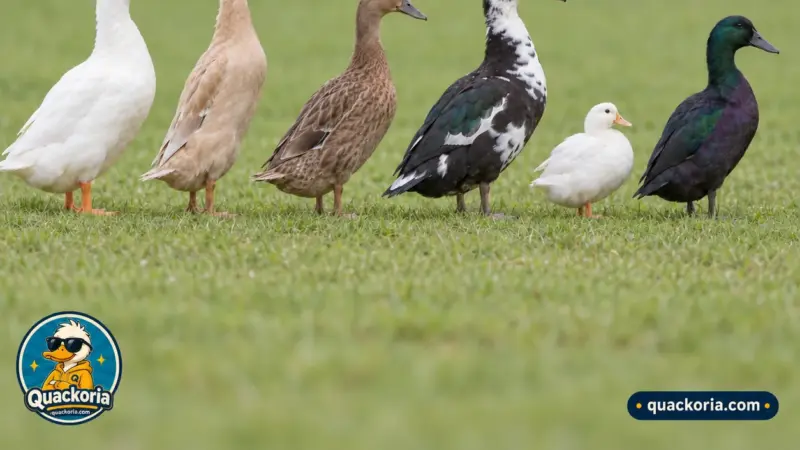
If you have ever seen a duck, you have almost certainly seen a mallard. It is the most abundant duck in the northern hemisphere and perhaps the most familiar, it lives comfortably alongside people, and nearly every domestic duck breed on earth — Pekin, Rouen, Runner, Khaki Campbell — descends from it. The Muscovy comes from a different ancestor altogether, and the Cayuga’s line may include another wild species too.
That ubiquity is why the mallard has quietly become the template for the idea of a duck. The sound in your head when you think of a duck is a female mallard’s.
Identification
The male
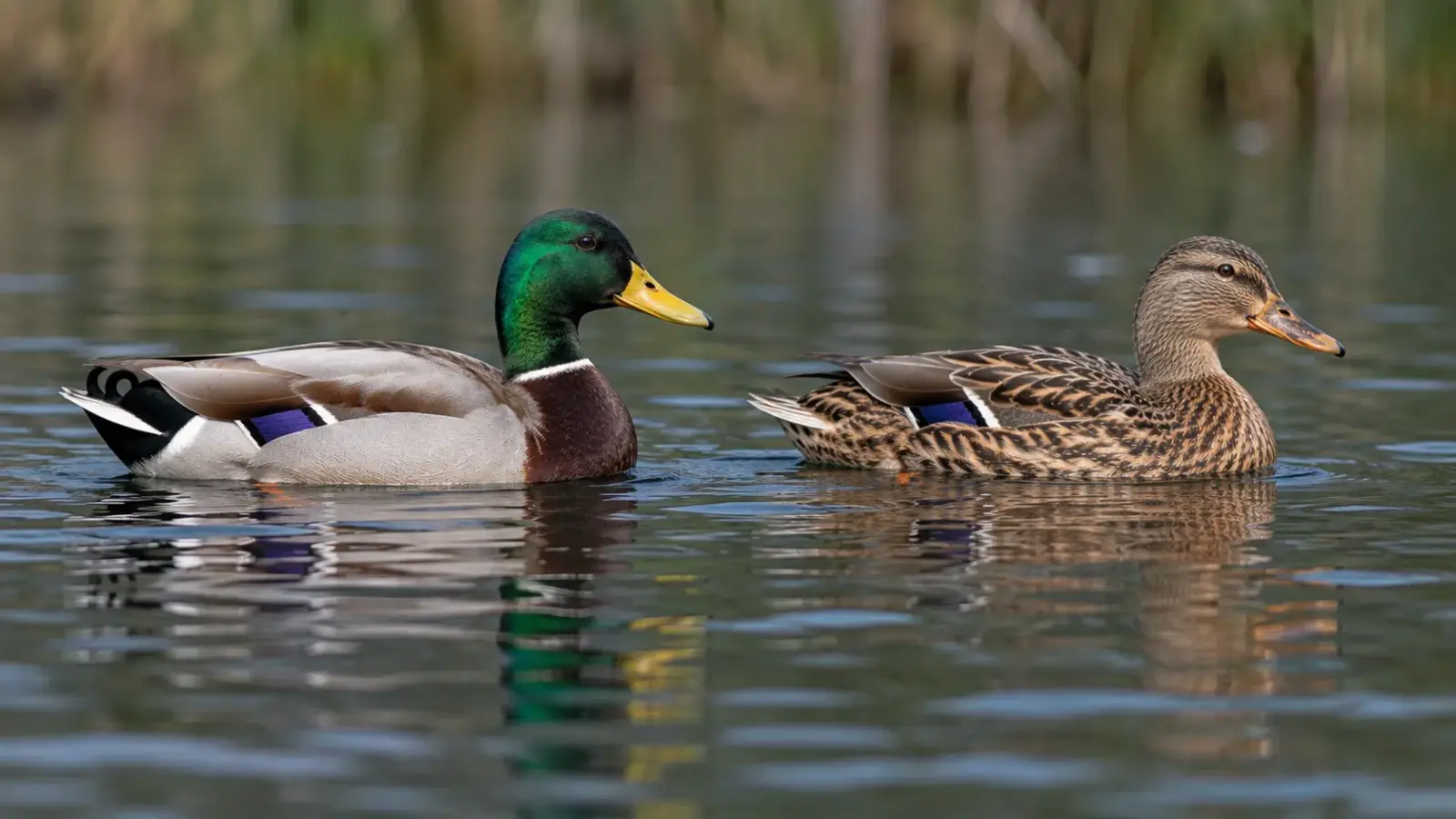
In breeding plumage, unmistakable: a glossy bottle-green head, a thin white neck ring, a chestnut-brown breast, pale grey body, black rear with two curled central tail feathers, and a yellow bill. The green is structural colour rather than pigment, so it shifts depending on the angle of the light.
The female
Mottled brown throughout, which is camouflage for sitting on a nest in vegetation. Her bill is orange with dark markings, and there is a dark stripe through the eye. She is easy to confuse with several other female dabbling ducks — which is where the wing comes in.
The speculum
Both sexes carry a bright blue-to-purple panel on the wing, bordered front and back with white. This is the speculum, and it is one of the most useful mallard field marks. It is visible in flight and often shows as a coloured flash on a folded wing. When you cannot separate two brown female dabblers, the speculum often settles it.
Ducks that are not mallards
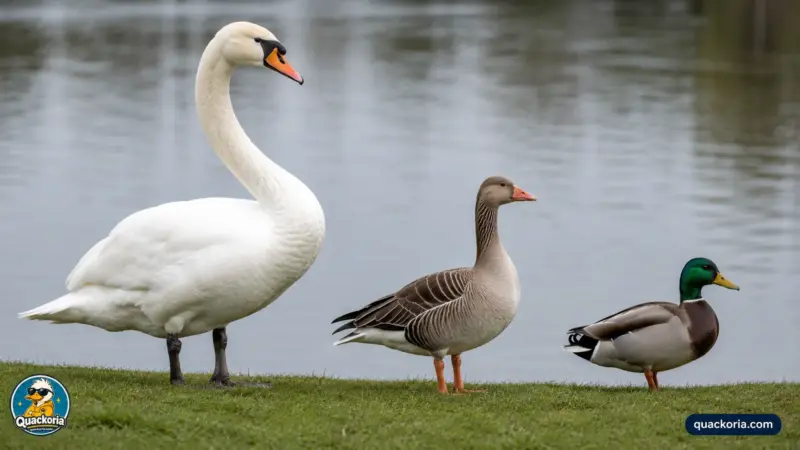
Plenty of birds get called mallards that are not. If you are unsure whether you are even looking at a duck rather than a goose or a swan, telling ducks, geese and swans apart covers the differences in shape, neck length and behaviour.
In eastern North America the duck most like a female mallard is the American black duck: darker all over, with a purple speculum that lacks the white borders. The two interbreed, and the American black duck page shows how to tell them, and their hybrids, apart. For any other brown duck, which wild duck did I see narrows the list.
The eclipse moult
This surprises people who only watch ducks in spring: in midsummer the drakes vanish. Not literally — they change.
After breeding, a male mallard moults into a drab, mottled, female-like plumage called eclipse, and during that change he sheds all of his flight feathers at once and cannot fly for several weeks — three to four by Cornell’s figure, 30 to 45 days by Ducks Unlimited’s. Ducks Unlimited says the henlike feathers “help conceal drakes while they are flightless during the wing molt.” He keeps the yellow bill, which is the giveaway.
Through the autumn the bright plumage grows back in time for the courtship season, which in mallards begins remarkably early — pair formation is often well under way by midwinter.
Behaviour
Feeding
Mallards are dabblers. They feed at the surface and just below it, upending so the tail points skyward, and strain food from water and mud through the comb-like lamellae along the bill. They almost never dive. They also graze on land far more than people expect, and will work stubble fields and grassland well away from water.
The diet shifts through the year — invertebrates and protein in spring and summer, seeds and grain in autumn and winter. The full picture is in what ducks eat.
Voice
The female makes the loud classic quack, often in a series that starts loud and gets softer. The male makes a quieter, raspier call of one or two notes. The difference is consistent enough to sex a bird by ear, and it is explained in why ducks quack.
Courtship
Mallard courtship is elaborate and involves groups of males displaying around a female: head-shakes, sudden bill-jerks that flick water, tail-shakes, and a whistling grunt. Pairs form months before breeding.
It is worth being honest that mallard mating behaviour is often aggressive, involving forced copulation and the pursuit of females by males. It is well documented.
Nesting and young
The female builds the nest alone, usually on the ground in dense cover, lined with down plucked from her own breast. She will also use tree hollows, balcony planters and rooftop terraces — mallards are opportunists.
She lays seven to thirteen eggs by Audubon’s count, one a day, and only begins incubating in earnest late in the laying period, so that the whole brood hatches together. Incubation takes 23 to 30 days, according to both Cornell and Audubon. The male plays no part in incubation or in raising the young.
Ducklings leave the nest within a day and can swim and feed themselves immediately, but for the first weeks they depend on their mother, who keeps them warm and dry by covering them with her body and wings. Everything about ducklings covers that development in detail.
Habitat and range
Mallards live almost anywhere there is fresh water: lakes, rivers, canals, marshes, flooded fields, park ponds, drainage ditches, coastal lagoons. They are native across Europe, Asia and North America and have been introduced widely elsewhere, including Australia and New Zealand — where hybridisation with native ducks has become a genuine conservation concern.
Where people feed them they can become, in Cornell’s words, “very tame and approachable”; where they are heavily hunted, they are wary.
Migration
Mallards are partial migrants. Northern populations move south in autumn; populations in milder regions largely stay put, moving only as far as they must to find open water. This is why the birds on your local pond may be residents, winter visitors, or a mix that changes month to month. Where ducks go in winter covers how that works.
Lifespan
Most wild mallards that survive their first year live a few more. Predation, hunting, hard winters and collisions all take a toll, and many ducklings die young: Ducks Unlimited puts duckling survival anywhere from 10 percent to more than 70 percent, with mortality highest in the first two weeks. Ringing recoveries include birds well over twenty years old, but those are outliers rather than expectations. Kept domestic ducks live longer: the Open Sanctuary Project gives an average life expectancy of 8 to 15 years. The numbers and what drives them are in how long ducks live.
The mallard and the domestic duck
Every domestic duck except the Muscovy traces back to Anas platyrhynchos. The Cayuga’s line may include another wild species: Metzer Farms says the breed “is thought to have been developed from the wild Black Duck”, and Oklahoma State says it “was developed from a wild black duck, the Black East India, and the Rouen.” Thousands of years of selection produced birds that lay far more eggs, grow far heavier, and in many cases cannot fly — but they remain the same species, which is why domestic and wild ducks interbreed freely wherever they meet.
That is why park populations are full of birds that are almost, but not quite, mallards: white bibs, odd sizes, unusual bill colours. They are mallard genes in unfamiliar arrangements.
If you keep any of those descendants, the practical side of their care is in our guide to common duck health problems and keeping ducks through winter.
Frequently asked questions
How do you tell a male mallard from a female?
In breeding plumage the male has a glossy green head, a white neck ring, a chestnut breast and a yellow bill. The female is mottled brown with an orange-and-brown bill. Both have the blue speculum on the wing.
Why do male mallards lose their green head in summer?
It is the eclipse moult. After breeding, the male moults into drab, female-like plumage and, during that change, sheds all his flight feathers at once and is unable to fly for several weeks. Ducks Unlimited says the henlike feathers help conceal drakes while they are flightless.
Are all park ducks mallards?
No, but many are, or are mallard crosses: Cornell calls the mallard "an abundant city and suburban park duck". Domestic ducks bred from mallards frequently interbreed with wild ones, which is why park populations contain so many odd-looking birds with white patches or unusual sizes.
How long do mallards live?
In the wild, most that reach adulthood live a few years, though ringed birds have exceeded twenty. Kept domestic ducks live longer: the Open Sanctuary Project gives an average life expectancy of 8 to 15 years.
Sources
- Cornell Lab of Ornithology — Mallard
- British Trust for Ornithology — BirdFacts: Mallard
- The Wildfowl & Wetlands Trust — Ducks found in UK wetlands
- Cornell Lab of Ornithology — Mallard identification
- Cornell Lab of Ornithology — Mallard life history
- Cornell Lab of Ornithology — Mallard sounds
- Audubon Field Guide — Mallard
- RSPB — Mallard
- Ducks Unlimited — Understanding Waterfowl: Mallards and Their Relatives (J. Dale James)
- Ducks Unlimited — Mallard Annual Life Cycle
- Ducks Unlimited — Waterfowl Feathers (David Brakhage)
- Scottish Wildlife Trust — Everything you needed to know about eclipse plumage!
- New Zealand Birds Online — Grey duck
- Cornell Lab of Ornithology — American Black Duck identification
- Ducks Unlimited — The Scoop on Duck Bills (Brian Davis)
- Stanford University, Birds of Stanford (Ehrlich, Dobkin and Wheye) — Duck Displays
- Ducks Unlimited — Extrapair Paternity (J. Jasper Lament)
- Toronto Wildlife Centre — Ducks nesting on a balcony or rooftop
- Ducks Unlimited — Life in the Egg (Bruce Batt)
- Ducks Unlimited — Understanding Waterfowl: Brood Ecology (Johann Walker)
- Ducks Unlimited — Ducklings and Goslings (J. Brian Davis)
- Victoria University Research Repository — Guay and Tracey (2009), Feral Mallards: A risk for hybridisation with wild Pacific Black Ducks in Australia? (The Victorian Naturalist)
- Ducks Unlimited Canada — Migration: A perilous journey
- JNCC — Severe Weather Scheme
- The Open Sanctuary Project — Additional Care Recommendations For Older Ducks
- University of Kentucky Cooperative Extension — Selecting Ducks (ASC-198)
- The Open Sanctuary Project — Domesticated Ducks: How We Got Here
- GigaScience — Zhang et al. (2018), Whole-genome resequencing reveals signatures of selection and timing of duck domestication
- New Zealand Birds Online — Mallard
- Metzer Farms — The Great Duck Disguise: What's Really Going on with Eclipse Plumage
- Metzer Farms — Cayuga Ducks
- Oklahoma State University — Breeds of Livestock: Cayuga Ducks