Quackoria Care
Do Ducks Need a Pond?
The short answer is no — but ducks do need water, and more of it than most people expect. Here is the difference between water a duck needs and water a duck enjoys.
Key takeaways
- Ducks must have water deep enough to dunk their whole head, at all times.
- A pond is a luxury. The RSPCA asks for a paddling pool or trough they can bathe in; Metzer Farms says swimming water is not essential.
- Water must be changed daily — ducks foul it fast.
- Every water container needs an easy way out; ducklings can drown in containers they cannot climb out of.
- Stand the water on a well-drained bed of shingle, or move it regularly, away from the house — or you will be managing mud all year.
What you need
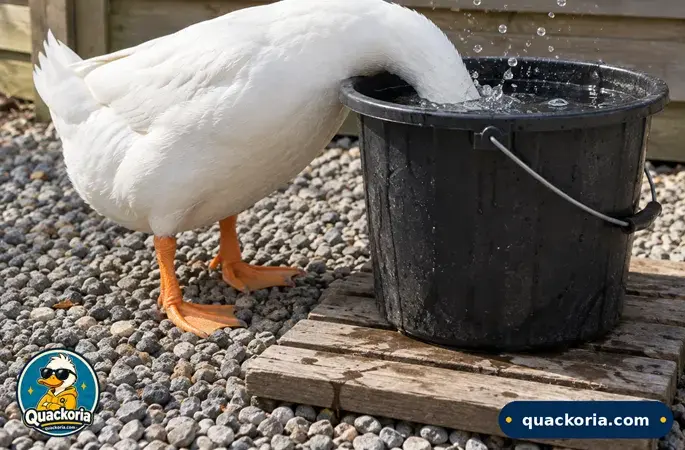
- A drinker deep enough for a duck to submerge its whole head
- A shallow tub, trough or hard plastic children's pool for bathing
- A ramp, brick or step so birds can get out easily
- Gravel or slabs under the water station to stop a mud pit forming
- A stiff brush for daily rinsing
What ducks actually need
Two things, and only one of them is swimming.
Water to drink and to dunk. A duck’s eyes and nostrils are cleaned by pushing its whole head under water. A shallow dish it can only sip from is not enough. In a study of ducks reared for meat, birds without the chance to at least dip their heads and splash their feathers could not keep their eyes, nostrils and feathers fully clean (Jones, Waitt and Dawkins, 2009), and the RSPCA’s justification for its duck standards cites a study in which open water meant fewer birds with dirty or blocked nostrils. Whatever container you use, it must let the head go fully under.
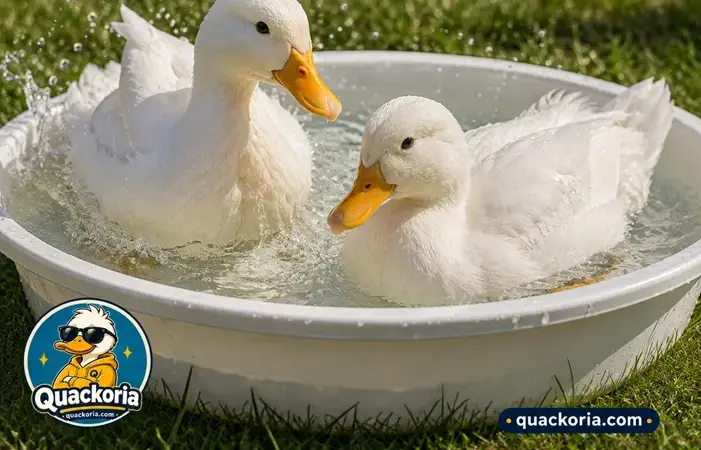
Water to bathe in. Bathing washes the feathers, and the preening that follows guides their barbules back into place so they interlock, and spreads oil that keeps them healthy, flexible and waterproof (Cornell Lab Bird Academy). International Bird Rescue stresses that it is the feather’s structure, kept in order, that makes it waterproof, not the oil on its own. Ducks with no bathing water get dirty, scruffy feathers: PoultryDVM sees wet feather most often in ducks kept in dirty, muddy conditions without fresh water to bathe in. Not every source calls it essential: Metzer Farms, eXtension and Cornell’s Duck Research Laboratory say swimming water is not, though Metzer’s answer to dull, ragged feathers is to “Provide them with swimming water several times a week”.
Neither of those requires a pond. The RSPCA’s advice is that where there is no pond, a kids’ paddling pool or trough will do. The British Waterfowl Association answers “Do all waterfowl need a pond?” with “So the answer is yes”, but adds that “The pond need not be huge for basic health, provided the water is changed frequently and kept clean.”
What a pond adds
Enjoyment, mostly. Of swimming water, Metzer Farms says “The birds love it”, and deeper water lets ducks do more: the RSPCA’s justification for its standards notes that ducks used 10 cm of water for dabbling and 20–30 cm for floating and swimming. But a pond is not the only way to give them that. In a study of ducks reared for meat, the authors concluded that troughs or overhead showers may improve welfare as much as small ponds (Jones, Waitt and Dawkins, 2009).
What a pond also adds: mud and algae — the University of Arkansas Extension lists the wastes of ducks and geese among the nutrients that feed pond algae. What it does not add is safety: the British Waterfowl Association calls it “a myth that waterfowl are safe from foxes and rats when on islands”.
The practical setup that works
- A drinker beside the feed, tall enough for a full head dunk, refilled daily.
- A bathing tub — a hard plastic children’s pool, a mortar tub or an old sink. Big enough to sit in, and at least 10 cm deep, the minimum in the RSPCA’s farm standard; RSPCA Australia suggests 10–20 cm for dabbling and more than 20 cm for swimming.
- A way out. A brick, a ramp, a sloped side; the RSPCA’s advice is water “shallow enough that they can get out easily”. Ducklings in particular can drown in a container they cannot step out of: the US Fish and Wildlife Service warns that ducklings in a swimming pool “may drown if they become exhausted because they cannot get out”.
- A drained base. A bed of shingle underneath (RSPCA), or a slatted or wire floor (Metzer Farms), so the area drains instead of becoming a permanent bog.
- A tipping routine. Tip, rinse, refill, once a day; the RSPCA’s advice is to clean the container at least once a day before refilling it.
Keep the water out of the house
Water inside the duck house means wet bedding. The Merck Veterinary Manual links wet litter to footpad dermatitis and ammonia burns, and PoultryDVM lists damp bedding that is rarely changed among the risks for aspergillosis, usually a respiratory infection (Merck). Put bathing water well away from the door, and if you leave a drinker in overnight, stand it in a tray or on a wire platform. There is more on this in building a safe duck house.
Winter
Ducks cope with cold far better than people expect — see keeping ducks through winter — but they must never be left without liquid water. A heated bowl or base outside the house, or checking, breaking ice and refilling several times a day as the University of Maryland Extension advises, both work. Bathing water is the part that can stop in hard frost: Metzer Farms says ducks do not need swimming water every day. Water deep enough to dunk the head cannot stop.
Cleaning without chemicals
Tip, rinse and scrub daily with a stiff brush and plain water (the RSPCA advises cleaning at least once a day). Do not use detergent on anything ducks will bathe in — soap lowers the surface tension that keeps water sitting on top of their feathers, which is exactly the property that keeps them dry and warm, and PoultryDVM lists detergent on the feathers among the causes of wet feather. If you want to know why that matters, this is how duck waterproofing works.
Sizing the water to the flock
No university, welfare body or hatchery we could find publishes a pool size per duck for a garden flock. The figures that do exist:
- The RSPCA farm minimum: from three weeks old, a bathing facility at least 50 × 100 cm inside, with at least 10 cm of water and at least 833 cm² of water surface for every 100 ducks. It is a floor for commercial flocks, not a target for a garden.
- The RSPCA’s pet advice: a kids’ paddling pool or trough, deep enough to wash the head and body but shallow enough to get out of easily.
- Your own numbers: the pool and pond planner works out the area and volume of a pool for your flock without inventing a per-duck target.
Whatever you pick, make it easy to empty: it needs cleaning every day.
Beating the mud
Ducks plus water plus soil equals mud, every time — the RSPCA warns that the ground around water facilities “is likely to become wet and muddy” — and mud is not just unpleasant: PoultryDVM lists muddy and flooded ground among the risks for bumblefoot, a foot infection. Three things help:
- Drainage. A well-drained bed of shingle under and around the water station (RSPCA). Keep it smooth rather than rough: PoultryDVM counts hard and rough surfaces among the bumblefoot risks too.
- Move the tub. If it stands on grass, shift it regularly so the ground can recover (RSPCA); for ducks on range, the UK welfare code says drinking facilities should be moved every one or two days.
- Direct the overflow. Tip the tub downhill and away from the house and the feeding area; the RSPCA asks for outdoor feed to be kept clean and dry.
If you do have a real pond
Lucky ducks — but a few practicalities:
- Stocking. A handful of ducks on a small pond will strip the plants and cloud the water. Fewer birds on more water keeps it healthy.
- Edges. Ducks need at least one gently sloping bank to get in and out. Steep-sided ornamental ponds are a drowning risk, especially for ducklings.
- Predators. Water is no moat. Birds still go into a locked house at dusk — the pond is not a safe place to sleep; eXtension’s advice is to have the flock roost in a secured place at night, with every door closed and locked.
- Treatments. No detergents in water ducks bathe in. For algae, the University of Arkansas Extension says chemicals give short-term control but are “not a long-term solution”, and that the nutrients released when treated algae die “may only serve to grow more of the same problem species”.
Ducklings and water
Different rules entirely. Young ducklings are not fully waterproof (RSPCA) and chill fast. In the first three weeks they need water to drink and to dip their whole heads in — the RSPCA’s farm standard asks for at least 4.5 cm from day old — but not to swim in: eXtension says not to let them swim for the first three weeks, and Metzer Farms says the safest is to wait until five weeks or more. When they do swim, keep it supervised, with somewhere warm to dry afterwards — the full schedule is in raising ducklings week by week. Any container a duckling can reach needs to be shallow enough to stand up in, or covered. The ways ducklings and adults drown, and the ramps and ratios that prevent it, are in can ducks drown.
Signs your water setup is not working
- Crusted or blocked nostrils, or weepy eyes — check the water is deep enough to dunk a whole head in. A discharge from the eyes or nostrils, sneezing or noisy breathing can also mean illness: see common duck health problems.
- Dirty, matted feathers that stay wet — check the bathing water is clean and there is enough of it. Wet feather has other causes too, from lice and mould to oil or detergent on the feathers (PoultryDVM).
- Sore or swollen feet — check the ground: PoultryDVM lists muddy, flooded, hard and rough surfaces and damp bedding among the risks for bumblefoot, and the same health guide covers when a sore foot needs a vet.
- Bathing water that is green and thick soon after you fill it — the British Waterfowl Association notes that waterfowl soil the water every time they bathe. Empty it more often, and keep a separate supply of clean drinking water (RSPCA).
Frequently asked questions
Can ducks live without swimming water?
Sources differ. Metzer Farms, eXtension and Cornell's Duck Research Laboratory say swimming water is not essential; the RSPCA says ducks need open water, such as a kids' paddling pool or trough, deep enough to wash the head and body. What they cannot do without is water deep enough to dunk the whole head, which keeps their eyes and nostrils clear, and regular bathing keeps their feathers in condition. A tub big enough to sit in meets the RSPCA's advice.
How deep should a duck pool be?
Deep enough for the bird to put its whole head under, and at least 10 cm, the RSPCA farm standard's minimum for bathing water from three weeks old. RSPCA Australia suggests shallow water of 10–20 cm for dabbling and more than 20 cm for swimming and floating, and in a study the RSPCA cites, ducks spent more time in 10 cm of water than in 30 cm. Give a way to climb out at one end.
How often should I change the water?
Daily, and more often in hot weather. Ducks stir up sediment and pass droppings while they bathe, so bathing water fouls quickly.
Do ducks need water at night?
Yes. The UK welfare code says ducks should "have fresh water at all times", the RSPCA advises access to food and water in the house, and the British Waterfowl Association says they "nearly always wish to drink when feeding". Bathing water can stay outside; to keep the bedding dry, stand an indoor drinker in a tray or on a slatted or wire floor.
Will ducks ruin a garden pond?
A small ornamental pond with a handful of ducks turns muddy fast, and duck droppings feed algae. Ducks and a clear planted pond are hard to have at the same time.
Sources
- RSPCA — outdoor areas for pet ducks and geese
- RSPCA — Welfare standards for domestic/common ducks (June 2023)
- RSPCA — Domestic/common ducks: standards justification
- RSPCA Australia — How should I care for my pet ducks?
- DEFRA — Code of recommendations for the welfare of livestock: ducks
- Metzer Farms — Frequently asked questions
- Metzer Farms — How do I keep it dry around my duck and goose drinkers?
- British Waterfowl Association — Ponds
- British Waterfowl Association — Plants
- eXtension (Jacob, University of Kentucky) — Raising meat ducks in small and backyard flocks
- Cornell University Duck Research Laboratory — Basic duck care
- Cornell Lab Bird Academy — How feathers are built
- International Bird Rescue — Clearing up misconceptions about feather waterproofing
- Jones, Waitt & Dawkins (2009), Water off a duck's back: showers and troughs match ponds for improving duck welfare, Applied Animal Behaviour Science 116:52–57
- PoultryDVM — Wet feather in ducks
- PoultryDVM — Bumblefoot in ducks
- PoultryDVM — Aspergillosis in pet ducks
- Merck Veterinary Manual — Management of backyard poultry
- Merck Veterinary Manual — Aspergillosis in poultry
- NC State Extension (Ferket & Davis) — Feeding ducks
- The Open Sanctuary Project — Creating a good home for ducks
- eXtension — Predator management for small and backyard poultry flocks
- US Fish and Wildlife Service — Ducks in your pool
- University of Arkansas Extension FSA9094 (Stone & Daniels) — Algal blooms, scums and mats in ponds
- University of Maryland Extension FS-1133 — Winter weather and small flocks: what you need to know
- King, Elliott & Williams (2020), Effects of petroleum exposure on birds: a review, Science of the Total Environment
- Encyclopaedia Britannica — Surfactant