Quackoria Learn
Do Ducks Have Tongues?
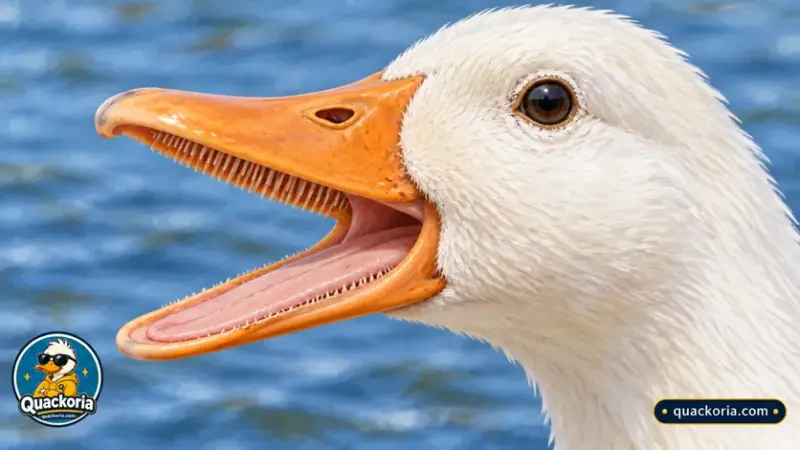
Yes, ducks have tongues, and bigger, stranger ones than you would guess: about 6.3 centimetres long in a domestic duck, with a horny plate on the tip and rows of bristle-like papillae along the edges, working as the moving part of a pump that strains food out of water.
Key takeaways
- In adult domestic ducks the tongue averages 6.3 cm, with a spatula-shaped tip capped by a horny "lingual nail" and a cartilage rod inside.
- Rows of conical and filiform papillae along the edges form "the food filtration apparatus", working with the bill's lamellae like a sieve.
- The tongue, upper bill and lower bill move together to pump a one-way flow of water; ducks can adjust the gap to select particles by size.
- A mallard has about 375 taste buds to a human's nearly 8,000; in birds most sit on the palate, and in mallards they are also on the mouth floor and the bill tip, not just the tongue.
- Like all birds, ducks lack the sweet-taste receptor; they keep bitter receptors, and touch sensors in the bill find food by feel.
Yes, and it is a bigger, stranger tongue than you would guess. In an adult domestic duck it is about 6.3 centimetres long, reaches to the end of the lower bill, has a horny plate on its tip and rows of bristle-like papillae along its edges, and is the moving part of a pump that pulls water through the bill and strains the food out. What it barely does is taste: a mallard has about 375 taste buds to a human’s nearly 8,000, and most of them are not on the tongue at all.
What a duck’s tongue looks like
The most complete description comes from a 2016 study in the journal Zoomorphology, which examined the tongues of eight adult domestic ducks under light and electron microscopes. “The total length of the tongue averaged 6.3 cm, of which the apex averaged 0.8 cm in length, the body with the lingual prominence was 4.9 cm, and the root had a mean length of 0.6 cm.” The tip is spatula-shaped and capped underneath by a stiff plate the authors call the lingual nail, “1.3 and 1 cm” long and wide. Along both edges of the tongue’s body run the papillae — “14 pairs of the small conical papillae” at the front, then “six pairs of large conical papillae of different shapes” behind them, with a dense mat of finer filiform papillae over the front rows. Inside is a skeleton: “The adipose tissue covered the internal skeleton of the tongue formed by the elongated entoglossum cartilage of the hyoid apparatus.” So a duck’s tongue has a stiffening rod, but in the domestic duck it is cartilage rather than bone.
A Muscovy’s tongue is built to the same plan. A 2013 anatomical study in Veterinarski Arhiv contrasts it with a chicken’s: “Whereas the tongue is long and broad, with a shovel-shaped tip in the duck, the fowl’s tongue is broad, lancet-shaped and does not extend to the full limit of the lower beak.” The Muscovy too has “numerous long brush-like horny lingual papillae” along the front edges, which “may act as a filter that actively supplements the horny lamellae on the lateral margins of both the upper and lower beaks”.
A pump and a sieve
A dabbling duck feeding in shallow water is running water through its bill and keeping what is edible. The Zoomorphology authors call the domestic duck “a specialist filter-feeder” and identify the parts: “The structures on the lateral surfaces of the tongue, the conical and filiform papillae, constitute the food filtration apparatus.” The tongue is also part of the engine. A 1989 study in Zoomorphology that measured the filtering of seeds “ranging in size from 0.01 to 4.6 mm” in three duck species describes a “water pump” whose stroke is tied to the tongue — “The pumping and the filtering mechanisms influence each other mutually”, the authors write, and the tongue’s movements are constrained by the pump. A 2006 study in the journal Zoology says ducks “use movements of the tongue, maxilla and mandible to create a one-way flow”, and showed that they are not passive sieves: by opening the bill wider they can change what the comb-like lamellae keep, and “can actively select particles by size”. The lamellae are the bill’s half of the machine; on a northern shoveler, Cornell counts “about 110 fine projections (called lamellae) along the edges that act like a colander”. How a dabbler differs from a diver in all this is in dabbling vs diving ducks.
Grazing and pecking
Ducks also eat on land, and the tongue changes role. The same study notes that “Behavioral observations of foraging revealed that these birds also use a terrestrial feeding mechanism such as grazing and pecking”, and assigns the parts: “The process of pecking involves the spatula-shaped apex of the tongue and a specific horny plate—the lingual nail. In the grazing mechanism, large conical papillae and lamellae in the beak are required.” Moving a mouthful backward uses “the median groove, lingual combs, the rostral border of the lingual prominence and distinct rows of conical papillae”. A duck has no teeth to chew with — the story of the serrations people mistake for teeth is in do ducks have teeth — so the tongue does the sorting and the gizzard does the grinding.
Can ducks taste?
A little. Ducks Unlimited: “Waterfowl have only about 400 taste buds, while humans have 9,000”, adding that “the presence of small numbers of taste buds indicates that waterfowl have at least some capacity to distinguish between certain flavors.” A 2023 review of the bird taste system in Frontiers in Physiology gives the mallard 375 taste buds, against 767 in a chicken and 7,902 in a human. Where they are is the surprise: “Most taste buds in birds are located on the soft and glandular epithelia of the palate”, and “In Mallards, taste buds occur not only on the tongue but also in the mouth floor and the bill tip. This suggests the ability of Mallards in distinguishing taste cues just by holding food materials between the bill tips without bringing them further into the oral cavity”. A duck tastes with its bill before it commits.
What it cannot taste is sweet. The review states that “the entire avian clade evolved based on the early loss of sweet taste receptor (T1R2)” — a loss so old that, as Harvard Medical School put it when reporting the discovery of how hummingbirds re-invented sugar detection, “an ancestor of birds- likely within Dinosauria- lost an essential subunit of the only known vertebrate sweet receptor”. Bitter is different: birds keep bitter receptors, which the review says play “a primary defense function to prevent the ingestion of potential toxic compounds”, and ducks have four of the genes for them. So your duck’s enthusiasm for grapes is not about sweetness, and its rejection of some foods may well be.
The bill feels what the tongue cannot taste
Touch does the work taste does not. Ducks Unlimited describes “Highly sensitive nerve endings called Herbst corpuscles” in “a series of pits running along the tip of the bill”, which “allow species like canvasbacks to find succulent wild celery tubers and other soft foods while probing the substrate of wetlands.” The Zoomorphology study found the same receptors, with a second type called Grandry corpuscles, arranged across bill and tongue into what the authors call a “bill-tongue organ monitoring food transportation”. A duck in murky water eats by feel. What it is feeling for is in what do ducks eat, why bread is the wrong answer is in can ducks eat bread, and the whole apparatus, tongue included, is drawn in the duck anatomy explorer.
Frequently asked questions
Do ducks have tongues?
Yes. A 2016 study of adult domestic ducks measured the tongue at an average of 6.3 cm, with a horny plate at the tip and rows of papillae along the edges.
What does a duck use its tongue for?
Pumping and sieving. With the bill it drives a one-way flow of water, and the papillae along its edges strain out seeds and small animals; on land the tip is used for pecking.
Do ducks have taste buds?
A few. Ducks Unlimited puts waterfowl at "about 400"; a 2023 review gives the mallard 375, against 7,902 in a human, mostly on the palate and bill tip.
Can ducks taste sweet things?
No. Birds lost the sweet-taste receptor T1R2 early in their evolution; hummingbirds famously re-purposed their savoury receptor to detect sugar, and ducks did not.
Does a duck's tongue have a bone?
It has an internal skeleton from the hyoid apparatus; in the domestic duck the part inside the tongue is described as cartilage.
Sources
- Skieresz-Szewczyk and Jackowiak (2016), Morphofunctional study of the tongue in the domestic duck, Zoomorphology 135(2)
- Igwebuike and Anagor (2013), The morphology of the oropharynx and tongue of the Muscovy duck, Veterinarski Arhiv 83(6)
- Kooloos, Zweers et al. (1989), Comparative mechanics of filter feeding in Anas platyrhynchos, Anas clypeata and Aythya fuligula, Zoomorphology 108
- Gurd, D. B. (2006), Filter-feeding dabbling ducks can actively select particles by size, Zoology 109(2)
- Cornell Lab of Ornithology, All About Birds — Northern shoveler
- Ducks Unlimited — Understanding waterfowl: the five senses (John M. Coluccy)
- Niknafs, Navarro, Schneider and Roura (2023), The avian taste system, Frontiers in Physiology 14
- Harvard Medical School — Liberles lab finds hummingbirds evolved a new way to detect sugars (2014)
- National Geographic — Birds lost their sweet tooth, hummingbirds got theirs back (Ed Yong, 2014)