Quackoria Care
What to Feed Ducks: A Keeper’s Guide to Feed, Niacin and Treats
You are standing in a farm store looking at bags, and none of them says duck. This is the article for that moment: which feed at which age, what happens if you use chicken feed instead, and the one nutrient that will lame your ducklings if you get it wrong.
Key takeaways
- Starter to 2 weeks at 18-22.5% protein, grower after at 16-19%, layer from about a month before the first egg (NC State, Minnesota) or the first egg (Metzer) at 16-18% with about 3% calcium.
- Niacin at 55 mg/kg, which is 25 mg/lb, for starter. Metzer and NC State publish the same figure in different units; NC State drops to 20 mg/lb after two weeks.
- Chicken feed is a stopgap. Chick starter needs niacin added; broiler starter already has enough; turkey starter has too much protein.
- Medicated chick starter: Minnesota Extension says incorrect use of some chicken and turkey medicated feeds could harm ducklings; one trial (Holderread, with Oregon State) found no mortality, stunted growth or cripples in Khaki Campbell ducklings to four weeks at label rates. NC State adds an FDA-approval point.
- Mould is the hazard the duck sources single out: Merck names ducks and turkeys as particularly sensitive to aflatoxicosis.
- Water that covers the whole head is a health requirement, not a luxury: the RSPCA farm standard gives at least 4.5 cm from day old and full-body water at least 10 cm deep from 21 days.
What you need
- Duck starter, grower and layer feed as appropriate to age
- A sealed, cool, dry feed container
- A waterer deep enough to submerge the whole head
- A slatted or wire platform for under the waterer
- Oyster shell, for laying ducks only
A note before the numbers. Published protein figures for ducks disagree — not wildly, but enough that a single confident percentage would be dishonest. You get the range and the source. Where every source agrees, we say so, because that is useful information too.
The three feeds, and the ages they belong to
A duck’s diet changes twice in its life: once when it stops growing fast, and once when it starts laying. That gives you three feeds.
| Stage | Roughly | Protein — the published range |
|---|---|---|
| Starter | 0–2 weeks | 18–22.5% |
| Grower | 2–3 weeks onwards | 16–19% |
| Layer | About a month before the first egg, or from the first egg | 16–18% |
Where those ranges come from:
- NC State Extension publishes a full stage table: starter 20% (0–2 weeks), grower 18% (2–6 weeks), finisher 16% (6–8 weeks), developer 14.5%, layer 16%.
- Metzer Farms publishes higher: starter 22–22.5% (0–2 weeks), grower 17.5–19% (3 weeks to first egg), duck layer 17.5%.
- eXtension gives 20% for newly hatched ducklings, notes that the duck or waterfowl starter and grower feeds in most feed stores run 18–20%, and then makes a claim the others do not: that there is no benefit in feeding more than 16% protein in a well-balanced feed after two weeks of age. Its guide to feeding laying ducks reproduces a second table (from the Central Poultry Development Organisation, Southern Region, for egg-producing Khaki Campbells) with 20% starter, 16% grower and 18% layer.
That last point is the real disagreement. Metzer keeps its grower at 17.5–19% all the way to the first egg, and NC State gives 18% from two to six weeks before dropping to 16% and 14.5%; eXtension says anything over 16% after two weeks is wasted. We are not going to pretend to settle it. What all three agree on is the shape: high for a fortnight, lower after that, and never a return to starter levels once growth slows.
There is a reason to care about the top of the range as well as the bottom. Angel wing — the twisted wing tip that never straightens — is one of the reasons. Today’s Veterinary Practice describes its causes as likely multifactorial, including increased intake of high-energy food, rapid growth and genetics, names high levels of protein and carbohydrates among the nutritional culprits, and cites a study in which feeding a 32% protein diet to greater sandhill cranes led to a wing deformity rate of 25%. Ducks are not cranes and 32% is far above anything you would buy, but it is a reason not to assume that more protein is better.
Calcium is the other switch
Layer feed is not just protein. It carries far more calcium, for the shell: 2.9% (NC State) to 3.00% (Metzer), against a fraction of that in starter and grower.
Layer feed is made for birds about to lay or laying, not for growing ducklings: Metzer lists its duck layer for “During Egg Production”. The published timing of the switch differs. NC State says to begin breeder layer feed one month before the first egg is laid, and Minnesota Extension to change to a breeder-laying ration about a month before egg production starts; Metzer’s grower runs from three weeks to the first egg. The age ducks start laying is covered in when do ducks start laying eggs?
Niacin: the one figure to get right
If you remember nothing else from this article, remember this one.
Metzer Farms says waterfowl do not make niacin well from tryptophan, so they need more of it in the feed than chickens do. A duckling short of it becomes reluctant to move, and then its hocks swell and its legs bow. Metzer warns that death may follow within two to three weeks if the birds stay on a low-niacin diet, and that recovery depends on adequate niacin within 24 hours of the first sign.
Two independent sources give the same starting figure in different units, and it is also the National Research Council’s requirement for Pekin ducks, as reproduced in the Merck Veterinary Manual:
- Metzer Farms: 55 mg/kg of feed
- NC State Extension: 25 mg/lb in starter, 20 mg/lb from 2 weeks, 25 mg/lb for breeders
25 mg/lb is 55 mg/kg, so for starter the two agree. NC State’s 20 mg/lb after two weeks is about 44 mg/kg, a little below Metzer’s 55.
A proper duck starter already contains it. The problem arises only when you feed something else — which brings us to the question everyone actually types into a search box.
Can ducks eat chicken feed?
The published sources answer it with “it depends which chicken feed”, and the detail is worth having. Cornell’s Duck Research Laboratory says that if duck rations are not available and chicken feeds are, they will serve as a satisfactory substitute.
From eXtension:
- Chick starter — usable, but niacin must be added: it is made for egg-type chicks, which have a lower niacin requirement than ducks. Metzer Farms likewise warns that a chick starter made only for laying chickens probably does not have enough niacin.
- Broiler starter — made for a bird “which has a niacin requirement similar to that of ducks”, so the niacin is already there.
- Turkey or game bird starter — contains adequate niacin, but the much higher protein “can be detrimental to the health of ducklings”.
NC State suggests a specific workable substitution: a 23% protein chick starter for the first two weeks, followed by a 20% protein broiler grower — while warning that broiler feed may contain medications that do not have FDA approval for ducks.
So the honest answer: chicken feed is a stopgap, not a diet. If you are using chick starter, add niacin. If you have a choice, buy the duck feed.
Adding niacin, if you must
eXtension says that if you use a chick starter or grower diet, you need to add supplemental niacin to the ducks’ water. Brewer’s yeast is often suggested, but Metzer Farms points out that the amount of yeast needed throws off the balance of the other nutrients in the feed, and says it is probably best to add niacin with tablets, vitamin packets or liquid niacin. Get the dose from your feed supplier, a vet or the duckling niacin calculator rather than from a forum — this is a nutrient with a target figure, and guessing is a mistake.
The medicated feed question
You will read that medicated chick starter kills ducklings. The sources are more measured than that. Minnesota Extension says that incorrect use of certain medicated feeds formulated for chickens and turkeys could harm ducklings, and that waterfowl may be more sensitive to some drugs than other poultry.
Metzer Farms reports a trial by Dave Holderread with Oregon State University: sulfaquinoxaline, zoalene or amprolium at the manufacturers’ use levels for chickens and turkeys “did not cause mortality, stunted growth or cripples when fed to Khaki Campbell ducklings to 4 weeks of age”. That is one study, of one breed, over the first four weeks, so treat it as evidence rather than proof.
A different concern comes from NC State: broiler feeds may contain medications that are not FDA-approved for ducks.
Metzer’s advice: if a medicated and a non-medicated starter are equally nutritious, use the non-medicated one; if the only starter that meets the ducklings’ needs is medicated, it is better than one that does not.
Grit
Grit is small hard stones that sit in the gizzard and grind food. Metzer Farms says it is needed if ducks are fed whole grains, and not needed on mash, crumble or pellets, because the feed mill has already ground the feed. Minnesota Extension’s fact sheet simply says to provide insoluble grit. More detail is in do ducks eat rocks?
Grit is not oyster shell. They are sold side by side and are completely different: grit is insoluble and mechanical, oyster shell dissolves and supplies calcium for eggshells. Metzer: “Do not confuse grit with oyster shell.”
Metzer says wild birds find all the grit they need in their natural environment, and that free-range chickens with access to dirt do not necessarily need it; it gives no separate figure for ducks.
Mould is the real hazard
Of the feeding hazards, this is the one the duck sources single out.
Merck’s poultry poisonings entry singles out ducks and turkeys as particularly sensitive to aflatoxicosis. Cornell’s Duck Research Laboratory describes ducks as highly susceptible to aflatoxins, and says very small amounts will cause high mortality. NC State: never use feed that is mouldy.
Which means the boring advice is the important advice:
- Buy smaller quantities in hot weather (University of Georgia Extension)
- Store in a container with a tight-fitting lid, somewhere cool (University of Georgia Extension); Cornell adds that feed for long storage should be no more than 10–12% moisture
- Bin anything musty, clumped or discoloured without debating it
- With wet mash or other moist feeds, give only what the ducks will clear up in a day; Cornell says feed left longer will likely become mouldy
That last point matters for ducks specifically, because of how they eat.
Feed and water go together — and that is a problem
eXtension says ducks should never be given access to feed without water nearby, because without water they can choke on their feed, and advises placing the waterer directly next to the feeder.
The consequence is unavoidable: feed gets carried into the water, water gets carried into the feed, and the ground between them turns to mud. NC State notes that a duck’s attraction to water “can cause a serious wet litter problem if the waterer is not designed properly”, and gives a placement rule — waterer pan height should be even with the lower neck area of the average duck.
What helps:
- Water kept off the bedding — the RSPCA’s farm standard puts water in dedicated areas out of the main house, or on raised perforated flooring, so that spilt water does not reach the litter
- The waterer on a slatted or wire platform — Minnesota Extension’s low, wire-covered frames; Metzer’s slatted or wire floor — so spillage drains away instead of pooling
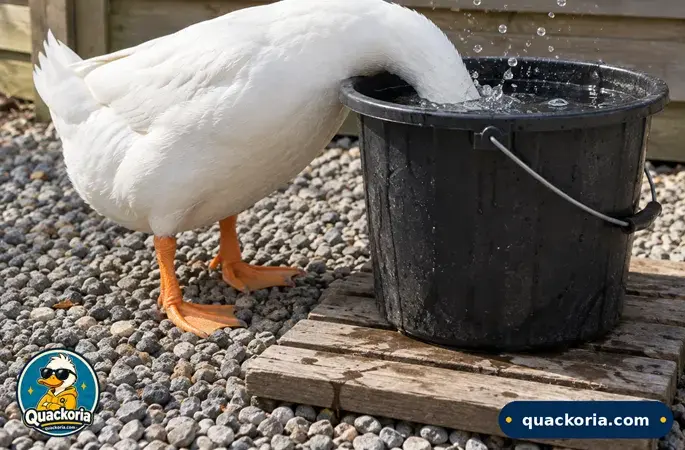
- Deep enough to submerge the whole bill and head, which is a health requirement rather than a preference — see below
- Feed offered in an amount they finish, not left standing in the wet
Water depth is a health requirement
A duck cleans its eyes and nostrils by dunking its head. In a study of ducks reared for meat, birds without the chance to at least dip their heads and splash their feathers with water could not keep their eyes, nostrils and feathers fully clean (Jones, Waitt and Dawkins, 2009).
The RSPCA’s welfare standard for farmed ducks puts numbers on it: from day old, open water that can “cover the head fully”, at least 4.5 cm deep; from 21 days, full-body access to water at least 10 cm deep. RSPCA Australia suggests shallow water of 10–20 cm where ducks can dabble and submerge their heads. DEFRA’s code recommends troughs deep enough for the ducks to get their heads completely under water, with no figure. Merck notes that waterfowl need up to five or six times as much water relative to feed as standard poultry.
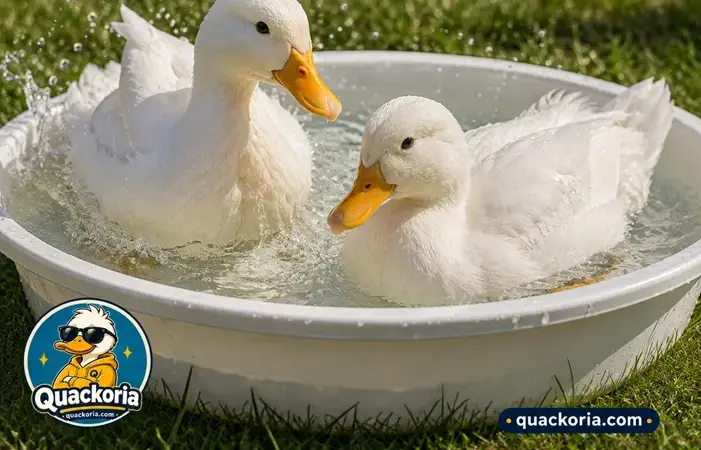
None of this needs a pond: a bucket or trough covers the head, and the RSPCA’s own advice for pet ducks is that a paddling pool or trough will do where there is no pond. We cover the difference in do ducks need a pond?
Treats, and the things to keep away
Treats should stay small — Metzer Farms says they “should not be a large part of your ducks’ daily feed” — or you undo the balance you paid for.
Generally fine: peas (frozen, thawed), lettuce and other greens, cucumber, courgette, sweetcorn, mealworms, dandelions, slugs and snails (all on Metzer’s treat list), and oats (on the Canal & River Trust’s list).
On the avoid lists of Metzer Farms and the Open Sanctuary Project:
- Onion, leek, chives — the Open Sanctuary Project says the thiosulphate in onions can cause haemolytic anaemia (Metzer says the same of onions, though it lists leeks among its treats)
- Chocolate and caffeine
- Salt — Merck says more than 2% salt in the ration is usually considered dangerous for chickens and turkeys, that 2% in the feed depresses growth in young ducks, and that birds under 21 days are more susceptible
- Rhubarb leaves, nightshade plants, green potatoes
- Dairy — Metzer: ducks are lactose intolerant
- Alcohol
- Anything mouldy — see above; this is the big one
Two frequently-listed items deserve a caveat rather than a ban. Avocado is dangerous to birds — the University of Illinois’s veterinary college and Metzer Farms both say so, and Metzer says persin can be fatal to ducks — but Merck’s avocado entry names budgies, canaries, cockatiels, ostriches, chickens and turkeys, not ducks, and gives no duck dose. Citrus: Metzer says it interferes with calcium absorption in ducks, and the Canal & River Trust and the Scottish SPCA say to avoid it, but we found no veterinary or university source on the mechanism. Both stay off the menu here.
The full dataset, with what is settled and what is disputed marked separately, is in the can ducks eat…? checker.
And bread
Short version: not toxic, and not much of a food.
No source calls bread toxic. The Canal & River Trust and the Scottish SPCA advise against it, the WWT’s Generation Wild activity says to avoid it, and New York’s DEC says the best thing for waterfowl is to stop artificial feeding altogether; the RSPB, according to the Real Bread Campaign, has no official position. But the Wildfowl & Wetlands Trust has also said bread is fine as long as it only forms a small part of the diet, and the Queen’s Swan Marker has called the claim that it is bad for swans “not correct”. Where they mention mould, they agree: never mouldy bread.
The angel wing argument is disputed. Indiana’s Department of Natural Resources says most cases are caused by a diet of bread; Professor Christopher Perrins, quoted in the Queen’s Swan Marker’s statement, says there is no evidence of a connection; and Today’s Veterinary Practice names high-energy food, rapid growth and genetics, with high levels of protein and carbohydrates among the nutritional culprits. The Canal & River Trust’s case against bread does not rest on it.
The full argument, with who says what, is in can ducks eat bread?
Foraging: what a duck feeds itself
Given space, ducks find some of their own food: eXtension notes that ducks allowed to forage for green plants, insects, snails and slugs can meet some of their nutritional needs that way.
This does not mean a backyard flock can live on foraging. Cornell’s Duck Research Laboratory says ducks fed that way will likely grow very slowly and produce a small number of eggs. Treat foraging as the thing that makes ducks worth keeping — they will clear your slugs — rather than as a feeding strategy.
What wild ducks eat, and why that is a different question from what to feed yours, is covered in what do ducks eat?
The short version
- Starter to 2 weeks (18–22.5% protein), grower after (16–19%), layer from about a month before the first egg or from the first egg (16–18%, calcium about 3%)
- Niacin 55 mg/kg in starter — Metzer and NC State agree, and it is the nutrient that lames ducklings when it is missing
- Chicken feed is a stopgap: chick starter needs niacin added, broiler starter already has it, turkey starter has too much protein
- Grit for whole grain (Metzer); grit is not oyster shell; oyster shell only for layers
- Mould is the hazard the duck sources single out — buy small, store sealed, bin anything musty
- Water that covers the whole head: at least 4.5 cm from day old, and from 21 days full-body water at least 10 cm deep (RSPCA farm standard)
- Water beside the feed, off the bedding, on a wire or slatted platform
Treats, one food at a time
Every treat question has its own page, with the USDA figures, what the duck sources say and the portion that keeps the complete feed doing its job: grapes, tomatoes, strawberries, bananas, rice, watermelon, lettuce, apples, carrots, corn, mealworms and cheese. The can-ducks-eat checker covers the rest, including the foods to keep away.
This is husbandry guidance, not veterinary advice. If a bird is ill or injured, find an avian vet.
Frequently asked questions
Can ducks eat chicken feed?
As a stopgap, with a caveat that depends which one. Cornell's Duck Research Laboratory calls chicken feed a satisfactory substitute if duck rations are not available. eXtension says chick starter needs niacin added for ducks, broiler starter is made for a bird with a niacin requirement similar to a duck's, and turkey or game bird starter has enough niacin but protein high enough to be detrimental to ducklings. Buy duck feed if you can.
How much niacin do ducklings need?
55 mg per kg of feed, published by Metzer Farms. NC State Extension gives 25 mg per pound in starter, which is the same figure in different units, and 20 mg per pound after two weeks. Metzer describes deficiency as a reluctance to move, then swollen hocks and bowed legs.
Is medicated chick starter safe for ducklings?
The sources are cautious rather than alarmed. Minnesota Extension says incorrect use of certain medicated feeds formulated for chickens and turkeys could harm ducklings. Metzer Farms reports a trial (Holderread, with Oregon State University) in which amprolium, sulfaquinoxaline or zoalene at chicken and turkey use levels did not cause mortality, stunting or cripples in Khaki Campbell ducklings to four weeks. NC State adds that some broiler feeds contain medications not FDA-approved for ducks. Metzer prefers non-medicated starter when it is equally nutritious.
Do ducks need grit?
Metzer Farms says grit is needed for whole grains and not needed on pellets, crumble or mash, because the feed is already ground; Minnesota Extension's fact sheet simply says to provide insoluble grit. Grit is not oyster shell - grit is insoluble and mechanical, oyster shell dissolves to supply calcium and belongs only to laying birds.
Is bread bad for ducks?
No source calls it toxic. The Canal & River Trust, the Scottish SPCA and the WWT's Generation Wild advise against it and NY DEC discourages feeding waterfowl at all; the WWT has also said it is fine as a small part of the diet, and the Queen's Swan Marker calls the claim that it is bad for swans "not correct". Whether bread causes angel wing is disputed: Indiana's DNR says most cases are caused by bread, while Professor Perrins, quoted by the Swan Marker, says there is no evidence of a connection. All sides agree on never feeding mouldy bread.
Sources
- NC State Extension, Feeding Ducks
- eXtension, Feeding Ducks Intended for Consumption
- Metzer Farms — Duck and Goose Feed Nutrition (minimum nutrient requirements)
- Merck Veterinary Manual, Management of Backyard Poultry
- eXtension (Jacquie Jacob, University of Kentucky) — Feeding Ducks for Egg Production Kept in Small Flocks
- University of Minnesota Extension — Raising Ducks (Poultry Fact Sheet 43)
- Cornell University Duck Research Laboratory — Duck Nutrition
- Cornell University Duck Research Laboratory — Duck Health Care (aflatoxin)
- Merck Veterinary Manual — Poisonings in Poultry
- Merck Veterinary Manual — Avocado (Persea spp) Toxicosis in Animals
- Metzer Farms — Niacin Deficiency and Leg Problems
- Metzer Farms — Determining How to Supplement Your Ducks' Diet with Niacin
- Merck Veterinary Manual — Nutrient Requirements of Pekin Ducks (National Research Council, 1994)
- Metzer Farms — Can Medicated Feeds Be Used for Waterfowl?
- Metzer Farms — Grit: Do Ducks Need It or Not?
- University of Georgia Extension — Keep Feed "Healthy" in the Summer (Dale, 1999)
- Metzer Farms — Treats Your Ducks Will Love
- Metzer Farms — Foods Ducks Should Not Eat
- The Open Sanctuary Project — Things That Are Toxic To Ducks
- University of Illinois College of Veterinary Medicine — Bad for Birds: Prevent Poisoning in Avian Pets
- Today's Veterinary Practice — Treating Angel Wing Deformity: A Sling for the Wing (Wade, 2022)
- Indiana Department of Natural Resources — Angel Wing Syndrome
- RSPCA — Welfare standards for domestic/common ducks (June 2023)
- RSPCA — Outdoor areas for pet ducks and geese
- RSPCA Australia — How should I care for my pet ducks?
- DEFRA — Code of recommendations for the welfare of livestock: ducks
- Jones, Waitt & Dawkins (2009), Water off a duck's back: showers and troughs match ponds for improving duck welfare, Applied Animal Behaviour Science 116:52–57
- Metzer Farms — How do I keep it dry around my duck and goose drinkers?
- Canal & River Trust — Why is bread bad for ducks?
- Canal & River Trust — What do ducks eat? 6 things you can feed ducks
- Scottish SPCA — What to feed ducks
- New York State Department of Environmental Conservation — Stop Feeding Waterfowl
- Wildfowl & Wetlands Trust, quoted in Discover Wildlife — Should we feed bread to ducks?
- Wildfowl & Wetlands Trust, Generation Wild — Feed a bird
- The Swan Sanctuary — Official statement on bread from the Queen's Swan Marker (2018)
- Real Bread Campaign (Sustain) — Should I give bread to ducks and swans? (on the RSPB's position)