Quackoria Care
Keeping Muscovy Ducks: The Duck That Is Not a Mallard
Almost everything written about ducks is written about Mallard descendants, and the Muscovy is not one. It is a different species from a different continent with different instincts, and a keeper who treats it like a Pekin will be surprised in at least five ways. This is the breed on its own terms — what is genuinely different, what the sources agree on, and where they do not.
Key takeaways
- Cairina moschata, from Mexico to Argentina — not a Mallard descendant. Most duck advice is written for a different bird.
- Quiet: Cornell Lab calls Muscovies 'usually silent' and Metzer says they have no loud quack. Females give a quiet quack or croak; males hiss.
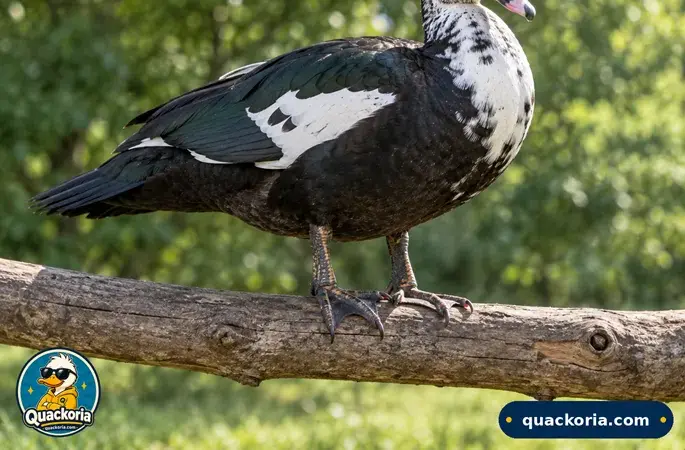
- Flies and perches. Metzer rates flying 'Excellent'; Cornell describes roosting high in trees. Roof the run or clip.
- Claws for perching. Wear gloves to handle them (Metzer).
- 35 days to hatch in an incubator; Cornell Lab gives 30–31 for the wild nest. Crosses with other ducks are sterile mules or hinnies.
- Drakes 10–12 lb, females 5–6 lb (eXtension). More sensitive to cold than other breeds, with frostbite on the bare face (Open Sanctuary Project); better in heat than common ducks (Cornell).
- 100–150 eggs a year (Metzer), but mothering rated 'Excellent' — the only breed on Metzer's chart so rated.
What you need
- A roofed run, or the willingness to clip a wing
- A perch in the house — Muscovies prefer to sleep off the ground
- Gloves and long sleeves for handling
- Extra space per bird for the drakes
- A very dry, draught-free house for winter
Not a Mallard, and not really “a duck” in the usual sense
Every domestic duck you can name — Pekin, Runner, Campbell, Cayuga, Rouen, Call — descends from the wild Mallard, Anas platyrhynchos. The Muscovy is Cairina moschata, a separate species from the tropical forests of the Americas. Cornell Lab of Ornithology gives its native range as coastal and lowland habitats from northern Mexico to Argentina, in heavily wooded country along lakes, lagoons, mangrove swamps and slow streams.
That origin explains most of what follows. A wild Muscovy is a bird of warm forests that nests in tree cavities, perches on branches, and eats animal as well as plant food. It is a duck in the broad sense — it dabbles, it swims, it has webbed feet — but it is a perching, clawed, usually silent duck that flies well enough to treat a fence as a suggestion.
It was domesticated in the Americas: Cornell Lab of Ornithology says it was already being kept by native people in Peru and Paraguay when the early Spanish explorers arrived.
What is different — the five surprises
1. They are quiet
Cornell Lab of Ornithology calls Muscovies “usually silent”. The females give a quiet quack or croak when frightened and a soft call to their ducklings; the males hiss and puff during courtship, and eXtension says Muscovies “hiss like a goose”. Metzer describes them as calmer and quieter than other ducks, with no loud quack, which makes them a reasonable choice where neighbours are close.
Metzer’s FAQ, describing mule ducks, says they share the Muscovy’s characteristics: “large, quiet, slow moving and have long claws”. Slow-moving on the ground, that is. See below.
2. They fly, and they perch
Metzer rates Muscovy flying ability as “Excellent” — the only common domestic breed with that rating, against “None” for Pekins, Runners, Cayugas and most of the rest. Cornell describes the wild bird perching in trees by day and roosting high in trees at night, often in groups.
A domestic Muscovy does something similar: Metzer says that, as a flying duck, it “will often perch in trees”, and that Muscovies can fly quite well. The practical problem is a bird that flies over the fence.
Which means: a Muscovy run needs a roof, or the birds need a wing clip, or you accept that they go where they like. The predator guide covers roofing a run; for a Muscovy it is as much about keeping the ducks in as keeping the fox out.
3. They have claws
Perching birds need to grip, and Oklahoma State’s breed register says a Muscovy’s feet “are equipped with strong sharp claws for grasping tree branches and roosting”. They are also, when the bird is picked up wrongly, for forearms.
The handling rule for all ducks — never by the legs, wings closed, weight from below — is in how to hold a duck. The Muscovy addition is protection: Metzer says Muscovies, “especially the males, are very strong and it is best to use gloves when handling them because of their sharp nails”, and the Humane Slaughter Association also recommends gloves. The Open Sanctuary Project suggests a thick, long-sleeved shirt for the arms.
4. They incubate for 35 days, not 28
The hatchery and extension sources give the domestic Muscovy about 35 days — Cornell’s Duck Research Laboratory, eXtension, Penn State, Metzer, and Mississippi State (which gives 35–37). A keeper who sets Muscovy eggs on a 28-day calendar will open the incubator a week early.
Cornell Lab of Ornithology, describing the wild bird on the nest, gives 30–31 days. That is a real gap between the ornithological and the hatchery figure, and we cannot resolve it — it may be wild versus domestic, natural nest versus incubator, or measurement. Plan for 35 in an incubator and do not panic at an early pip. The incubation guide covers the settings and the hatch calculator has the 35-day option.
5. Crossing them with other ducks produces mules
Because it is a different species, a Muscovy crossed with a Mallard-type duck produces sterile offspring — genuinely, in the way a horse and a donkey do. Metzer’s description: a Muscovy drake on a Pekin female gives a mule duck; the reverse cross, a Pekin drake on a Muscovy female, gives a hinny. Both male types are sterile. Hinny females lay, but the eggs will not hatch.
Mule eggs take 32 days, between the two parents. About 60% of mules are male. And left to themselves the two species mate badly: Metzer puts natural fertility at only 20–30%, against about 80% with artificial insemination, and its FAQ says the chances are poor that a Muscovy and a Pekin kept together will cross — so an accidental mule in a mixed backyard flock is less likely than the drake’s efforts suggest.
The practical point for a keeper: if you want purebred ducklings from your Mallard-type ducks, any that a Muscovy drake fathers will be sterile mules. Separate them before the breeding season.
Size, and how much they eat
Big, and with a very large gap between the sexes. eXtension gives Muscovy drakes at 10–12 lb (4.5–5.4 kg) and females at 5–6 lb (2.3–2.7 kg); Metzer’s table spans 6.5–13 lb for the breed. Metzer says adult males are “almost twice the size of females”; the Cornell Duck Research Laboratory puts the male at 30–50% heavier. Either way the gap matters for housing and handling.
They eat accordingly. Cornell lists the wild bird’s food as grasses, sedges, seeds and tubers alongside insect larvae and adults, spiders, crustaceans, molluscs, worms, small fish and small reptiles, and notes that in the tropics it eats termites. Metzer calls domestic Muscovies excellent foragers, “eating larger amounts of grass than other types of domestic ducks”. Feed as any other duck — the feeding guide applies — and expect more of it.
Cold: the one thing they do badly
A bird from Mexico to Argentina is not built for a northern winter. The Open Sanctuary Project says Muscovy ducks “tend to be more sensitive than other breeds” to the cold. The fleshy red skin around the face — the caruncles — is bare, and the same source notes that Muscovies “can also develop frostbite on their caruncles”; the feet are at risk too, since “All ducks can develop frostbite on their feet”.
What helps: a dry, draught-free house they will actually use (a bird that would rather roost in a tree may need shutting in), deep dry bedding — Maryland Extension warns that air blowing directly on birds can chill them, and says three to four inches of pine shavings or straw provides good insulation — and unfrozen water they can dunk their heads in. The British Waterfowl Association says all waterfowl need to be able to immerse their heads fully, and the head-washing requirement in duck water needs does not pause for winter. The general winter routine is in keeping ducks in winter; for a Muscovy, read it as more urgent.
The flip side is heat: the Cornell Duck Research Laboratory says “Muscovies tolerate hot weather much better than common ducks.” In a hot climate that is a good reason to choose them.
Temperament and the flock
Cornell’s note on the wild bird is that males “behave aggressively toward each other throughout the year” but “do not defend breeding territories”, and that Muscovies are often seen in pairs “even though individuals have multiple mates”.
Drakes fight. Cornell says males “may fight ferociously with each other in ponds”, and the British Waterfowl Association says wild drakes “often fight over food, territory or mates”. Give them plenty of space, or — if you do not want ducklings — keep females only, which removes the drake fights altogether.
Towards people, they are calm: Metzer scores them 1.0, the “Very Calm” end of its temperament scale, and Oklahoma State’s breed register says “They are considered friendly ducks but are wary of humans.” What they are not is a lap bird: the size, the claws and the general dignity of the animal argue against it.
Towards small animals, they are predators in a small way: Cornell lists small fish and reptiles among the wild bird’s foods, and the British Waterfowl Association adds amphibians.
Eggs and mothering
Muscovies are not egg ducks. Metzer’s table gives 100–150 eggs a year, against 200–290 for its best layers, and 75–85 grams for each egg.
What Muscovies are, by Metzer’s account above every other domestic duck, is mothers. Metzer rates their mothering ability “Excellent” — the only breed on its chart with that rating (the Mallard is “Very Good”) — and says “There is no breed of duck that does a better job of hatching and raising their young.” Of the eggs, it says: “Oftentimes they are difficult to hatch in an incubator but a broody Muscovy will do an excellent job”. Cornell gives the wild clutch as 8–15 eggs, and says the female “defends the nest and cares for the nestlings on her own”.
If you want to hatch ducklings with the least effort and the best result, a broody Muscovy is the way. The management of a sitting duck is in broody ducks; the one Muscovy difference is the extra week.
She will also sit on other birds’ eggs: the British Waterfowl Association says domestic Muscovies are often used as “broodies” for incubating other waterfowl eggs.
Housing a Muscovy
The duck house guide applies, with three changes:
- A perch. The Open Sanctuary Project says Muscovies “typically choose to sleep up off the ground when given the opportunity”, and that some will use a flat board-style perch “as long as the board is at least as wide as their feet”. Because mature drakes are so large, it advises tiered designs or lower roosts, so a heavy bird does not have to fly or jump down from a height.
- A roof on the run, or a wing clip, for the fliers.
- More space per bird is sensible, because the drakes are almost twice the size of the females (Metzer). None of the sources gives a separate Muscovy figure; the space calculator has the published figures for ducks in general.
Water: the same as any duck — see duck water needs. Oklahoma State’s breed register says Muscovies “do not swim much because their oil glands are under developed compared to most ducks”, but the head-washing requirement is the same.
Is a Muscovy the right duck?
Yes, if: noise is the constraint; you are in a warm climate; you want a bird that forages hard; you want to hatch and raise ducklings with the least intervention; you like a calm, characterful, unusual bird.
No, if: you want a lot of eggs; you have cold winters and cannot house them well; you cannot roof the run or clip wings and cannot lose a bird over the fence; you want to breed your Mallard-type ducks and would have to keep a Muscovy drake away from them.
The wider breed comparison is in duck breeds: a beginner’s guide, and the question of how many and which sexes in how many ducks to keep.
The short version
- A different species (Cairina moschata) from tropical America, not a Mallard descendant
- Quiet — “usually silent” (Cornell Lab), with no loud quack (Metzer)
- Flies and perches: Metzer rates flying “Excellent”. Roof the run or clip wings.
- Claws. Wear gloves to handle them (Metzer).
- 35 days to hatch in an incubator; Cornell Lab gives 30–31 for the wild nest — an unresolved gap
- Crosses with other ducks are sterile mules or hinnies; natural cross-fertility only 20–30% (Metzer)
- Drakes 10–12 lb, females 5–6 lb (eXtension) — twice the size
- More sensitive to cold than other breeds, with frostbite on the face (Open Sanctuary Project); better in heat than common ducks (Cornell)
- 100–150 eggs a year, but mothering rated “Excellent”
This is husbandry guidance, not veterinary advice. If a bird is ill or injured, find an avian vet.
Frequently asked questions
Are Muscovy ducks quiet?
Quiet, not silent. Cornell's Lab of Ornithology says Muscovies are usually silent: females give a quiet quack or croak when frightened, and males hiss and puff during courtship. Metzer describes them as calmer and quieter than other ducks, with no loud quack, which makes them a reasonable choice where neighbours are close.
Can Muscovy ducks fly?
Yes, well — Metzer rates their flying 'Excellent', the only breed on its chart with that rating, and Cornell describes the wild bird roosting high in trees. A Muscovy run needs a roof, or the birds need a wing clip, or you accept that they go over the fence.
How long do Muscovy eggs take to hatch?
35 days in an incubator, per Cornell's Duck Research Laboratory, eXtension, Penn State, Metzer and Mississippi State (35–37). Cornell Lab of Ornithology gives 30–31 days for the wild bird on its nest — a discrepancy we cannot resolve. Plan for 35.
What happens if a Muscovy breeds with a Pekin?
A sterile mule. Metzer: a Muscovy drake on a Pekin female gives a mule duck, the reverse cross a hinny; both male types are sterile and hinny females lay infertile eggs. Mule eggs take 32 days and about 60% are male. Natural cross-fertility is only 20–30%, so an accidental mule is less likely than the drake's efforts suggest.
Can Muscovy ducks survive cold winters?
With care. The Open Sanctuary Project says Muscovies tend to be more sensitive to the cold than other breeds and can get frostbite on their caruncles, the bare red skin on the face; any duck can get it on its feet. A dry, draught-free house they will actually use, deep dry bedding and unfrozen water to dunk in. In heat they do better: the Cornell Duck Research Laboratory says they tolerate hot weather much better than common ducks.
Sources
- Cornell Lab of Ornithology — Muscovy Duck life history
- eXtension (Jacob, University of Kentucky) — Selecting a Duck Breed for Small or Backyard Poultry Flocks
- Metzer Farms — Compare Duck Breeds
- Metzer Farms — How Mule Ducks Are Created
- Cornell Lab of Ornithology — Muscovy Duck sounds
- Cornell Lab of Ornithology — Muscovy Duck overview
- Cornell University Duck Research Laboratory — Hatching Duck Eggs
- Cornell University Duck Research Laboratory — Domestic Ducks
- Penn State Extension 4-H Embryology — Incubation period of other species
- Mississippi State University (Smith) — Care and Incubation of Hatching Eggs
- Metzer Farms — Muscovy Ducks
- Metzer Farms — FAQ
- Oklahoma State University — Breeds of Livestock: Muscovy Ducks
- British Waterfowl Association — Muscovy (wild)
- British Waterfowl Association — Ponds
- The Open Sanctuary Project — Creating a Good Home for Ducks
- The Open Sanctuary Project — Gentle Handling and Restraint for Ducks
- Humane Slaughter Association — Catching and handling: ducks
- University of Maryland Extension FS-1133 — Winter Weather and Small Flocks: What You Need to Know