Quackoria Learn
How Do Ducks See? Panoramic Vision and Four Kinds of Colour
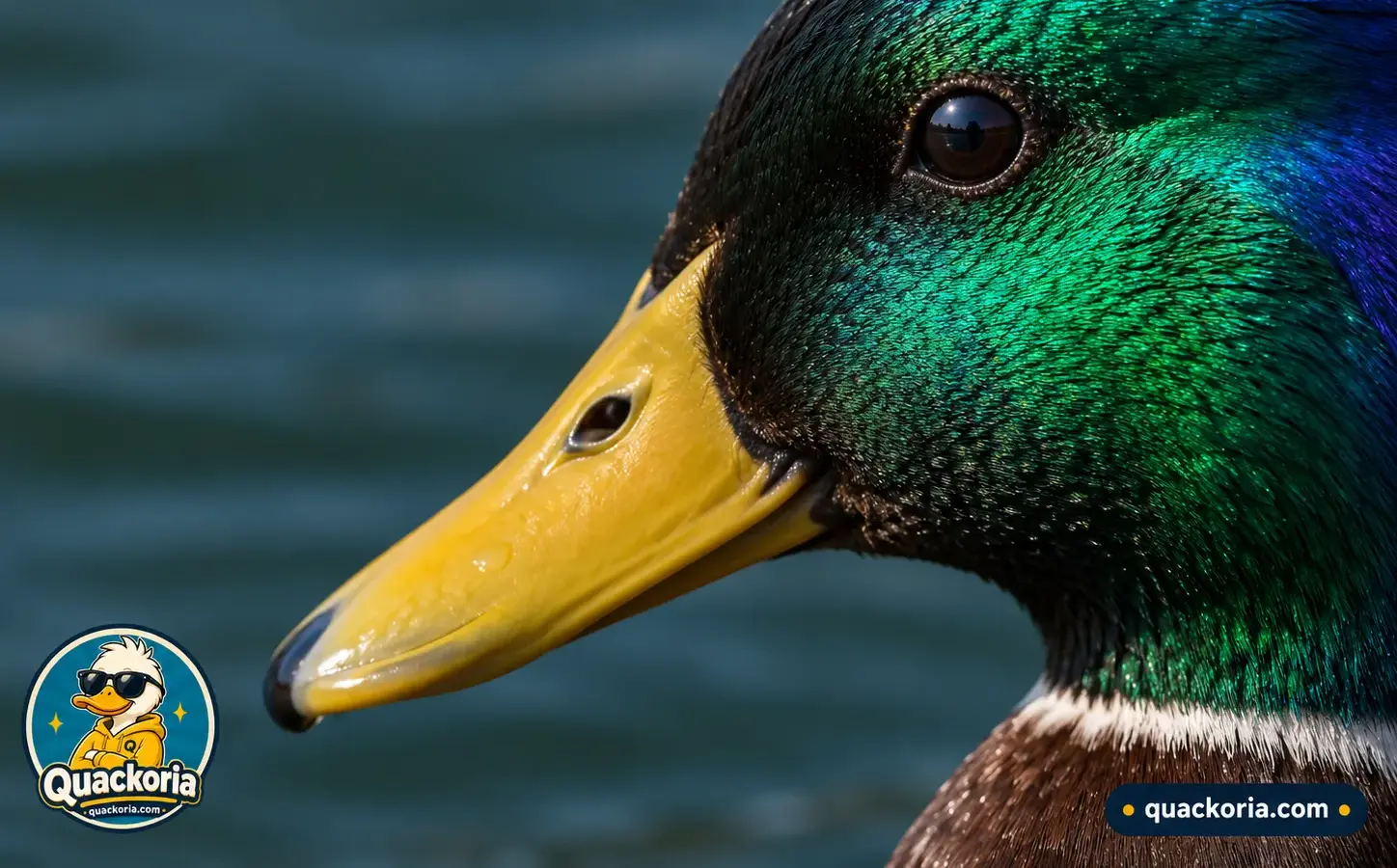
A mallard's eyes are set high on the sides of its head, and the result is complete visual coverage of the sky above and around it — no blind spot behind. It has four types of colour-detecting cone where you have three. What it does not have is a cone tuned to ultraviolet or, as far as a study of twelve waterfowl species could find, a fovea — and there is no evidence that its third eyelid works like goggles, whatever you have read.
Key takeaways
- Mallards have panoramic vision — complete coverage of the sky above and around the head, with no rear blind area.
- They are tetrachromatic: four cone types, demonstrated directly in mallards in 1988.
- They are violet-sensitive, not ultraviolet-sensitive. Many birds have a cone tuned to UV; the mallard is among those that do not.
- No fovea was found in a study of twelve waterfowl species. Instead they have a horizontal visual streak — an adaptation for scanning the horizon rather than for pin-sharp detail.
- The widely quoted “340 degrees” and “sees three times further than a human” figures trace to uncited pages and are not supportable.
Seeing the whole sky
Graham Martin’s work on avian visual fields, which includes a 1986 paper on the mallard specifically, classifies the mallard as what he calls a Type 2 visual field. His description of that type is remarkable: “the bird gains panoramic vision above and around the head, i.e. it has complete visual coverage of the celestial hemisphere. There is no blind area above or to the rear.”
Think about what that means for a bird on the water. A hawk cannot approach from behind. There is no direction from which something can drop out of the sky unseen. For an animal that spends its life as prey with its head down in the water, that is worth a great deal.
It is paid for at the front. Type 2 birds have a binocular field — the narrow zone both eyes see at once, which is where depth perception comes from — of ten degrees or less, with the bill at the very edge of vision or outside it entirely. For comparison, most birds have 20 to 30 degrees, and owls have about 50. A mallard essentially cannot look at its own bill.
That is fine for a duck, because a dabbling duck does not need to see its food. It strains it out of water and mud by touch, using the ridges along the bill edge. Those ridges are what makes the eyes free to do something else entirely.
The 340-degree figure, and why we are not using it
Search this subject and you will be told, over and over, that ducks have a 340-degree field of view.
We tried to find where that came from. It traces to Ducks Unlimited, which states it without a citation — and which, on a different page, states that mallards have a 360-degree lateral viewing window. Those two pages disagree with each other and neither cites anything. The 360-degree version is at least consistent with the primary literature; the 340-degree one, which is the figure that gets repeated, is not.
The published claim is not a number of degrees at all. It is Martin’s stronger and stranger statement: complete coverage of the sky, no blind area behind. Quoting a degree figure actually understates it.
There is a real disagreement in the literature worth knowing about too. A 2023 study of 39 waterfowl species gives the mallard a maximum binocular field width of 22 degrees, where Martin’s classification puts Type 2 birds at ten or less. Martin is a co-author on both. Whatever the reason for the difference, it means neither figure should be quoted alone.
The trade-off, seen within one family
The clearest way to understand what a duck’s eyes cost and buy is to compare two ducks.
Martin measured the New Zealand blue duck, which hunts aquatic invertebrates visually in fast rivers, against the pink-eared duck, which filter-feeds:
- Blue duck: binocular field 34 degrees, bill visible within it, and a blind area 48 degrees wide behind the head.
- Pink-eared duck: binocular field 17 degrees, bill at the periphery, and no rear blind area at all.
The blue duck moved its eyes forward to see what it was catching, and bought that with a hole in its awareness behind. The pink-eared duck kept the full circle and gave up seeing forwards. Across 39 species, maximum binocular width ranges from 16 degrees in the snow goose to 38 in the long-tailed duck — and the differences line up with how each bird feeds, not with how closely related they are.
Mallards sit near the pink-eared end. They are, visually, built to notice things rather than to examine them. This is the same trade-off that makes the one-eye-open sleep in how ducks sleep work: a single laterally placed eye covers an entire flank on its own.
Four colours — but not ultraviolet
In 1988, Jane and Bowmaker measured the light-absorbing pigments in mallard retinas directly. They found four types of single cone, absorbing maximally at about 420, 452, 502 and 570 nanometres, plus double cones and rods. Four cone types against your three: mallards are tetrachromatic, and unlike most claims about bird vision, this one was measured in ducks rather than assumed from other birds.
They also have coloured oil droplets sitting in front of the cones, acting as cut-off filters. The effect is to sharpen the separation between colour channels — a piece of optical engineering with no equivalent in the human eye.
Now the correction. That shortest-wavelength cone peaks at about 420 nm. That is violet. Ultraviolet is shorter.
Birds come in two types: violet-sensitive and ultraviolet-sensitive, depending on which version of a particular opsin gene they carry. Genetic surveys place the mallard firmly in the violet-sensitive group. UV sensitivity has evolved repeatedly among birds — in parrots, songbirds, gulls and others — and the mallard, the one waterfowl species in the 2003 survey, is not among them.
So “ducks can see ultraviolet” is a true statement about many birds applied to a bird that lacks the ultraviolet-tuned cone. Its eye filters ultraviolet too: a 1999 review of avian UV vision notes that birds vary in their sensitivity to UV, and names the mallard as the only bird then known whose ocular media appear to contain pigments that reduce short-wave transmission, letting through only half the light at about 380 nm. Ducks Unlimited’s page on bird vision makes exactly this slip, treating tetrachromacy and UV vision as the same thing. They are not: a fourth cone can be violet.
No fovea, and what ducks have instead
Here is the fact that reframes the whole subject.
A 2013 study of retinal structure across twelve waterfowl species found no fovea in any of them — no pit of densely packed cones giving a small zone of exceptional acuity. Its authors suggest that waterfowl either lack one or have only relatively shallow foveas. A well-developed fovea is what an eagle has, and it is why an eagle can resolve detail we cannot.
What waterfowl have instead is an oblique visual streak: a band of higher cell density running across the retina. And because a duck holds its head with the bill angled down, that streak sits horizontally — so the horizon is exactly what gets sampled at higher resolution.
That is not worse than a fovea. It is a different instrument for a different job. An eagle needs to resolve a mouse at range. A duck needs to notice movement anywhere along the skyline, in any direction, while feeding. The retina is built for the second problem.
Which is why the other figure you will see everywhere — Ducks Unlimited’s claim that birds see fine detail “two-and-a-half to three times farther away than people can”, applied to ducks — should be treated with suspicion. It is uncited where we found it, and the retinal anatomy points the other way. The same 2013 study estimated peak acuity from retinal cell density and eye size for seven waterfowl species: 11.9 cycles per degree for the mallard, against 73–143 for diurnal hawks and eagles. That is an anatomical estimate rather than a behavioural test, but the gap is wide: a 2017 study of raptor eyes notes that large raptors such as wedge-tailed eagles have about twice the spatial resolution of humans. A bird without a fovea is not a candidate for exceptional peak acuity.
The third eyelid is not a pair of goggles
Ducks have a nictitating membrane — a translucent third eyelid that sweeps across the eye sideways. It protects and moistens the cornea, and it is genuinely useful for a bird that puts its face in water.
What there is no evidence for is that it acts as a contact lens for underwater vision, despite that being one of the most repeated facts about ducks anywhere.
The idea was tested in 1978. The finding was negative on three independent measures: the refractive indices of the cornea and the nictitating membrane are nearly identical, at about 1.37; the membrane does not change the refractive state of the eye; and its curvature when drawn across the eye is virtually the same as the cornea’s. It cannot be correcting anything, because optically it is barely there.
One honest caveat: that study describes its subjects as “a number of aquatic birds”, and we could not confirm that ducks were among them. So the precise position is that the goggles hypothesis has been tested in aquatic birds and rejected, and has not been separately tested in ducks. It is not something we would state as a duck fact in either direction.
Can ducks see underwater?
Not sharply, and for a reason that has nothing to do with the third eyelid. Water and the cornea have nearly the same refractive index, so the moment any air-adapted eye goes under, the cornea stops doing most of its focusing and the image lands behind the retina — a blur. In a 2020 optical model of a hooded merganser’s eye, that loss came to “approximately 56 dpt”, or dioptres, of focusing power.
Diving ducks have an answer, and it has been measured. The merganser forces its soft lens through a rigid pupil to make a small, strongly curved bulge, and the same paper reports “an even higher accommodation response of about 80 dpt was determined by Sivak et al. (1985), who examined the focal shift of enucleated eyes” — enough to hunt by, though the same model puts the merganser’s underwater acuity at roughly a third of what it is in air. We could not find a published figure for a dabbling duck such as the mallard, and mallards do not seem to need one: a 2017 study of the duck bill describes waterfowl as “tactile-specialist birds” that “efficiently select edible matter in muddy water without visual or olfactory cues”, because “most trigeminal neurons in ducks are touch receptors”. A mallard with its head under water is feeling for food, not looking for it.
What it all adds up to
A mallard’s visual system is a coherent design, and every piece of it points the same way.
Eyes high and to the sides, giving complete coverage of the sky. A retina that samples the horizon at higher resolution than anywhere else. Four colour channels with filtering oil droplets. Almost no forward binocular vision, because the bill works by touch and does not need watching. And a brain that can shut down one hemisphere while the eye connected to the other keeps that panoramic coverage running — with a reaction time of 0.165 seconds if something comes at it.
None of that is built for scrutiny. All of it is built for not being caught. It is the visual system of an animal that has been prey for a very long time and has got extremely good at it.
If you want the behavioural half of the same story, it is in how ducks sleep. And if you want to know what those eyes are usually pointed at, what ducks eat is the answer most of the time. The sense that comes second, and where the ears you cannot see are hidden, is in do ducks have ears.
Frequently asked questions
How wide is a duck's field of vision?
Wider than a degree figure captures. The primary research describes mallards as having complete visual coverage of the sky above and around the head, with no blind area behind. The commonly quoted “340 degrees” traces to uncited pages that contradict each other.
Can ducks see in colour?
Yes, with more colour channels than you have. Mallards have four types of colour cone against your three, measured directly in 1988, plus coloured oil droplets that sharpen the separation between channels.
Can ducks see ultraviolet light?
Not in the way many birds can. Many birds have a cone tuned to ultraviolet; the mallard does not — it is violet-sensitive, with its shortest cone peaking at about 420 nm, and its eye's optical media let through only half the light at about 380 nm. Tetrachromatic does not mean ultraviolet.
Do ducks see better than humans?
Not in the way it is usually claimed. A 2013 study of twelve waterfowl species found no fovea — no zone of exceptional acuity — and instead a horizontal streak suited to scanning the horizon. Its anatomical estimate of the mallard's peak acuity is 11.9 cycles per degree, against 73–143 for diurnal hawks and eagles, and the “three times further than a human” figure is uncited where we found it.
Do ducks have a third eyelid for seeing underwater?
They have a third eyelid, but there is no evidence that it works as goggles. A 1978 study of aquatic birds found the membrane has nearly the same refractive index and curvature as the cornea and does not change the eye's focus; we could not confirm that ducks were among the birds tested. It protects and moistens the eye.
Can ducks see underwater?
Not sharply. Water has nearly the same refractive index as the cornea, so an air-adapted eye loses most of its focusing power the moment it goes under, and there is no evidence that the third eyelid corrects that. Diving ducks compensate: a hooded merganser squeezes its lens through the pupil and has been measured at about 80 dioptres of accommodation. Dabbling ducks such as mallards feed under water mainly by touch, with a bill tip packed with mechanoreceptors.
Sources
- Martin (2007), Visual fields and their functions in birds, Journal of Ornithology 148
- Cantlay et al. (2023), Binocular vision and foraging in ducks, geese and swans, Proc. R. Soc. B 290:20231213
- Martin, Jarrett & Williams (2007), Visual fields in Blue Ducks and Pink-eared Ducks, Ibis 149
- Jane & Bowmaker (1988), Tetrachromatic colour vision in the duck, J. Comp. Physiol. A 162:225–235
- Ödeen & Håstad (2003), SWS1 opsin sequencing, Molecular Biology and Evolution 20:855–861
- Ödeen & Håstad (2013), Phylogenetic distribution of ultraviolet sensitivity in birds, BMC Evolutionary Biology 13:36
- Lisney et al. (2013), Eye shape and retinal topography in waterfowl, J. Comp. Physiol. A
- Sivak, Bobier & Levy (1978), The refractive significance of the nictitating membrane of the bird eye, J. Comp. Physiol. 125:335–339
- Urban et al. (2020), Amphibious vision — optical design model of the hooded merganser eye, Vision Research 175
- Sivak, Hildebrand & Lebert (1985), Magnitude and rate of accommodation in diving and nondiving birds, Vision Research 25
- Schneider et al. (2017), Molecular basis of tactile specialization in the duck bill, PNAS 114
- Rattenborg, Lima & Amlaner (1999), Half-awake to the risk of predation, Nature 397:397–398
- Mitkus et al. (2017), Specialized photoreceptor composition in the raptor fovea, Journal of Comparative Neurology
- Cuthill, Partridge & Bennett (1999), UV vision and its functions in birds, Proc. 22nd International Ornithological Congress
- Bowmaker, Wilkie & Hunt (1999), Photoreceptors and molecular genetics of visual pigments, Proc. 22nd International Ornithological Congress
- Encyclopaedia Britannica — Nictitating membrane
- Ducks Unlimited — Amazing Waterfowl Facts (source of the 340-degree figure)
- Ducks Unlimited — A Bird's-Eye View (source of the 360-degree, UV and acuity claims)