Quackoria Learn
Dabbling Ducks vs Diving Ducks: How to Tell Them Apart
Watch how they leave the water. A dabbling duck springs almost vertically into the air. A diving duck has to run across the surface, flapping, before it can get airborne — because its wings are smaller. Its legs, too, are set far back, for swimming rather than walking.
Key takeaways
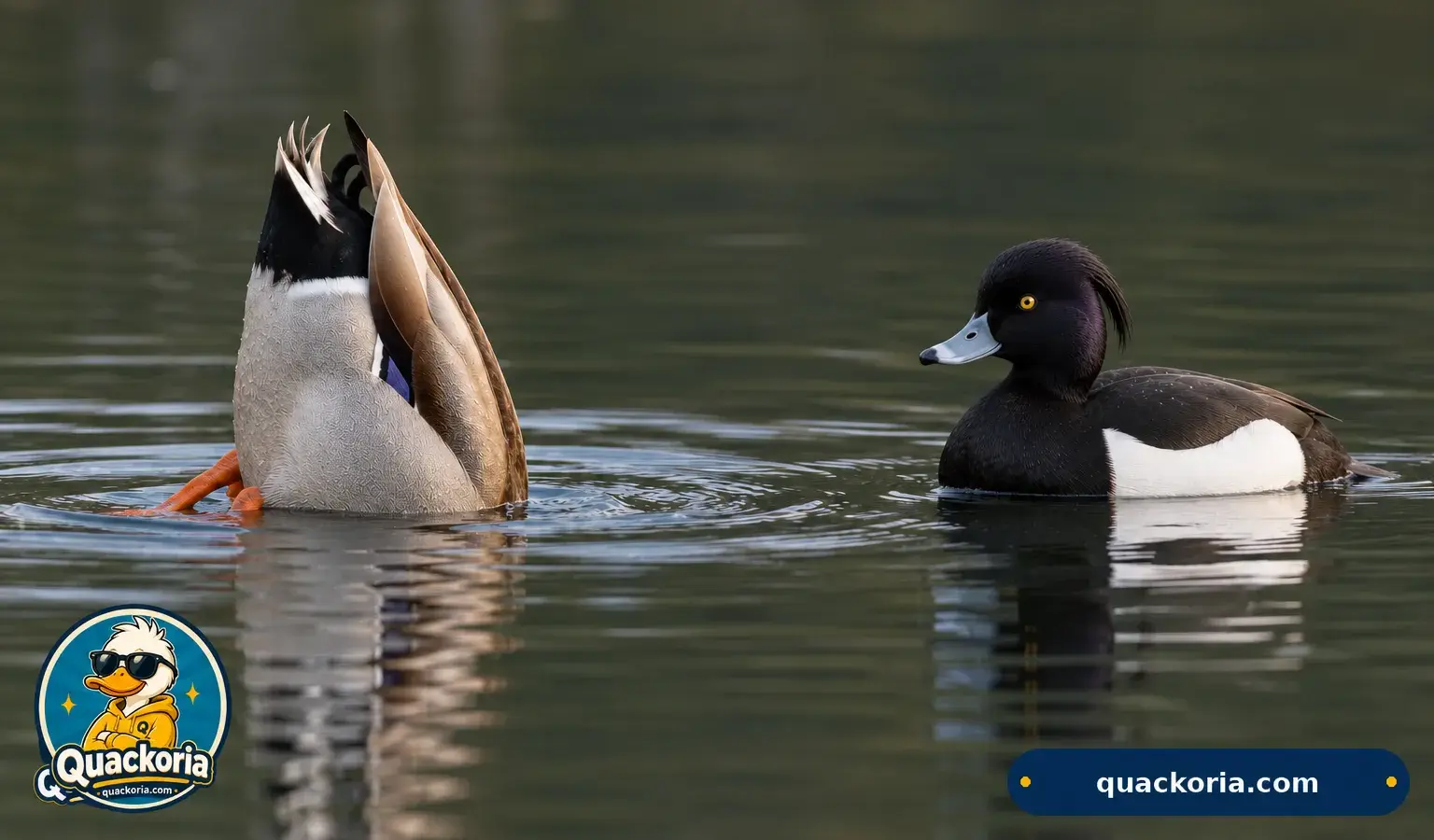
- Dabblers tip up and feed near the surface. Divers go under, and some go a long way under.
- A dabbler springs straight off the water. A diver runs along the surface to take off, and lands in a long splashing glide.
- Divers have legs set further back, larger feet with a lobed hind toe, and smaller, swept-back wings.
- Tufted ducks average about 20 seconds underwater at 3–14 m. Long-tailed ducks are the deepest, reported at over 60 m.
- “Diving duck” is field shorthand, not taxonomy; “dabbler” roughly matches a real group, the tribe Anatini. Sea ducks are a real biological group too.
The take-off tells you everything
If you only learn one distinction, learn this one, because you can use it at a hundred metres.
The Pennsylvania Game Commission states it directly: “Instead of springing straight out of the water into flight, as puddle ducks are able to do, diving ducks must run across the water to build up speed before taking off.” Missouri’s Department of Conservation adds the other end of the flight — divers “slide onto a lake or river with a long splashing glide”.
The reason is wing area. Dabblers have large wings relative to their weight, which lets them beat slowly, stay airborne easily and twist through trees. Divers have narrow, swept-back wings — Ducks Unlimited compares them to a fighter jet’s — which are fast in a straight line and useless for a vertical launch. A diving duck is built for what happens under the water, and pays for it above.
How each one feeds
Dabbling ducks feed at or just below the surface, and when they want something deeper they upend — tail in the air, head down, reaching as far as their neck allows. That is nearly the whole limit of their range: Britannica says dabblers feed by tipping up, and only “uncommonly by diving (with opened wings)”. A green-winged teal, Ducks Unlimited notes, is confined to a few inches of water; a trumpeter swan, using the same method with a much longer neck, can reach food thirty inches down.
Mallards rarely dive to feed. Cornell puts it flatly: they “don’t dive, but dabble to feed, tipping forward in the water to eat seeds and aquatic vegetation.” Audubon’s field guide is a little more careful, listing dabbling, submerging head and neck and up-ending, and only then “rarely by diving”.
Diving ducks go under and swim. That opens water that is out of a dabbler’s reach.
There is a lovely detail in the bill. Ducks Unlimited says most dabbling ducks have 50 to 70 lamellae — comb-like ridges along the bill edge used to strain food from water. For the northern shoveler, a filter-feeding specialist, it gives about 400 — 180 on the upper mandible and 220 on the lower — though the Cornell Lab gives about 110 and the US Fish and Wildlife Service simply says “hundreds”, so treat any single figure as rough. In mergansers and scoters, which take snails, shellfish and fish, Ducks Unlimited says lamellae are “almost nonexistent”, although the Wildfowl & Wetlands Trust describes sawbills as having lamellae along the bill edges to help grip fish. The bill tells you the diet. Ducks have no teeth — those ridges are what people mistake for them.
Built differently
The anatomical differences are consistent and checkable in the field.
- Legs. A diver’s legs are, in the Pennsylvania Game Commission’s words, “spaced widely apart and located well back on the body”, which is efficient for swimming and awkward on land. A dabbler’s legs sit further forward, and dabblers walk and graze comfortably.
- Feet. Divers have larger feet with a lobed hind toe — a character you can check in the hand, since Britannica describes the dabblers’ hind toe as “unlobed”.
- Body. Divers are more compact and denser overall. Before diving they compress their feathers against the body to squeeze out trapped air and reduce buoyancy.
- Wings. Smaller, narrower, held tighter to the body.
A 2025 study in the Journal of Experimental Biology trained mandarin ducks, which feed at the surface, and ferruginous pochards, which dive for their food, to swim horizontally 1 metre underwater, and found the difference even in how they paddle: “Mandarins used alternate foot paddling exclusively, while pochards varied their gait between alternate foot paddling and simultaneous paddling with both feet.” Only the pochards swam with the body tilted. Both had to counter their buoyancy under water; the pochards angled the lift from their feet downwards against it, while the mandarins’ feet produced upthrust that worked against that need.
How deep, and how long
Real measured figures, with the sources that produced them:
- Tufted duck — about 20 seconds underwater on average, at 3 to 14 metres (Cornell). A 1986 study found that when food was placed further away so that dives lasted longer, the heart rate fell gradually to about 77 beats per minute, against about 121 at rest; when the ducks were briefly unable to resurface, or were forcibly submerged, it fell to a minimum of 46.
- Greater scaup — usually forage in water less than about 2 metres (7 feet) deep, but can dive to about 7 metres (Cornell).
- Common eider — measured diving 11.3 metres to the sea floor at a study site in an Arctic polynya, descending at about 1.1 metres per second (Heath and colleagues, 2006).
- Typical dive — 10 to 30 seconds, sometimes more than a minute (Ducks Unlimited).
The deepest is the long-tailed duck, and the sources disagree badly about how deep. The Sea Duck Joint Venture — a partnership of US and Canadian wildlife agencies and conservation groups that specialises in exactly this group — gives more than 60 metres (200 feet), deeper than any other duck, while noting most feeding happens in under 9 metres. Pennsylvania’s Game Commission says they “may dive to 100 feet or more” (about 30 metres), which does not contradict it. Massachusetts’ wildlife division gives both 60 m and 100 m on the same page, unreconciled.
We would take the Sea Duck Joint Venture figure, because it is the specialist body for these birds. We would not repeat the 100 metre figure at all without a primary source.
Which is which
The birds most people actually encounter, sorted:
Dabblers: mallard, teal, wigeon, pintail, shoveler, gadwall, garganey. The Wildfowl & Wetlands Trust also files shelduck and mandarin here, though neither is a dabbling duck taxonomically.
Divers: pochard, tufted duck, scaup, goldeneye, eider, scoter, long-tailed duck, ring-necked duck, canvasback, redhead, bufflehead, ruddy duck.
Sawbills: goosander, red-breasted merganser, smew. These dive, but WWT gives them their own category, describing “a hook at the tip of the bill and lamellae along the edges to help grip fish”.
Twelve wild species now have a page of their own. Dabblers: the northern pintail, the northern shoveler, the green-winged teal, the American black duck and the American wigeon. Divers: the canvasback, the tufted duck, the bufflehead and the ruddy duck. A sawbill: the hooded merganser. And the two perching ducks, which nest in tree holes: the wood duck and the mandarin.
The useful mental shortcut: if it is on a village pond, it is most likely a dabbler — though the BTO notes that tufted ducks “can also be found on lakes and ponds in the middle of our busiest towns and cities”. If it is on a reservoir, a gravel pit or the sea, and it keeps vanishing, it is a diver.
Sea ducks, and a note on the labels
Sea ducks are a real taxonomic group — the tribe Mergini, though some authorities give the eiders a tribe of their own — sitting inside the divers. Britannica counts about 20 species worldwide. The Sea Duck Joint Venture, which works on North American birds, counts fifteen: the eiders, the scoters, the goldeneyes, the mergansers, harlequin duck, long-tailed duck and bufflehead. They are the deep-water specialists — Ducks Unlimited says they typically feed in water 3 to 20 metres (10 to 65 feet) deep — and the deepest-diving duck of all is one of them.
Here is the thing worth knowing about the vocabulary: “diver” is a behavioural category, not a biological one. Britannica defines a diving duck as “any duck that obtains its food by diving to the bottom in deep water rather than by dabbling in shallows”, and the label spans more than one tribe. “Dabbler” fits the biology better — Britannica places the dabbling ducks in the tribe Anatini — though field lists such as WWT’s add the shelduck and mandarin. “Sea duck” is a genuine taxonomic group. That is why you will see the same bird filed differently by different organisations — WWT puts mergansers under sawbills, Ducks Unlimited puts them under sea ducks, and both are right within their own scheme.
It is field shorthand, and good field shorthand. Just do not expect it to line up with a family tree. If you want the family tree, telling a duck from a goose and a swan is where the real divisions are, and the mallard is the dabbler almost every domestic duck descends from.
Frequently asked questions
What is the difference between a dabbling duck and a diving duck?
Dabblers feed at the surface by tipping up and can spring straight into the air. Divers swim underwater to feed, have legs set further back and smaller wings, and must run across the surface to take off.
Is a mallard a dabbling or diving duck?
Dabbling. Cornell states that mallards "don't dive, but dabble to feed" — they tip forward to reach seeds and aquatic plants just below the surface. Audubon's field guide adds that they forage "rarely by diving".
How deep can diving ducks go?
It varies by species. Tufted ducks dive 3–14 m for about 20 seconds; greater scaup reach about 7 m; common eiders in one Arctic study dived 11.3 m to the sea floor. The long-tailed duck is the deepest, reported by the Sea Duck Joint Venture at over 60 m.
How long can a duck stay underwater?
Ducks Unlimited gives a typical dive as 10 to 30 seconds, and says diving ducks can stay under for a minute or more. Tufted ducks average about 20 seconds, according to the Cornell Lab. In a 1986 study, their heart rate fell from about 121 beats per minute at rest to about 77 during dives lengthened by placing food further away.
Are sea ducks the same as diving ducks?
Sea ducks are a group within the divers — the tribe Mergini, with about 20 species worldwide by Britannica's count (some authorities give the eiders a tribe of their own). The Sea Duck Joint Venture lists fifteen in North America, including eiders, scoters, goldeneyes and mergansers. “Diving duck” is a behavioural label covering more than one group; “sea duck” is a real biological one.
Sources
- Cornell Lab of Ornithology — Tufted Duck Life History
- Cornell Lab of Ornithology — Greater Scaup Life History
- Cornell Lab of Ornithology — Mallard Life History
- Pennsylvania Game Commission — Diving Ducks wildlife note
- Sea Duck Joint Venture — Long-tailed Duck species fact sheet
- Sea Duck Joint Venture — Meet the Sea Ducks
- Heath, Gilchrist & Ydenberg (2006), Regulation of stroke pattern and swim speed across a range of current velocities: diving by common eiders wintering in polynyas in the Canadian Arctic, J. Exp. Biol. 209:3974–3983
- Stephenson, Butler & Woakes (1986), Diving behaviour and heart rate in tufted ducks (Aythya fuligula), J. Exp. Biol. 126:341–359
- Csillag & Ribak (2025), Underwater paddling kinematics and hydrodynamics in a surface swimming duck versus a diving duck, J. Exp. Biol. 228:jeb249274
- Wildfowl & Wetlands Trust — Ducks found in UK wetlands
- Missouri Department of Conservation — Deep Dives and Long Take-offs
- Ducks Unlimited — Wings in Action
- Ducks Unlimited — Waterfowl Feeding Adaptations
- Ducks Unlimited — Diving Ducks: Into the Deep
- Ducks Unlimited — The Curious Lives of Sea Ducks
- Cornell Lab of Ornithology — Northern Shoveler overview
- US Fish & Wildlife Service — Northern Shoveler
- Cornell Lab of Ornithology — Mallard overview
- MassWildlife (Mass.gov) — Long-tailed Duck
- Sea Duck Joint Venture — About the Sea Duck Joint Venture
- Encyclopaedia Britannica — Dabbling duck
- Encyclopaedia Britannica — Diving duck
- Encyclopaedia Britannica — Mergini
- Encyclopaedia Britannica — Shelduck
- British Trust for Ornithology — BirdFacts: Tufted Duck
- National Audubon Society — Mallard, Audubon Field Guide