Quackoria Care
A Duck Keeper’s Year: What to Do Each Season
Duck keeping runs on the calendar more than most people expect. The birds lay by daylight, moult after the breeding season, go broody with the laying season, feel the heat in summer and shrug off the cold — and almost every job a keeper does is easier at one time of year than another. This is the year, season by season, with each job linked to the guide that covers it in full.
Key takeaways
- Laying runs on daylight: Metzer Farms gives ducks at least 17 hours of light for continuous year-round laying, Cornell 14–17, and the University of Georgia 14; University of Minnesota Extension gives hens 12–14.
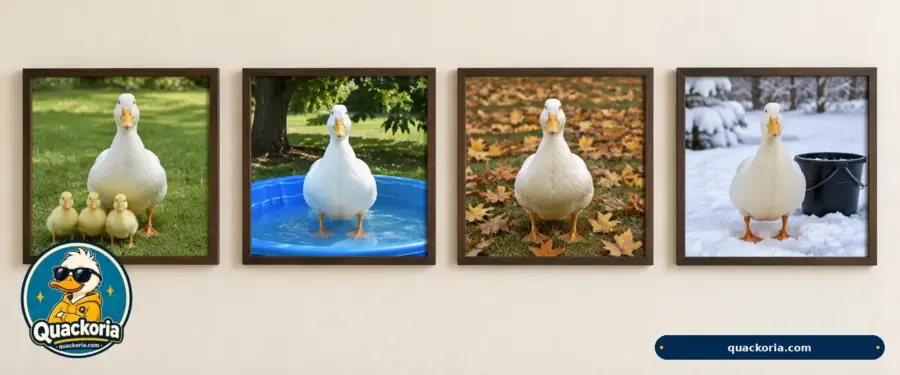
- Spring: laying restarts, broodiness comes with it, feather loss on the females shows the drake ratio is wrong, and the ground is at its wettest.
- Summer: heat is the weather that has to be managed. Shade, water refilled several times a day, an open house, and a mid-afternoon check.
- Autumn: laying winds down; decide on lights (Metzer's 17 light and 7 dark, with the RSPCA's farm minimum of 6 hours continuous darkness); winterise the house; build drainage while it is dry.
- Winter: dry bedding, unfrozen water to dunk in, no heat lamp — and Muscovies kept in from hard frost.
- Every day, every season: open after laying, water deep enough to dunk, collect, look at every bird, shut the door at dusk.
It is written for the northern hemisphere. Shift it by six months for the south, and read it loosely anywhere near the equator, where day length barely changes. Metzer Farms puts the same point as a comparison: “For example, a duck could lay longer in Florida than the same duck would lay in Alaska.”
The engine underneath: daylight
Much of what is seasonal in a duck traces back to one input. Laying is driven by day length. Metzer Farms: “Ducks need at least 17 hours of light in order to continuously lay year-round.” Cornell’s Duck Research Laboratory works to a lower range — “Adding artificial light to extend the daily light period to 14-17 hours” — and says that, with no decrease in day length, this “will provide adequate light stimulation for ducks to lay continuously for 7-12 months”. The University of Georgia brings ducks into full production on 14 hours. For comparison, University of Minnesota Extension says hens “need at least 12 to 14 hours of light each day to continue laying eggs”. Different birds, different figures, the same mechanism — which is why production peaks in spring and summer and falls away in autumn and winter.
Breed matters. Metzer: a Khaki Campbell “is even likely to lay year-round”, while a Mallard “is likely to slow or stop laying come fall and winter”.
Whether you add light in winter is covered under autumn. Everything else follows the sun on its own.
Spring (March–May)
The busy season. Laying restarts or peaks, broodiness arrives, ducklings hatch, and the ground is at its wettest.
Laying comes back
As days lengthen past the threshold, ducks that stopped in winter start again. Switch any bird that was wintered on maintenance feed back to layer ration — Minnesota Extension’s fact sheet on raising ducks says to “Change to a breeder-laying ration about 1 month before egg production starts” — and put the oyster shell out; the feeding guide has the protein and calcium figures.
Collect early and daily. The University of Georgia says “Most duck eggs are laid before 7 a.m.” and that “Removing the eggs as soon as possible lessens the problems of dirty and cracked eggs”; a spring nest is also a hidden nest. Collecting, cleaning and storing duck eggs covers keeping them in until mid-morning, and why not to wash a clean egg.
Broodiness
Broodiness comes with the laying season rather than with a date: we found no published source that gives a month. Breed makes a difference — on Metzer Farms’ own farm “the Cayuga seem to be the broodiest”, with Rouens next and Runners the least likely to sit — and a duck that sits has stopped laying: “Once they start sitting, they stop laying” (Metzer Farms). Decide early whether you want ducklings this year. If yes, mark a clutch and make the nest safe; if no, break the broody early rather than late. Both are in broody ducks.
Hatching
If you are incubating, set the eggs fresh and on duck settings rather than chicken ones. Mississippi State Extension: “Therefore, do not store eggs more than 7 days before incubating.” The incubation guide has the temperatures and the disagreements, and the hatch date calculator gives the dates. Ducklings hatched in spring have the whole warm season to feather and grow.
Drakes
This is the season to look at the females’ backs and necks for feather loss — the sign that there are too many drakes, or one too rough. Minnesota Extension’s fact sheet gives the breeder-flock figure: “Keep one male for each 5-6 females.” The rest of the arithmetic is in how many ducks to keep. Separate breeds now if you do not want crosses, and keep a Muscovy drake away from Mallard-type ducks unless you want birds that cannot breed — Metzer Farms: “Mules and hinnies cannot reproduce.” See keeping Muscovy ducks.
The ground
Spring rain on winter-trodden ground is the mud at its worst. The RSPCA’s advice is to “Prevent the surrounding ground from becoming wet and muddy” by moving the water facilities regularly, “or place the water container over a well-drained area, such as a bed of shingle”; Minnesota Extension says to “Place waterers over low, wire-covered frames to help reduce wet litter problems”. Rotate the run if you can — duck water needs has the full set-up.
New birds
Spring is when ducklings are sold and when most people start. If it is your first year, buying your first ducks is where to begin, and the honest comparison in ducks or chickens is worth reading before the farm store. Have the house built before the birds arrive — the duck house guide.
Summer (June–August)
Peak laying, peak growth, and the season in which the weather itself has to be managed.
Heat
Penn State Extension’s figure is that “Heat stress in poultry typically begins” when the air goes above 80 °F — written for poultry in general, on a page that does not mention ducks, so treat it as the point to start paying attention rather than a duck threshold. Shade the whole flock can lie in at once, water in the shade and refilled often — Metzer Farms: “During the summer months it might be necessary to refill their water source several times a day” — a pool to stand in, the house opened up, and a mid-afternoon check for the sign Metzer describes: “Sometimes because they are hot, they tend to sit, pant, and forget to drink water.” All of it, and the emergency routine for a bird already down, is in keeping ducks in summer.
Expect laying to dip in a heatwave. Penn State’s table, again for poultry in general, has egg size and shell quality suffering as temperatures reach the top of the 75–85 °F range, and at 85–90 °F “Egg size and shell quality deteriorate” and “Egg production suffers”. A duck laying less in a heatwave is not by itself a fault.
Ducklings growing
Spring ducklings are feathering and moving from starter to grower feed — the protein step-down is in the feeding guide, and the week-by-week milestones in raising ducklings week by week. Watch the legs. Metzer Farms describes niacin deficiency starting with birds “reluctant to move about”: “Eventually their hocks swell and their legs develop a bowed shape.”
The RSPCA’s welfare standard for farmed ducks asks for open water the whole body fits into “from no later than 21 days of age” — at least 50 × 100 cm and 10 cm deep — and for drinkers before that “of a design that prevents young ducklings from getting very wet or drowning” while their feathers are still not waterproof.
Predators
Long evenings mean the flock is out late, and the door-at-dusk rule is hardest to keep in June when dusk is at ten. Keep it anyway: eXtension’s advice is to “Have the flock roost inside a secured location at night, making sure to close and lock all doors” — more in protecting ducks from predators. Maryland Extension puts the fox season earlier than this: foxes “are often more of a problem in spring when they are raising young and other food sources are in short supply”. Where a hawk or an owl is persistent, eXtension says “the easiest way to protect your flock is to use a covered run”.
The moult
Ducks replace their feathers after the breeding season. Metzer Farms says “the eclipse molt generally occurs during the summer” — that is “For wild mallards in the Northern Hemisphere”, and it adds that “Domestic ducks don’t always follow the wild mallard calendar quite as neatly”, so take the timing as a pattern rather than a date. A drake in eclipse wears a drab plumage that “can make him look remarkably similar to a hen” for a few weeks. Expect laying to slow or stop with it. In commercial practice it is done on purpose: the University of Georgia says some keepers “molt the birds for 8 to 10 weeks to provide them a rest period for an additional lay period once they drop below 50% egg production”. Keep the feed as it is and leave the bird to it.
Water
Change the pool rather than topping it up: empty it onto a bed, not the run, and refill it in the shade. Drinking water goes the same way — several times a day in summer heat, on Metzer’s figure above, not twice.
Autumn (September–November)
Laying winds down, the flock settles, and this is the season to fix things before winter tests them.
Laying stops, or doesn’t
As day length drops below the threshold, the seasonal breeds stop and the laying breeds slow. A duck that stops in October and starts in February is behaving normally; the other reasons a duck stops — stress, a hidden nest, illness, age — are in when do ducks start laying eggs.
Adding light keeps them laying. Metzer’s method: bring the day up to 17 hours light and 7 hours dark, adding about half an hour every 3–4 days, split between morning and evening, at a level that is “sufficient light to read a newspaper” — “as little as .5 footcandle but it is probably better to get a level of 3-5 footcandles”. The RSPCA’s welfare standard for farmed ducks requires “a minimum period of 6 hours continuous darkness”, so 17/7 is the ceiling, not a starting point.
Whether to do it is a choice. A duck lit through winter lays through winter — Cornell’s figure is 7–12 months of continuous laying on a steady long day — and a duck left on natural daylight lays fewer eggs over the year. We found no published source for the common claim that a rested duck goes on laying for more years, so that is not a reason we can give you. Neither choice is wrong.
The house
Before the first frost: repair, re-roof, check every vent and window for gaps, replace rotten boards, re-fix any loose hardware cloth, and clean out completely. Ventilation is the thing to get right now — the house must move air above the birds all winter without a draught across them, and Merck notes that “Adequate ventilation enables the proper removal of moisture from the bedding”. The duck house guide has the principle.
The ground
Wire-covered frames, slats, a well-drained base, a moved water station — every mud measure in duck water needs is easier to build in dry October than in wet January.
Predators
This is the season to test the run before the weather does. Metzer Farms: “The winter months are a prime time for predators to try for your birds as there are fewer wild animals for them to hunt.” It advises checking the run’s fencing and repairing any damage before winter. Walk the fence line, check the skirt, and check the latch — the predator guide. Automatic door timers need resetting as dusk moves earlier; a door that closes at 8pm in November has shut out the flock.
The flock
Decide who winters. Extra drakes from a summer hatch need a decision before feed bills and fighting make it for you — options in how many ducks to keep. Introduce any new birds now, so the flock is settled before winter confines them — eXtension says “the new birds should be quarantined for at least two weeks prior to introduction”, while USDA APHIS’s backyard-flock guidance is to “Isolate poultry new to your flock or those coming back from a show for at least 30 days”.
Handle every bird once: turn it over, check the feet for footpad problems that wet bedding will make worse, check the weight, check under the wings — how to hold a duck for the technique and common duck health problems for what you are looking for.
Winter (December–February)
The easy season for the birds and the hard one for the keeper.
Cold
Ducks handle cold well — waterproof plumage over down, and feet they let run cold, explained in why don’t ducks’ feet freeze; frostbite does still happen, usually on the legs and feet. Metzer Farms says “Most waterfowl coops do not need insulation unless your winter nights frequently get down to 15 degrees Fahrenheit or less.” What they need is a dry, draught-free house, deep dry bedding, and unfrozen water. They do not need a heat lamp: the Open Sanctuary Project says “Heat lamps, especially those with glass bulbs, pose a serious fire risk; ceramic heat panels are a much safer option.” The full routine is in keeping ducks in winter.
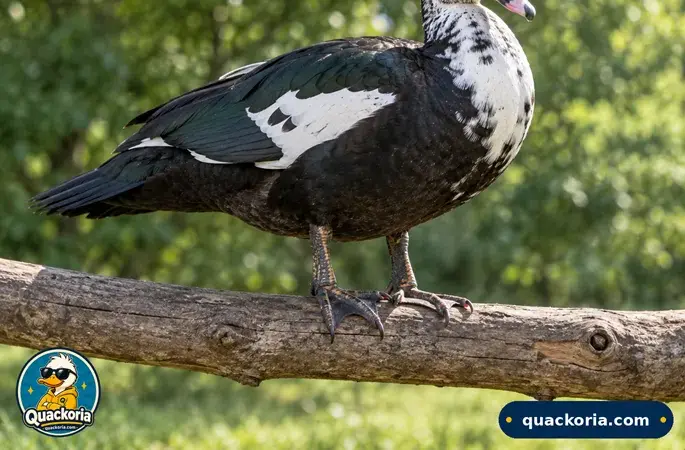
Muscovies are the exception. The Open Sanctuary Project says Muscovy ducks “tend to be more sensitive than other breeds” to cold, and that they “can also develop frostbite on their caruncles (the fleshy bulbous parts of their face mask)”. In hard frost, keep them in — keeping Muscovy ducks.
Water in frost
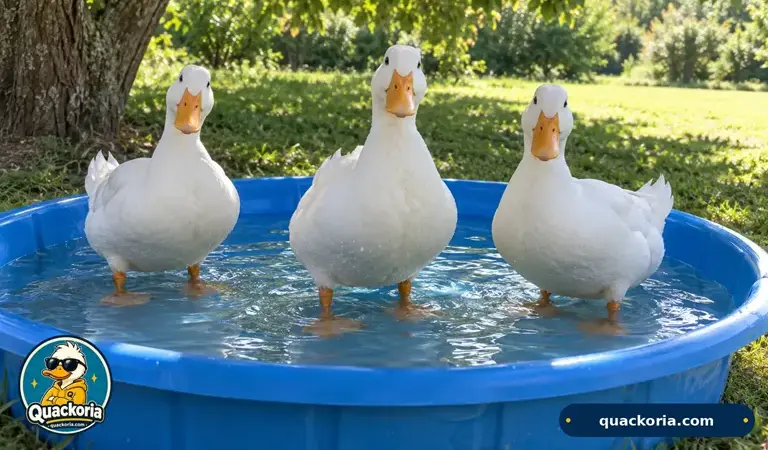
The head-dunking requirement does not pause: without water deep enough to submerge its head, a duck cannot keep its eyes and nostrils clean. University of Maryland Extension: “Be sure to provide liquid water deep enough for the birds to dunk and wash their heads”, and “it is important to check/replace the water several times a day”. A heated base or bucket does the same job with less walking. Bathing water can stop in hard frost; head water cannot. Duck water needs has the options.
Bedding
Wet bedding is the winter disease. Ducks carry more water in during frost, it dries slower, and the house is shut longer. The squeeze test from the duck house guide — a handful should clump then crumble — needs doing more often, not less. Merck’s list of what wet litter and the ammonia it produces do — “ammonia burns of the cornea”, footpad dermatitis, breast blisters and skin burns — is the winter list.
Feed
Ducks eat more in cold weather. Maryland Extension: “Birds will require extra energy during cold weather months so feed needs to be available at all times”, and “Treats and scratch grains that are high in energy can be given to them in the evening to help keep them warm all night.” Keep feed dry and out of the house.
Eggs, if any
Collect twice a day in frost: Penn State notes that “freezing whole-shell eggs will cause the shell to crack”. Laying breeds may lay through; the rest are resting. Do not push them.
Planning
Winter is when to order ducklings for spring, decide on breeds — the breeds guide — plan a bigger run, and read. It is also when a hatching plan gets made: which drake, which females, when to start collecting eggs.
A first year, in order
For someone starting from nothing, the sequence that avoids the commonest mistakes:
- Winter before: decide ducks or chickens (the honest comparison), decide how many (three minimum, all female), choose a breed.
- Late winter: build the house and run — the specification — and the water station with drainage. Have it finished before the birds.
- Spring: buy started birds rather than day-olds for a first flock — what to check. Layer feed, oyster shell, water deep enough to dunk.
- Early summer: first eggs, if the birds are of age. Learn the collecting routine. Learn to pick one up. Sort out shade before it is needed.
- Summer: heat management. Hold the door-at-dusk rule through the long evenings.
- Autumn: the first moult and the first laying pause — both alarming the first time, both normal. Winterise the house.
- Winter: unfrozen water, dry bedding, and not much else. Decide whether next year includes a drake.
The jobs that are the same every day
Whatever the season:
- Open the house in the morning, after the eggs are laid
- Fresh water deep enough to dunk in, and feed, outside the house
- Collect eggs
- Look at every bird for a minute — standing square, eyes clear, keeping up with the flock
- Shut the door at dusk
Ten minutes a day. None of the five is hard; the risk is in skipping one.
This is husbandry guidance, not veterinary advice. If a bird is ill or injured, find an avian vet.
Frequently asked questions
When do ducks stop laying for the year?
When day length drops below what they need — Metzer Farms says ducks "need at least 17 hours of light in order to continuously lay year-round", and Cornell's Duck Research Laboratory works to 14–17 hours — so from autumn into winter, with the laying breeds slowing and the seasonal breeds stopping. Metzer says a Khaki Campbell "is even likely to lay year-round", while a Mallard "is likely to slow or stop laying come fall and winter". They restart as the days lengthen in late winter.
Should you add light to keep ducks laying in winter?
It works. Metzer Farms' method brings the day up to "a total of 17 hours of light and 7 hours of dark", adding half an hour every 3–4 days at a level that is "sufficient light to read a newspaper", and Cornell reports 7–12 months of continuous laying on a steady long day. The RSPCA's welfare standard for farmed ducks requires "a minimum period of 6 hours continuous darkness". Whether to do it is a choice: a lit duck lays through winter, a duck on natural daylight lays fewer eggs over the year. We found no published source for the claim that a rested duck goes on laying for more years.
When do ducks moult?
After the breeding season. Metzer Farms says "the eclipse molt generally occurs during the summer" for wild mallards in the northern hemisphere, and that "Domestic ducks don't always follow the wild mallard calendar quite as neatly". A drake in eclipse wears a drab plumage that "can make him look remarkably similar to a hen" for a few weeks, and laying slows or stops with the moult — in commercial practice the University of Georgia says some keepers moult birds deliberately once production drops below 50%, "to provide them a rest period for an additional lay period". Keep the feed as it is and leave the bird to it.
What is the most important daily job with ducks?
The sources do not rank the daily jobs. The one with the clearest published backing is shutting the door at dusk: eXtension's advice is to "Have the flock roost inside a secured location at night, making sure to close and lock all doors". After that: water deep enough to dunk the head, feed and water outside the house, collecting eggs, and a minute's look at every bird for a duck standing apart or not keeping up.
Which season is hardest for ducks?
No source we found ranks the seasons, and the two hard ones are hard in different ways. Ducks are built for cold — waterproof plumage over down, and feet they let run cold — while heat is the weather that has to be managed: Penn State Extension says "Heat stress in poultry typically begins" above 80 °F, on a page written for poultry in general that does not mention ducks. Winter is easier on the birds and harder on the keeper, because of frozen water and wet bedding.
Sources
- Metzer Farms, Why Ducks Stop Laying
- Metzer Farms, A Guide to Increasing Duck Egg Production with Lights
- University of Minnesota Extension, Raising chickens for eggs
- RSPCA welfare standards for domestic/common ducks (2023)
- Penn State Extension, Hot Weather Management of Poultry
- Merck Veterinary Manual, Management of Backyard Poultry
- Cornell University Duck Research Laboratory, Duck Housing and Management
- University of Minnesota Agricultural Extension Service, Raising Ducks (Poultry Fact Sheet 43)
- University of Georgia Extension (Cunningham, 2006), Managing Ducks for Eggs
- University of Maryland Extension FS-1133, Winter Weather and Small Flocks: What You Need to Know
- University of Maryland Extension FS-1132, Identifying and Preventing Poultry Predators in the Mid-Atlantic Region
- eXtension, Predator Management for Small and Backyard Poultry Flocks
- eXtension, Biosecurity for Small Poultry Flocks
- USDA APHIS NAHMS, U.S. Backyard Poultry Flocks: Biosecurity Resources, Practices, Risks and Perceptions (2024)
- Mississippi State University Extension (Smith), Care and Incubation of Hatching Eggs
- Penn State Extension, How to Safely Handle and Store Eggs from Your Home Flock
- RSPCA, Outdoor areas for pet ducks and geese
- Metzer Farms, The Great Duck Disguise: Eclipse Plumage
- Metzer Farms, Broody Ducks and Geese
- Metzer Farms, Summer Heat Care: Keeping Ducks Cool and Hydrated
- Metzer Farms, Getting Your Ducks and Geese Ready for Winter
- Metzer Farms, Niacin Deficiency and Leg Problems
- Metzer Farms, Mule Ducks
- The Open Sanctuary Project, Creating a Good Home for Ducks