Quackoria Learn
Duck FAQ: 60 Questions About Ducks, Answered
Sixty questions people ask about ducks, each answered in a few sentences, with a link to the full article where there is one. Basics first, then bodies, behaviour, eggs, ducklings, and keeping ducks at home.
Key takeaways
- Ducks have no teeth; the ridges in the bill are a strainer. Their feet are allowed to run cold, just above freezing: vessels in the leg exchange some heat, and less blood is probably sent down.
- Only the female mallard makes the classic quack, and the quack does echo. Most ducks do not mate for life — pair bonds last four to eight months.
- Mallard-type eggs hatch in about 28 days, Muscovy in about 35. Ducklings can swim within a day or two of hatching, but they chill fast when wet and rely on their mother for warmth.
- Never keep one duck alone; three is the practical minimum. Water deep enough to submerge the head, a house shut at dusk, and better food than bread.
- Where we could find no good measurement — how keenly ducks smell, whether they recognise faces — the answer says so.
Every answer on this page is the short version. Where Quackoria has a full article on the question, the answer links to it, and that article carries the studies and the organisations the facts come from. Where the honest answer is “nobody has measured it”, the answer says so rather than inventing a number. The sources for the figures quoted here are listed at the bottom of the page.
Duck basics
1. What is a duck?
A duck is a waterbird in the family Anatidae, the same family as geese and swans — Britannica describes ducks as “relatively small, short-necked, large-billed” waterfowl — with legs set further back than a goose’s, and webbed feet. “Duck” covers well over a hundred species, from the mallard on the park pond to sea ducks that dive tens of metres. Duck vs goose vs swan explains where the family lines are drawn.
2. What is the difference between a duck, a goose and a swan?
Neck and legs, mostly. Geese have longer necks and legs set further forward, so they walk and graze comfortably on land; ducks have short necks and waddle. Swans are the largest of the three, with the longest necks. All three are one family, Anatidae.
3. How many kinds of duck are there?
Over a hundred wild species worldwide, which Britannica divides by behaviour into three main groups: dabblers that feed in shallow water, divers that go under, and perching ducks. Domestic breeds are a separate count, and all but the Muscovy descend from a single wild species, the mallard.
4. Is a mallard a duck?
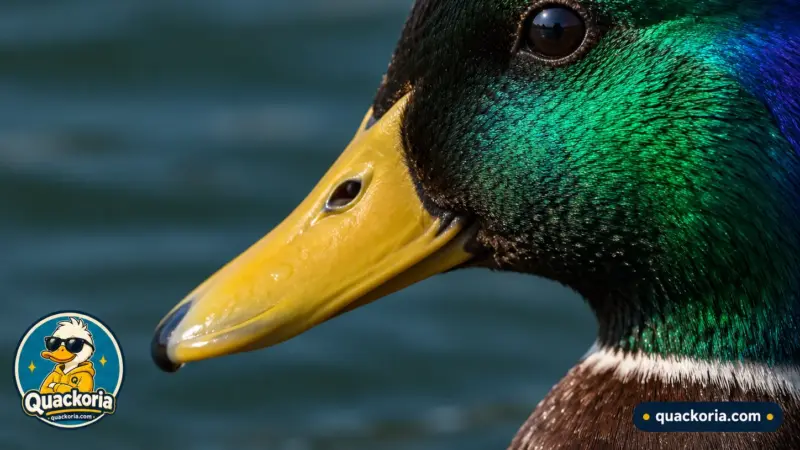
Yes, and probably the best-known one. The mallard is the green-headed park duck of Europe, Asia and North America, and the ancestor of nearly every domestic breed. The mallard article covers its plumage, its eclipse moult, and why so many park ducks look like odd mallards.
5. Where do ducks live?
On every continent except Antarctica, anywhere there is water: ponds, lakes, rivers, marshes, estuaries and open sea. Different species prefer different water. Dabbling ducks like the mallard want shallow water they can reach the bottom of by tipping up; diving ducks want deeper lakes and coasts.
6. What is a male duck called? And a female?
A male is a drake; a female is a duck, or a hen in keeping circles. Young are ducklings. A group on the water is called a raft or a paddling, and a group anywhere a flock — though “a group of ducks” is understood everywhere and offends nobody. The words, and where odd ones like badelyng come from, are in what a male duck is called and what a group of ducks is called.
7. How long do ducks live?
Most wild ducklings never reach adulthood, and a wild mallard that survives its first year commonly lives a few more, with ringed birds occasionally recovered past twenty. Well-kept domestic ducks commonly live eight to fifteen years, by the Open Sanctuary Project’s figure, and heavy breeds such as the Pekin and Muscovy are at greater risk of arthritis. How long do ducks live has the detail.
8. Are ducks intelligent?
Nobody has a fair scale to put ducks on, so any ranking you see is opinion. What is documented is impressive enough: ducklings imprint on the first moving, calling thing they meet within hours of hatching, kept ducks learn individual people and routines, and wild ducks time migration and pairing to the season with no calendar. One experiment — day-old ducklings learning “same” and “different” — is in are ducks smart.
9. Are ducks and chickens related?
Yes, more closely than they look. Chickens are in the order Galliformes (with pheasants and turkeys) and ducks in Anseriformes (with geese and swans), and the close relationship of those two orders is well supported: together they form the Galloanserae, whose two branches split in the Cretaceous (Pereira and Baker, 2009). It matters in practice: ducklings need roughly twice the niacin that chicks do, and the Merck Veterinary Manual, after saying poultry need 1.5–3.5 parts of water for every part of feed, adds that “waterfowl require up to 5–6 times that amount”. Ducks vs chickens compares them for anyone choosing.
10. Is it a duck or a goose on my pond?
Look at the neck. If it is long enough to make the bird look tall on land and it grazes grass like a lawnmower, it is a goose. If it is short and the bird tips up in the water, it is a duck. Size helps too: Britannica puts geese between large ducks and swans in size and build.
Duck bodies
11. Do ducks have teeth?
No. No living bird has teeth. The ridges along the inside of a duck’s bill are lamellae, thin plates that strain food from water like a sieve. Mergansers look toothed because their bills have a hook at the tip and lamellae along the edges to help grip fish, but they are still not teeth. The full explanation covers the egg tooth ducklings hatch with, too. And yes, ducks have tongues — long ones: do ducks have tongues.
12. Why don’t ducks get wet?
Mainly because of feather structure, rather than oil. The barbs and hooked barbules of a feather interlock into a mesh so fine that water sits on trapped air instead of passing through; calculations for six aquatic birds’ feathers put the breakthrough pressure at the equivalent of one to four metres of water, about 1.3 m for the mallard. Preen oil keeps that structure in condition — a mallard study found that blocking access to the preen gland for ten days had no significant effect, while three months without it left the plumage in worse condition and holding more water. Why ducks don’t get wet has the studies.
13. Why don’t ducks’ feet freeze?
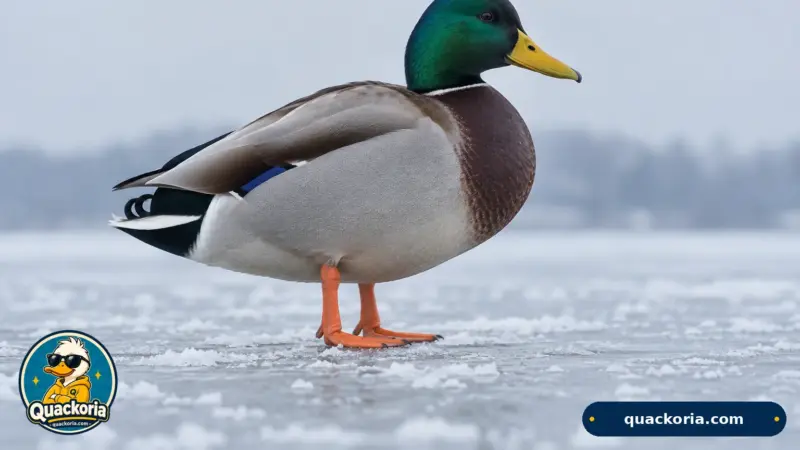
Arteries and veins in the leg run side by side and exchange some heat, so the blood reaching the foot has already given up some of its warmth and the blood returning to the body has been pre-warmed; the classic study on mallards also judged it probable that less blood is sent to the foot. In that study, the temperature under the skin of one mallard’s foot stayed several degrees above freezing in fluid at minus eight, while the birds’ core stayed at 39.9 °C. The feet article explains the numbers, and why frostbite still happens; the leg itself, knee included, is in do ducks have knees.
14. Can ducks see in colour?
Yes, and with four types of colour cone to your three. What they lack is a cone tuned to ultraviolet: the mallard’s shortest cone peaks in the violet, at about 420 nanometres. Their eyes sit at the sides of the head, so they see almost everything around them at once. How ducks see goes into the research.
15. How well can ducks hear and smell?
Hearing matters to them — Ducks Unlimited calls it perhaps the second most important sense to ducks and geese, after sight — and their ears are openings slightly behind and below the eyes, covered by soft feathers. Smell is the harder question. Ducks Unlimited says waterfowl can detect smells to varying degrees, though perhaps not as keenly as dogs or some other birds, and the research it cites is on greylag geese; we found no published figure for how keenly ducks smell. Where the ears are, and what a mallard can actually hear, is in do ducks have ears.
16. What is the bump on a duck’s bill for?
The tip of a duck’s bill is packed with touch receptors, which is how a duck can find food by feel where it cannot see it, in mud or murky water. The little “nail” at the very tip is used for hooking or moving food.
17. Why do male mallards lose their green head in summer?
It is the eclipse moult. After breeding, a drake moults his body feathers into a drab, female-like plumage — from mid-May to early July in male Anas ducks, by Pyle’s 2005 study of specimens — and wears it through the wing moult that follows, when he sheds all his flight feathers at once and cannot fly for three to four weeks. Cornell calls the eclipse plumage concealing, and Pyle suggests it evolved in ducks that benefit from camouflage at that time. The green grows back in a moult that Pyle dates from late August to early November. The mallard article explains the timing.
18. What is the blue patch on a duck’s wing?
The speculum: a coloured panel in the secondary feathers, on the trailing edge of the wing. It is blue with white borders on a mallard, green on a green-winged teal, and it helps tell species apart when the rest of the bird is brown. Both sexes have it.
19. Can ducks fly?
Wild ducks fly, and some migrate thousands of miles. Many domestic breeds cannot: on Metzer Farms’ breed chart the Pekin, Runner and Welsh Harlequin do not fly at all, and the University of Kentucky says the Rouen is too heavy to fly away, as does Metzer’s own Rouen page (“Mallards fly quite easily and Rouens do not”), though Metzer’s breed chart rates it, like the Khaki Campbell, a “maybe”. Calls, domestic Mallards and Muscovies fly well. Diving ducks need a running start across the water; dabblers spring straight up. Breeds, the summer moult and wing clipping are in can ducks fly; speed and altitude records in how fast can ducks fly.
20. Why do ducks stand on one leg?
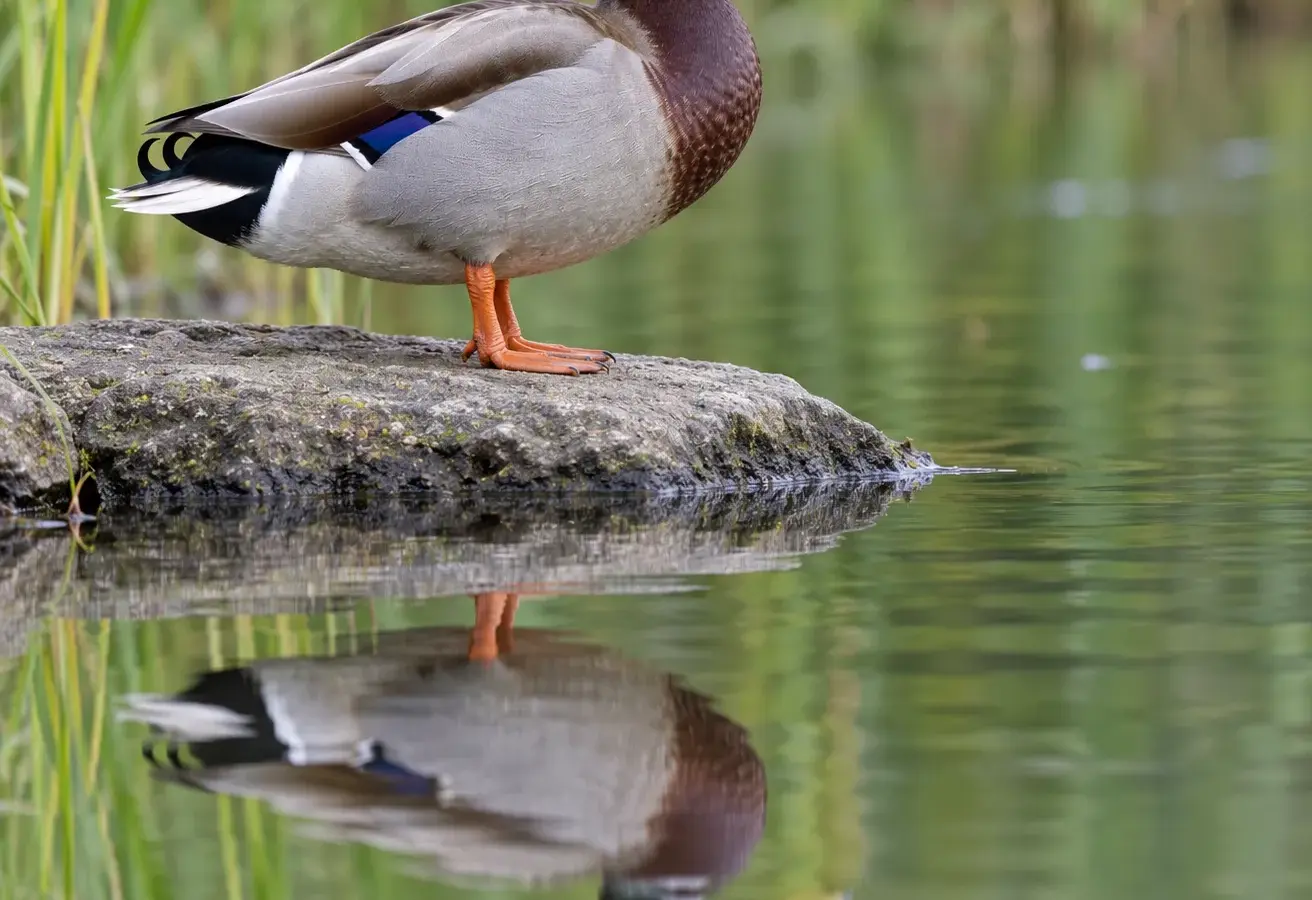
The usual explanation is heat conservation — tucking one foot into the feathers reduces the bare skin exposed — and a comparison across more than eight hundred bird species supports it in general. But a small field study in New Zealand found flamingos and pied stilts stood on one leg more as it got warmer, and no significant trend in mallards, so it is a good explanation rather than a settled one.
Duck behaviour
21. Why do ducks quack?
To keep in contact, to sound an alarm, and to court. Only the female mallard makes the loud descending “quack, quack, quack”; the male’s call is a quieter, raspier one- or two-note sound. And no, the quack does echo — an acoustics laboratory tested the myth. Why do ducks quack covers the calls.
22. Do all ducks quack?
No. Many female dabbling ducks quack — Ducks Unlimited names the green-winged teal, northern pintail, mallard and northern shoveler — but not every duck has the loud quack: Cornell’s Lab of Ornithology says Muscovies are usually silent, the males hissing and puffing in courtship and the females giving only a quiet quack or croak when frightened, and male wood ducks give a thin, rising and falling whistle. Even in mallards it is the females who quack.
23. Do ducks sleep with one eye open?
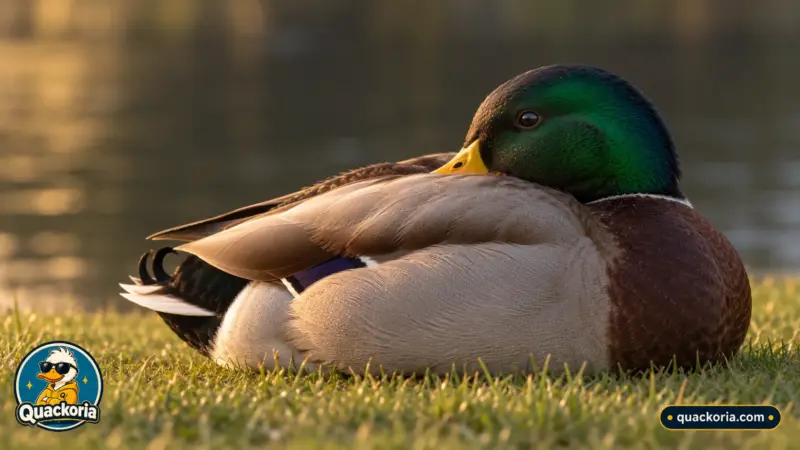
They can, and it has been measured. Ducks can put one half of the brain to sleep while the other stays awake, with the eye on the waking side open — ducks at the edge of a sleeping group do it far more than ducks in the middle, and point the open eye outward. How ducks sleep explains the experiments.
24. Do ducks mate for life?
Most do not. Typical duck pair bonds last four to eight months, forming between autumn and early spring depending on the species — mallards are among the earliest — and weakening as the female nests and starts incubating, often with a new partner the following year. Geese, swans and whistling-ducks are the waterfowl that pair long-term. The full article covers what is actually known.
25. Why do ducks migrate, and how far?
To follow open water and food: Ducks Unlimited says waterfowl migrate only as far as necessary to find them. Many populations are partial migrants — in the mallard, the BTO says, most northerly populations migrate while Britain’s breeding birds largely stay put — and some birds go thousands of miles: Cornell records a blue-winged teal banded in Alberta and shot in Venezuela a month later. Duck migration has more.
26. Why do ducks fly in a V?
For two reasons that are not mutually exclusive, says Bruce Batt of Ducks Unlimited: to save energy, each bird flying slightly off the wingtip of the one ahead to gain lift from the rising air it leaves behind, and to keep the flock oriented and in contact. On local feeding flights, he adds, saving energy is probably much less important than orientation and avoiding collisions. Geese are the famous V-fliers, but Ducks Unlimited calls the V formation characteristic of waterfowl on long-distance flights.
27. What is the difference between a dabbling duck and a diving duck?
Dabblers feed at the surface, tipping up with the tail in the air, and can spring straight into flight; mallards feed by dabbling and rarely dive. Divers swim underwater to feed, are less buoyant, have legs set further back, and have to run across the water to take off. Tufted ducks spend about twenty seconds underwater on average, at 3 to 14 metres; the long-tailed duck, a sea duck, feeds as deep as 200 feet. Dabbling vs diving ducks compares them.
28. Why do ducks bob their heads?
It is a display. Mallards pump their heads up and down during courtship, and a drake and duck bobbing at each other are usually a pair, or about to be. Ducks also bob briefly before taking off. Keepers describe kept ducks bobbing their heads when excited, but that is observation, not a studied behaviour. The courtship display, and what is and is not known about the rest, is in why do ducks bob their heads and why do ducks wag their tails.
29. Are ducks aggressive?
They can be: a broody duck, Metzer Farms says, becomes territorial and grumpy as she guards her eggs, and too many drakes, it warns, become very aggressive sexually and harm weaker females. So keepers keep drakes few. Metzer Farms says ten ducks or fewer can be kept in pairs, but that a flock of more than 25 or 30 needs one male for every three to five females unless the pen is large with plenty of hiding places, and University of Minnesota Extension, writing about breeder flocks, says to keep one male for each five or six females.
30. Do ducks recognise people?
Kept ducks clearly learn who feeds them: Metzer Farms says that when ducks know when to expect food and interaction, they begin to recognise and respond to their caretaker more readily. Whether they recognise faces as such, or a shape, a voice and a bucket, has not been tested in ducks as far as we could find.
Duck eggs
31. How many eggs does a duck lay?
A wild mallard lays a clutch of roughly eight to thirteen, one a day. Domestic layers are a different matter: on Metzer Farms’ breed chart, Khaki Campbells lay 165 to 240 a year and Metzer’s own hybrid layers 200 to 290, Rouens 140 to 180 and tiny Call ducks 25 to 50 — the lower figures without artificial light, the upper with 17 hours of light. The breed comparison tool lists twenty-one breeds side by side.
32. When do ducks start laying?
Usually at around five to seven months old, depending on feed and daylight: Metzer Farms puts sexual maturity at 20 to 24 weeks, and a duck that reaches that age without the right feed and light waits until the days lengthen in spring. When do ducks start laying eggs covers the age, the first eggs and what to check when laying stops.
33. How long does a duck egg take to hatch?
About 28 days for most mallard-derived breeds — Pekin, Campbell, Cayuga and the rest — and about 35 for Muscovies, which are a different species (Cornell Duck Research Laboratory). Metzer Farms gives Runners 29 days and Mallards 26.5. The hatch date calculator counts it out from your setting date.
34. Are duck eggs bigger than chicken eggs?
Yes, noticeably. A large chicken egg is about 57 g; duck eggs run roughly 65 to 100 g depending on breed, with Pekin eggs at the top. As a rough rule, two Pekin eggs, or two to two and a half from smaller breeds, replace three large chicken eggs, and weighing beats counting. Duck eggs vs chicken eggs and the egg converter do the arithmetic.
35. Do duck eggs taste different?
Richer: per 100 g a duck egg has about 45% more fat (USDA FoodData Central), and the yolk is proportionally larger — 32.4% of the egg’s weight against 27.5% for hen’s eggs in one comparison (Sun et al., 2019). In one sponge-cake trial, hen’s eggs made softer, higher cakes than duck eggs (Hwang et al., 2018); whether duck eggs are better in any dish is a matter of taste. Per egg they carry more protein, fat and calories than a chicken egg: for protein and calories that is mostly because they are bigger, but the fat gap is not just size, since even per 100 g a duck egg has the extra 45%.
36. What colour are duck eggs?
White, cream, pale green, pale blue and occasionally a charcoal grey, depending on the breed — Cayugas are known for dark eggs early in the season. We found no study testing whether shell colour changes a duck egg’s flavour or nutrition; for hens’ eggs, eXtension says brown and white eggs basically taste the same.
37. How long do duck eggs keep?
Refrigerated, the USDA gives three to five weeks for raw shell eggs and Penn State at least a month; neither publishes a duck-specific figure. An unwashed egg keeps its natural coating, though Penn State says it loses effectiveness over time; a washed one should be dried and refrigerated promptly. The freshness checker applies those rules to your egg, and collecting duck eggs covers washing and storage.
38. Does a floating egg mean it is bad?
No. The float test measures the air cell, which grows as the egg ages, so a floating egg is an old egg. The USDA’s line is that it may be perfectly safe; crack it into a separate bowl and judge by look and smell.
39. Do I need a drake for my ducks to lay?
No. Ducks lay with or without a male; a drake only makes the eggs fertile. So a flock kept for eggs needs no drake at all. How many ducks to keep covers drakes and flock size.
40. Why has my duck stopped laying?
Shortening days are a major reason in autumn: Metzer Farms says shorter days can stop ducks laying. Stress is another — from predators, loud noises, or a change of feed, animals or people — and a moulting duck is probably not laying, while a broody one stops once she starts sitting. Check the run for a hidden nest before assuming she has stopped, and if she also seems unwell, that is a matter for a vet.
Ducklings
41. How soon can ducklings swim?
Within a day or two of hatching, when the mother leads them from the nest to water. But young ducklings chill fast: Ducks Unlimited says their down is excellent insulation when dry but of little value when wet, and that the hen keeps her brood warm and dry by covering them with her body and wings, so wild ducklings keep going back under their mother. Ducklings raised without a mother need swims kept short, warm and watched — eXtension says not to let them swim at all for the first three weeks. The ducklings article covers the first weeks, and the ways ducklings and adults drown, with the ramps and ratios that prevent it, are in can ducks drown.
42. What do ducklings eat?
In the wild, mostly small invertebrates at first — midges, beetles, larvae, snails — because, Ducks Unlimited says, large amounts of protein are needed to grow tissue and feathers. Kept ducklings eat a starter crumb, and it must contain enough niacin: ducklings need roughly twice what chicks do, and a shortfall shows as bowed legs and swollen hocks. Raising ducklings week by week has the feeding schedule.
43. Why do ducklings follow their mother?
Imprinting. In a short window after hatching, a duckling fixes on the first suitable moving, calling thing it meets and follows it. In the wild that is normally the mother; in a brooder it can be a person.
44. How warm does a duckling brooder need to be?
Two published schedules disagree: eXtension gives 90–95 °F (32–35 °C) in week one dropping five degrees a week, while Cornell’s Duck Research Laboratory starts at 86 °F (30 °C) and drops faster, to 55 °F (13 °C) from day 35. eXtension gives the test to watch: cold ducklings huddle together under the heat source, and hot ones move to the outer limits of the brooder. The duckling age planner gives this week’s figures on both.
45. When do ducklings get their feathers?
Feathers replace down over the first several weeks, and Metzer Farms says ducklings are fully feathered at seven to nine weeks; a wild mallard first flies at about 50 to 60 days (BTO). Until a duckling is completely feathered, Metzer says, bring it in out of the rain.
46. When can ducklings go outside?
To live outside all the time, when they are fully feathered — at seven to nine weeks, Metzer Farms says — with shelter from the sun and heavy rain. Short daytime outings can start much earlier: Metzer allows them from 10 to 14 days old in spring and summer, and about three weeks in cooler weather, on a sunny day.
47. How can I tell if a duckling is a boy or a girl?
Mostly by waiting. The voice separates them from about six to ten weeks — the female’s quack gets loud and clear, the male’s stays low and raspy — and in every breed but the Muscovy the drake’s curled tail feather appears at around eight weeks. Vent sexing can be done on day-old birds (University of Minnesota Extension), but Metzer Farms says it can only be learned from someone showing you the steps. The sexing tool walks through each sign.
48. How many ducklings survive in the wild?
It varies enormously: Ducks Unlimited puts survival over the 50 to 70 days before ducklings can fly at anywhere from less than 10 percent to as high as 70 percent. The most common causes of death it lists are predation, adverse weather, starvation, disease and parasites, and it calls ducklings extremely vulnerable to hypothermia and predation in the first week after hatching.
49. I found a duckling on its own. What should I do?
Watch from a distance first: the RSPCA says the mother will usually be close, and advises contacting your local wildlife rehabilitation centre if the parents have not returned within two hours or are found dead. If it is injured, contact a wildlife rehabilitation centre rather than trying to raise it yourself — a duckling that imprints on a person may not recognise its own species, which can prevent its release (Washington Department of Fish and Wildlife).
50. Can I keep a wild duckling?
In many places, no. In the United States the Migratory Bird Treaty Act prohibits taking protected migratory birds without authorisation from the US Fish and Wildlife Service, and rehabilitators need a permit to keep sick, injured or orphaned ones, though anyone may pick one up to take it straight to a permitted rehabilitator. In Britain the Wildlife and Countryside Act makes it an offence to possess a wild bird, except to tend an injured one and release it. Domestic ducklings from a hatchery or a breeder are the legal, and easier, route.
Keeping ducks
51. What do ducks eat?
Wild ducks eat a mix of water plants, seeds and invertebrates, with the balance shifting by species and season. Kept ducks need a proper feed — waterfowl pellets, or a chicken or all-flock feed with enough niacin, which Cornell’s Duck Research Laboratory calls a satisfactory substitute — plus greens and whatever they forage. What do ducks eat covers the wild diet and what to feed ducks the kept one; why ducks also swallow stones is in do ducks eat rocks.
52. Can ducks eat bread?
It will not poison them, but it is filling and low in what a duck needs: the Canal & River Trust says it fills a duck’s stomach so that it does not forage for its natural food, and the Scottish SPCA advises against it. Not every body agrees, and the WWT has said it both ways: its children’s activity says to avoid bread, but it has also said bread is fine as long as it only forms a small part of the diet. Peas, sweetcorn, oats and chopped greens are the usual better options. Can ducks eat bread has the case, and the can-ducks-eat checker covers most foods.
53. Do ducks need a pond?
Not a pond, but they do need water deep enough to submerge the whole head, to keep their eyes and nostrils clean, and the UK welfare code says consideration should be given to troughs deep enough for ducks to get their heads completely under water. The RSPCA suggests a kids’ paddling pool or trough, deep enough for them to wash the head and body but shallow enough to get out of easily. Do ducks need a pond and duck water needs go through the options.
54. How much space do ducks need?
Metzer Farms suggests about 4 square feet each in the house and 50 square feet of run from eighteen weeks; the RSPCA’s welfare standard requires at least 2.5 m² of range per bird where the grass is well kept, and 4 m² where grass cover is poor. The space calculator does the sums for your flock.
55. How many ducks should I keep?
Never one, and three is the practical minimum: the RSPCA recommends keeping at least three birds who get on well together, and a pair becomes a single duck the day something goes wrong. Three Khaki Campbells, at Metzer Farms’ 165 to 240 eggs a year each, would average roughly 9 to 14 eggs a week. How many ducks to keep and the flock planner help with the arithmetic.
56. Can ducks live with chickens?
They can share a garden, but Cackle Hatchery advises separate shelters: ducks do not perch as chickens do, and shut in together overnight they alternate naps with play and can keep the chickens from resting. Feeding differs too: Metzer Farms says a chick starter made only for laying chickens probably does not have enough niacin for ducklings. Ducks vs chickens covers the practicalities.
57. Are ducks noisy?
Some are. Female Call ducks have a very loud quack — the British Waterfowl Association advises against keeping them if you have close neighbours — and in every mallard-derived breed the loud quack is the female’s. The Livestock Conservancy calls the Cayuga a quiet breed, and Cornell’s Lab of Ornithology says Muscovies are usually silent.
58. What kills ducks, and how do I keep them safe?
Foxes, raccoons, weasels, dogs and coyotes, hawks and owls, and snakes, depending on where you live; eXtension names them all. Many hunt at night, but hawks take birds by day. eXtension’s advice is to have the flock roost in a secured building with every door closed and locked, and least weasels can squeeze through holes a quarter of an inch across, which gets them through chicken wire — hence hardware cloth. Duck predators explains each threat and what killed my duck reads the evidence after the fact.
59. Can ducks stay outside in winter?
Yes. Metzer Farms calls waterfowl naturally hardy in cold weather, kept warm by their down, and says most duck houses need no insulation unless winter nights often fall to 15 °F (about −9 °C) or below; what they need is a house with plenty of bedding and protection from wind, and water that does not freeze. Heat lamps are not the answer: the Open Sanctuary Project says those with glass bulbs especially are a serious fire risk. Keeping ducks in winter has the routine.
60. How do I pick up a duck?
Never by the legs — the UK welfare code says birds should never be carried by the legs, and the Open Sanctuary Project says never to restrain a duck by its wings, legs, neck or feathers. One hand under the breast taking the weight, the other holding the wings closed, then tuck the bird under your arm. How to hold a duck shows the two holds and how to catch a duck without a chase.
Still have a question?
If a question is missing from this list, the full article on the topic almost certainly answers it: Quackoria Learn covers what ducks are and do, Quackoria Care covers keeping them, and the tools turn the figures above into answers for your own ducks. The duck quiz is twelve of these questions with the popular wrong answers included, if you want to find out how much of this page you already knew.
Frequently asked questions
Do ducks have teeth?
No. No living bird has teeth. The ridges inside a duck's bill are lamellae, thin plates that strain food from water like a sieve.
Why don't ducks' feet freeze?
Arteries and veins in the leg run side by side and exchange some heat, so the blood reaching the foot has already given up some of its warmth and the blood returning has been pre-warmed, and the classic study on mallards judged it probable that less blood is sent to the foot. In that study, the temperature under the skin of one mallard's foot stayed several degrees above freezing in fluid at minus eight.
Do ducks sleep with one eye open?
Yes, and it has been measured: one half of the brain sleeps while the other stays awake, with the eye on the waking side open. Ducks at the edge of a group do it far more than ducks in the middle.
Do ducks mate for life?
Most do not. Typical pair bonds last four to eight months, often with a new partner the following year. Geese, swans and whistling-ducks are the waterfowl that pair long-term.
How long does a duck egg take to hatch?
About 28 days for most mallard-derived breeds — Metzer Farms gives Runners 29 and Mallards 26.5 — and about 35 for Muscovies, which are a separate species.
How soon can ducklings swim?
Within a day or two of hatching, when the mother leads them to water — but young ducklings chill fast when wet, so wild ducklings keep returning to the mother to be warmed and dried under her, and ducklings raised without one need short, supervised swims; eXtension says none at all for the first three weeks.
Can ducks eat bread?
It will not poison them, but it is filling and low in what a duck needs, and the Canal & River Trust and the Scottish SPCA advise against it, though the WWT, which has also advised avoiding it, has said it is fine as a small part of the diet. Peas, sweetcorn, oats and chopped greens are better.
How many ducks should I keep?
Never one, and three is the practical minimum — the RSPCA recommends at least three birds who get on well together — because a pair becomes a single duck the day something goes wrong. Three Khaki Campbells, at Metzer Farms' 165 to 240 eggs a year each, would average roughly 9 to 14 eggs a week.
Sources
- Cornell Lab of Ornithology — Mallard life history
- Cornell Lab of Ornithology — Mallard sounds
- Kilgore & Schmidt-Nielsen (1975), Heat loss from ducks' feet immersed in cold water, The Condor 77
- Rattenborg, Lima & Amlaner (1999), Half-awake to the risk of predation, Nature 397
- Giraudeau et al. (2010), Effects of access to preen gland secretions on mallard plumage, Naturwissenschaften 97:577–581
- Srinivasan et al. (2014), Quantification of feather structure, wettability and resistance to liquid penetration, J. R. Soc. Interface 11:20140287
- Jane & Bowmaker (1988), Tetrachromatic colour vision in the duck (Anas platyrhynchos L.): microspectrophotometry of visual pigments and oil droplets, J. Comp. Physiol. A 162:225–235
- Pavlovic, Weston & Symonds (2019), Morphology and geography predict the use of heat conservation behaviours across birds, Functional Ecology 33
- Ducks Unlimited — Understanding waterfowl: courtship and pair bonding
- Cornell Lab of Ornithology — Tufted Duck life history
- Cornell University Duck Research Laboratory — Hatching duck eggs
- Metzer Farms — Compare duck breeds
- Metzer Farms — How much space do ducks need
- Metzer Farms — Sexing ducks and geese
- Metzer Farms — Niacin deficiency and leg problems
- eXtension — Raising meat ducks in small and backyard flocks (brooding temperatures)
- RSPCA welfare standards for ducks (2023)
- DEFRA — Code of recommendations for the welfare of livestock: ducks
- USDA FSIS — Shell eggs from farm to table
- Penn State Extension — How to safely handle and store eggs from your home flock
- USDA AMS — United States standards, grades and weight classes for shell eggs
- U.S. Fish & Wildlife Service — Migratory Bird Treaty Act of 1918
- Canal & River Trust — Why is bread bad for ducks?
- Functional Ecology Plain Language Summaries — Morphology and geography predict the use of heat conservation behaviours across birds
- Harker & Harker (2010), Why do birds stand on one leg? A pilot study of exotic and native New Zealand birds, Notornis 57:173–177
- Encyclopaedia Britannica — Duck
- Encyclopaedia Britannica — Goose
- Encyclopaedia Britannica — Swan
- Encyclopaedia Britannica — Anserinae (swans and geese)
- Encyclopaedia Britannica — Anseriform
- Encyclopaedia Britannica — Galliform
- Pereira & Baker (2009), Waterfowl and gamefowl (Galloanserae), The Timetree of Life
- Ducks Unlimited — Waterfowl of the world
- Ducks Unlimited — Amazing waterfowl facts
- Ducks Unlimited — Understanding waterfowl: masters of the air and water
- Cornell Lab of Ornithology — Long-tailed Duck life history
- Cornell Lab of Ornithology — Mallard overview
- Cornell Lab of Ornithology — Mallard identification
- Cornell Lab of Ornithology — Green-winged Teal identification
- British Waterfowl Association — Domestic ducks
- Merriam-Webster — raft
- Merriam-Webster — drake
- Merriam-Webster — Geese, ducks, swans and their location (collective nouns)
- British Trust for Ornithology — BirdFacts: Mallard
- Ducks Unlimited — Story of survival
- The Open Sanctuary Project — Additional care recommendations for older ducks
- Martinho & Kacelnik (2016), Ducklings imprint on the relational concept of "same or different", Science (University of Oxford record)
- Bjärvall, The hatching and nest-exodus behaviour of mallard, Wildfowl
- Metzer Farms — How to raise friendly ducks
- Merck Veterinary Manual — Nutrient requirements of Pekin ducks (National Research Council, 1994)
- Merck Veterinary Manual — Linoleic acid, mineral and vitamin requirements of Leghorn-type chickens (National Research Council, 1994)
- Merck Veterinary Manual — Management of backyard poultry
- Harris, Hasso, Ferguson & Fallon (2006), The development of archosaurian first-generation teeth in a chicken mutant, Current Biology (University of Manchester record)
- Ducks Unlimited — The scoop on duck bills
- Wildfowl & Wetlands Trust — Ducks found in UK wetlands
- Ducks Unlimited — Understanding waterfowl: the five senses
- Pyle (2005), Molts and plumages of ducks (Anatinae), Waterbirds 28:208–219
- University of Kentucky Cooperative Extension — Selecting ducks (ASC-198)
- Cornell Lab of Ornithology — Blue-winged Teal overview
- Ducks Unlimited — Wings in action
- Karl S. Kruszelnicki, ABC Science (2004) — Quacks don't echo (the myth, tested at the University of Salford)
- Ducks Unlimited — Waterfowl vocalizations
- Cornell Lab of Ornithology — Muscovy Duck sounds
- Cornell Lab of Ornithology — Wood Duck sounds
- Ducks Unlimited — Understanding waterfowl: the magic of migration
- Scientific American — Why do migratory birds fly in a V-formation? (Bruce Batt, Ducks Unlimited)
- Ducks Unlimited — Understanding waterfowl: flocking together
- Ducks Unlimited — Waterfowl feeding adaptations
- National Audubon Society — Mallard
- Cornell Lab of Ornithology — How to recognize duck courtship displays
- Johnsgard (1965), Handbook of Waterfowl Behavior — Tribe Anatini
- Metzer Farms — Broody ducks and geese
- Metzer Farms — FAQ
- University of Minnesota Extension — Raising Ducks (Poultry Fact Sheet 43)
- Ducks Unlimited — Understanding waterfowl: brood ecology
- The Livestock Conservancy — Khaki Campbell duck
- The Livestock Conservancy — Cayuga duck
- USDA FoodData Central — Egg, duck, whole, fresh, raw (FDC 172189)
- USDA FoodData Central — Egg, whole, raw, fresh (FDC 171287)
- Sun, Liu, Yang & Xu (2019), Egg quality and egg albumen property of domestic chicken, duck, goose, turkey, quail, and pigeon, Poultry Science 98:4516–4521
- Hwang, Shyu, Yeh & Sung (2018), Study on sponge cake qualities made from hen, duck and ostrich eggs, Journal of Food and Nutrition Research 6
- eXtension — What is the difference between brown and white eggs?
- Metzer Farms — Why has my duck stopped laying eggs?
- Metzer Farms (John Metzer) — How do I know which of my ducks are laying eggs?
- Ducks Unlimited — Ducklings and goslings
- Ducks Unlimited — Duckling survival
- Cornell University Duck Research Laboratory — Duck housing and management (brooding temperatures)
- Metzer Farms — Preparing for your birds' arrival (rearing instructions)
- RSPCA — Found a baby duck, goose or swan?
- Washington Department of Fish and Wildlife — Wildlife Rehabilitation Manual (3rd edition, 2019)
- U.S. Fish & Wildlife Service — Migratory bird rehabilitation permit (3-200-10b)
- RSPB — What does the Wildlife and Countryside Act 1981 do?
- Cornell University Duck Research Laboratory — Duck nutrition
- Wildfowl & Wetlands Trust, quoted in Discover Wildlife — Should we feed bread to ducks?
- Scottish SPCA — What to feed ducks
- Jones, Waitt & Dawkins (2009), Water off a duck's back: showers and troughs match ponds for improving duck welfare, Applied Animal Behaviour Science
- RSPCA — Outdoor areas for pet ducks and geese
- RSPCA — Keeping ducks and geese as pets
- Cackle Hatchery — Keeping ducks together with chickens
- British Waterfowl Association — Call ducks
- eXtension — Predator management for small and backyard poultry flocks
- Metzer Farms — Getting your ducks and geese ready for winter
- The Open Sanctuary Project — Creating a good home for ducks
- The Open Sanctuary Project — Gentle handling and restraint for ducks
- Metzer Farms — Male vs female: how to identify adult ducks
- Metzer Farms — Rouen ducks
- Wildfowl & Wetlands Trust, Generation Wild — Feed a bird